
How to Upskill as a Solo HR at a Startup
- 25 Jan 2026
- 11 mins

Being the solo HR at a fast-growing startup may sound exhilarating. Who wouldn't want to play a role in shaping the culture and hiring to scale a young company?
But if you ask many in that position, they'll tell you it's as much a curse as it is a blessing.
Startups move fast and often break things in the process; I don't think there's anyone more acutely aware of that than the brave individuals who work in startup HR. I've led HR and consulted with over 150 companies, and in this guide, I'll break down the top challenges you can expect and tactics to follow to upskill and overcome them.
The Key Roles Solo HR Leaders Play in Startups
I'm not exaggerating when I say that you hold the keys to your company's success in your hands.
While you may not be entirely responsible for everything below, you can expect to play a role or contribute to the following:
- Culture: With top talent in demand and large companies able to offer massive salaries, signing bonuses, and benefits, culture will be what retains your best employees. In the early stages, the founding team will set the pace, but HR plays a role in shaping and evolving a company's culture.
- Compliance: This is where I see founders assume HR's primary value lies, but compliance is only one facet of HR. Still, you will play a significant role in ensuring your company hires, pays, and handles conflicts correctly.
- Hiring: The people you bring into your company will significantly impact its trajectory in the early stages. Expect to play a role in developing hiring standards and a consistent interview process across teams.
- Employee engagement: It's easy for employees in large companies to hide and coast, but in a small startup, everyone needs to bring their best and contribute. Expect to play a role in ensuring that your employees are engaged, motivated, and rewarded for their effort.
- Onboarding: First impressions matter, and a chaotic first week can sour even the most excited new hire. You'll need to build a structured onboarding process that gets people productive quickly while making them feel welcomed and set up for success from day one.
- Benefits: Early-stage companies can't compete dollar-for-dollar with tech giants, but benefits can make a difference. Your role is to identify which benefits will actually move the needle for your team without blowing your budget on perks nobody uses.
As a fractional head of HR, I've had my hands in the above and more. And I've seen how they are directly tied to a company's success or failure.
For example, one B2B SaaS company I worked with reached an enviable milestone: they had $8M in ARR with around 15 employees after six years in business. But growth stalled. They had a weak talent pipeline that turned their engineering team into a revolving door, and they had started turning away new customers.
This was a people problem, not a technology problem. After a thorough review of their entire recruitment operations and interview process, I:
- Defined a clear employee value proposition
- Revamped their careers website
- Updated their job postings with improved language and targeting
- Developed job description templates for them to use
- Trained managers and staff on the proper way to interview
After implementing these changes, the time to hire dropped by 30%, and all hires made in the subsequent six months stayed on for at least a year. The company also doubled revenue over the following 12 months, so trust me: HR is a growth driver for your company, and you are in the driver's seat.
The Biggest Challenges You Will Face as a Solo HR
Just because you hold the keys to success doesn't mean that it'll be easy. As a solo HR expect to experience the following challenges in your way:
- Daily fires to put out: As the only HR person, you're the first call for everything. From "the health insurance portal is down" to "two engineers just got into a heated argument." Expect to spend your days triaging urgent issues while trying to carve out time for strategic work that never seems to make it off your to-do list.
- Lack of resourcing: You likely don't have a recruiting team, a comp analyst, or an HR systems administrator. It's just you. Every project means learning new software, building processes from scratch, and making do with whatever budget and tools you can scrape together.
- Changing (and competing) directions: Startups pivot constantly, and HR has to pivot with them. Headcount plans can change on a dime, new teams can be spun up based on product needs, and there's the constant spectre of a RIF in the background. You'll need to stay flexible and rebuild your plans on the fly without losing momentum.
- Limited influence without full authority: You're often advising founders and managers who may not understand HR or may dismiss your recommendations as "too corporate" or "not startup enough." You have to sell every initiative and pick your battles carefully, knowing you can't make an impact without leadership buy-in.
- No peer support: There's no one else in the building who understands your work or can reality-check your decisions. You'll be isolated within your company, which means no sounding board when you're facing a tough termination or negotiating with a difficult employee.
So you have a lot of responsibility, a lot on your plate, and plenty of headwinds to fight against. For the remainder of this article, I'll share tips and guidance that you can follow to succeed despite the odds.
Tips to Manage Multiple HR Responsibilities With Limited Resources

You have a lot on your plate to juggle, and most of it is table-stakes work for your company. That said, you need to find a way to carve hours back into your week to focus on strategy and not just the day's to-do list.
The biggest mistake I see people make around HR in startups is to over-index on compliance. Compliance matters, but it's not the end-all and be-all, and spending all your time on compliance will leave you running on a hamster wheel with no relief. You can free up more hours in your week by doing the following:
- Automate as much as possible
- Think strategically and tactically
- Secure leadership buy-in
Automate as Much as Possible
Upskilling in your role requires spending time on the right things, and the best way to free up time is to automate as much as possible.
Eliminate repetitive tasks with technology to keep scaling efficiently, and don't fall into the trap of adding manpower where automation can excel. Things like new-hire onboarding, paperwork reminders, benefits administration, and employee engagement can all be automated, freeing up your plate. Ultimately, what and how you automate depends on your HR tech stack. That said, I frequently use and recommend Zapier because it integrates with many HR tools. If a company still doesn't have an HR platform, they can build automations with Zapier using basic Google apps or similar tools.
If there's no one in your company to advise you, seek out mentorship from an experienced HR leader who can help you recognize when to integrate tech solutions over expanding headcount, optimizing your budget effectively
The next priority should be to standardize and systematize as much as possible. Whether it's interviewing, employee engagement, or performance management, look for repetitive tasks and ways to make them routine. While this administrative work may be important to your company, it rarely adds value to your skill set or career.
If possible, outsource some of this work. Check out my guide on in-house versus outsourced HR to see your options.
Think Strategically and Tactically
I get it: the new hire's check didn't go out with payroll, two team members won't stop bickering, and only 5% of employees filled out the latest employee engagement survey.
Your day-to-day is filled with a to-do list that is a mile long, and very little of the work is something you'd mention on your resume. A lot of your work will be hyper-tactical, but don't forget to carve out time to think strategically as well.
The difference between strategy and tactics is that the strategy determines what tactics you choose. When you only operate through a tactical lens, then you're going to spend all day, every day responding to what comes your way. By thinking strategically, you can then free yourself up to choose the tactics, and that's where success stories like the one I shared earlier come from.
Secure Leadership Buy-in
You may lead HR for your company, but you need leadership buy-in to implement your initiatives.
A lack of alignment means you're fighting an uphill battle on multiple fronts, but alignment and trust from your CEO result in the following:
- When your priorities align with your CEO's, execution becomes easy.
- You can implement an HR strategy more efficiently than if you were doing everything on your own.
- You'll get a bit more leeway and slack when doing things. That means more freedom to shape the culture, the ability to design a hiring process, or a seat at the table in strategic decisions.
But more than that, it means more time strategizing and less time convincing the rest of the company that your programs are worth doing. If your CEO has your back, you've got an enforcer for your initiatives. Check out my guide to partnering with your CEO to learn more. Next, I'll share tactics to help you upskill in your role.
Upskilling Strategies for Solo HR
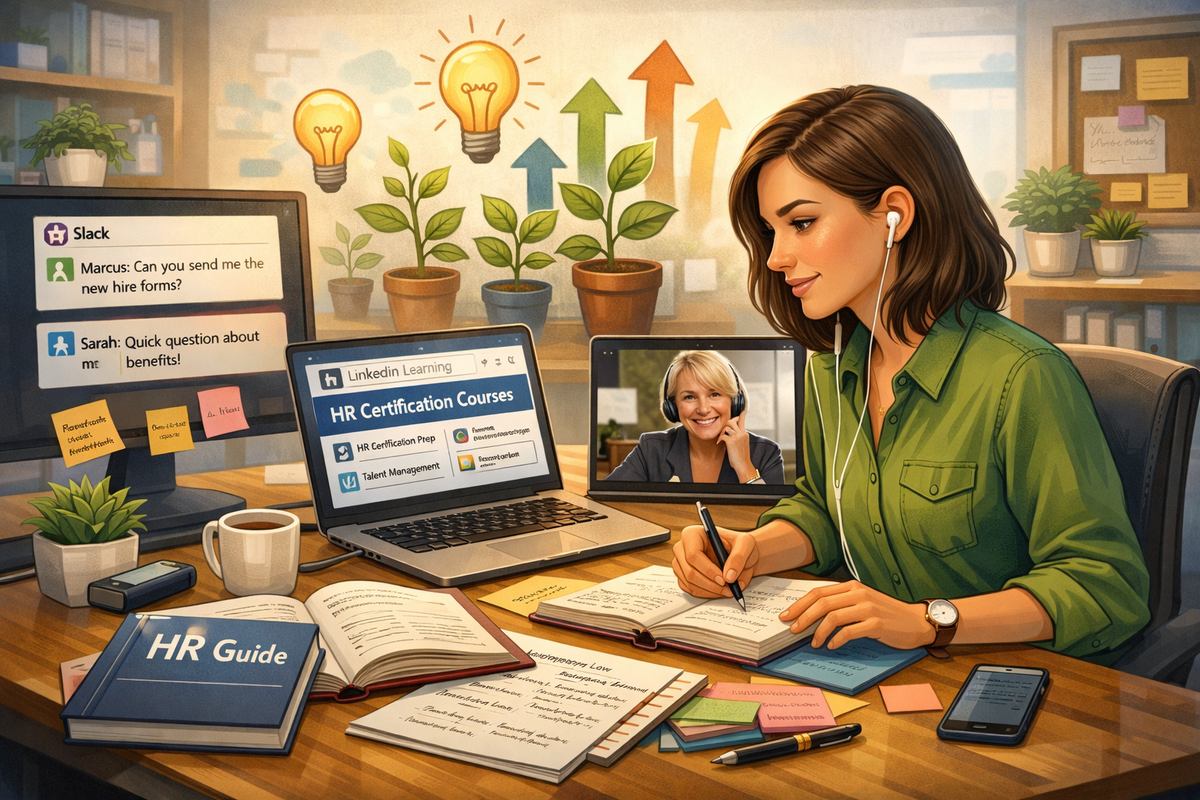
You can get certified, graduate from an MBA program, and still feel like you have no idea what to do once Monday morning rolls around.
That's the difference between being certified to do a job and having the necessary skills and experience to do the job effectively. In a big company, "upskilling" usually means taking a certification so you can add some credentials to your LinkedIn profile. In the chaotic world of startups, there is no replacement for hands-on experience.
When I say upskilling, I mean using your experiences to shape the following skills:
- Execution
- Influence in your organization
- Communication
- Process and initiative design
- Resilience
You don't have to wait years to earn your battle scars, though. Simply do the following:
- Learn by doing, systematically
- Build your network
- Get (the right) education
- Invest in yourself
Being a solo HR requires being a master of all trades for your company. So read on for tactics to help you build experience and confidence quickly.
Learn By Doing, Systematically
Embrace challenges and the unknown, and prioritize learning by doing.
I get it, it's easier to stick with what you know and what you are comfortable with. But growth doesn't come from staying in your comfort zone and never leaving. Growth in your skill set and career comes from expanding what you are capable of and earning your stripes.
Don't fly blind, though. Document what you do: what works, what doesn't work, how could a process or initiative be improved? A simple notepad or a running Google Doc works wonders as a start. By prioritizing learning through the process, it'll be easier to say "yes" to projects you are less familiar with or less comfortable with, and you'll gain more experience as a result.
Build Your Network and Ask For Help
Whatever you are experiencing right now, you are not alone.
In a silo, it can feel lonely, though. That's where your network becomes critical, whether you nurture that network in-person or online. Chances are that there are dozens (at least) of people in your exact shoes. Chances are also good that they've managed to deal with the same issues you're facing and come out the other end.
Seek out mentors at conferences, meetups, other startups in your industry, or even online through communities. There are tons of HR communities to pick from, so find one that matches your style and dive right in.
Resources and Education for HR Leaders
HR certifications can be useful, but most provide a broad (and enterprise-level) perspective on HR, focusing on only one or two areas of interest for startups, such as compliance, recruiting, or org design. This may be serviceable for HR in a large company, but it often leaves HR leaders at startups wanting.
That said, certifications have their purpose and use cases, which can give you a baseline knowledge of compliance and HR. The top options are:
- HR Certification Institute (HRCI) - The Professional in Human Resources (PHR) is for early-career HR professionals.
- Society for Human Resource Management (SHRM) - globally recognized HR organization with over 300,000 members in 165 countries.
- Chartered Institute of Personnel Development (CIPD) - the UK's leading HR certification organization, so it's not as in-demand in US-based startups, but it is common in regions such as the Middle East and Asia.
These will give you a solid foundation for HR principles. If you want startup-specific knowledge, then a specialized HR course for startups will be the way to go.
Invest in Yourself
Fill your own cup.
As the solo HR leader, the buck stops with you. That means that when you're showing up for work, you need to be in a headspace that allows you to bring your A-game.
The job is stressful and often thankless. But getting bogged down in negatives or succumbing to imposter syndrome is a recipe for failure, not success. Whether it's taking a mid-afternoon walk, getting Starbucks every morning, or prepping for a vacation, take the time to invest in yourself, your knowledge, and your mental health.
Download the Free Startup HR Survival Guide
I've seen it time and time again: companies that do not prioritize HR or view it as a strategic function fail. It starts with poor engagement, then leads to layoffs, and finally ends with the company being sold for parts.
As a solo HR leader, this responsibility falls on you. But don't worry, I have something for you to handle the pressure.
Successful startups scale because they build the systems needed to attract and retain top performers, and equip them to do their best work. I mapped out this and more in my Startup HR Survival Guide. In this free guide, you will learn:
- How HR can drive growth
- How to hire
- How HR evolves as your company grows
And more! Fill out the form below to download the free guide and put your company on the path to hyper-growth.