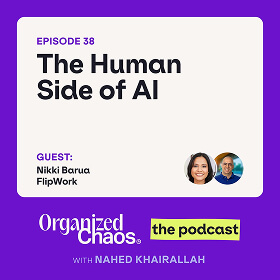

In this episode, I sit down with Nikki Barua, visionary entrepreneur, transformation expert, and CEO at FlipWork. Rather than centering on her impressive backstory, we dive quickly into her bold thesis: every leader today must think on a 300 year horizon, redesign how their organization engages with AI, and radically reimagine the role of people, leadership, and HR in this new era.
The Realities of Entrepreneurship: Risk, Resilience, and Mindset
We kicked things off by pulling back the curtain on entrepreneurship, stripping away the romanticism. Behind the glossy headlines are years of uncertainty, personal sacrifice, and a relentless confrontation with fear. Entrepreneurship is less about a single “big bet” and more about a continuous series of decisions made under ambiguity. The differentiator is not just strategy, but resilience and the mental models founders bring to each setback and pivot.
We talked about what entrepreneurs often get wrong: assuming capital will solve structural problems, mistaking activity for progress, and underestimating how much self reprogramming is required to scale beyond one’s original comfort zone. The entrepreneur’s primary job is to expand their own capacity for complexity, rather than chasing external validations or shortcuts.
Key Takeaway: Entrepreneurship is a long game in emotional endurance and mindset mastery. The founders who endure are those who treat uncertainty as a training ground, build resilience by design, and understand that evolving themselves is as important as evolving their business model.
Discipline Before Dollars
There is a sharp distinction between bootstrapping and raising capital, not just as funding strategies, but as mindsets. Bootstrapping forces a discipline around value creation, unit economics, and thoughtful growth. It requires the business to prove real traction with real customers, rather than relying on investor enthusiasm as a primary metric.
There is a trap that many early stage founders fall into: pursuing capital as a form of validation and as a substitute for a solid operating model. Money amplifies both strengths and weaknesses. When you pour capital onto an unproven structure, you often scale chaos, not impact. On the other hand, bootstrapping instills rigor, prioritization, and a bias toward sustainable, long term health.
Key Takeaway: Capital should be fuel on a well designed engine, not a band aid for unresolved problems. Founders who learn to operate lean, prove value early, and build structural discipline are far better positioned to use investment strategically rather than desperately.
The 300 Year Business Framework: Thinking Beyond Your Lifetime
One of the most provocative ideas Nikki brought to the discussion is the concept of building a company with a 300 year vision. She challenges leaders to move beyond 3 to 5 year plans and even beyond their own lifetime, asking: “What kind of impact should this organization have on the world long after I am gone?” This shift forces a reframe from short term optimization (profit, valuation, personal exit) to long term legacy (enduring value, human uplift, societal contribution).
With a 300 year lens, leaders must think differently about products, culture, governance, and technology. The question becomes: What capabilities must we build so that the organization stays adaptable, relevant, and aligned to its purpose, no matter how technology or markets shift? AI then is not a shiny tool, but a structural capability baked into the organization’s DNA.
Key Takeaway: A 300 year vision is less about predicting the future and more about designing a company that can continuously reinvent itself while staying anchored to a meaningful, long term purpose. This creates a strategic filter that elevates decisions from “What helps us this quarter?” to “What strengthens our ability to matter decades (or centuries) from now?”
Where AI Belongs in the Organization
AI cannot be treated as a side project or a novelty trapped within IT. When AI sits purely under technology or as an isolated innovation lab, it becomes disconnected from the realities of people, culture, and business outcomes. AI should be viewed as a horizontal capability intertwined with strategy, operations, and talent.
During the conversation, we highlighted the dangers of relegating AI to a technical silo: misaligned priorities, limited adoption, and resistance from the rest of the business who see it as “their project, not ours.” Instead, we advocate for AI to be owned at the highest levels of leadership, with strong partnership between business, HR, and technology. The question shifts from “What tools should we buy?” to “How do we rewire how we work, decide, and create value using AI?”
Key Takeaway: AI is an organizational capability. Leaders must elevate it into the core of business strategy and ensure cross functional ownership if they want meaningful transformation rather than scattered experiments.
Human Capital at the Center of AI Transformation
A recurring theme in the conversation is that AI transformation is ultimately about humans, not algorithms. We called out a central risk: organizations rushing into tools, platforms, and pilots while neglecting the people who must adopt, adapt, and thrive alongside these systems. Fear, confusion, and skill gaps can quietly sabotage even the most sophisticated AI roadmap.
Companies must invest in mindset shifts and skills in parallel with technical initiatives. This means designing clear narratives about “what AI means for us,” clarifying roles, expectations, and opportunities, and creating learning journeys that are accessible and continuous. Treating people as an afterthought in AI programs is the fastest route to resistance, low ROI, and cultural damage.
Key Takeaway: You cannot separate AI strategy from people strategy. Sustainable AI adoption demands intentional investment in communication, capability building, and psychological safety, so employees see AI as a collaborator and amplifier, not a threat.
The Evolution of HR in the Era of AI
HR is now positioned at the front lines of AI driven change. If AI changes how people work, learn, and are evaluated, then HR cannot remain on the sidelines. It must become a designer of the new workplace.
HR’s mandate should expand to include AI literacy, workforce redesign, and helping leaders reimagine roles, competencies, and career paths. Rather than being a function that reacts to change, HR must co-lead transformation: mapping where AI can augment roles, where new capabilities are needed, and how to keep the human experience meaningful in an increasingly digital environment.
Key Takeaway: HR’s future is deeply intertwined with AI. The function has a choice: remain a back office operator, or step into a strategic role architecting how human potential and AI capabilities combine to power the next generation of work.
AI-Enabled Leadership
AI-enabled leadership is not about knowing how to code or becoming a technical expert. It is about leaders developing the curiosity, humility, and courage to engage deeply with new technologies and their implications. Leaders must be willing to unlearn outdated models, ask better questions, and make decisions informed by data and AI insights while still honoring human judgment and values.
The new leadership profile is someone who can bridge worlds: translating strategy into experiments, blending human intuition with algorithmic intelligence, and guiding teams through ambiguity. They must normalize learning in public, admit what they do not know, and model the behaviors they want their organizations to adopt around experimentation and adaptation.
Key Takeaway: AI enabled leadership is a human skill set. It is defined less by technical mastery and more by a leader’s ability to integrate AI into decision making, culture, and strategy while keeping ethics, empathy, and purpose at the center.
Practical Example: How an Organization Operationalizes AI
To ground the discussion, we referenced how companies like Zapier have approached AI adoption thoughtfully. Rather than scattering isolated pilots, they establish an AI roadmap, clarify ownership, and intentionally design how AI supports different teams and functions. This includes identifying use cases, standardizing guidelines, and creating internal enablement so people feel supported, not overwhelmed.
The real magic lies not in a single “killer app,” but in the compounding effect of many well integrated use cases across the business. Over time, this creates an environment where AI is normalized as part of everyday workflows instead of a special project. The lesson is that operational excellence in AI is about choreography, alignment, and iteration, not one big moonshot.
Key Takeaway: Successful AI integration is built through structured roadmaps, clear ownership, and ongoing enablement. Organizations that treat AI as a coordinated operating system rather than a scattered collection of experiments see more durable impact.
My Final Thoughts
I absolutely loved this conversation with Nikki. It is rare to find someone who can fluently move between big vision and the practical realities of organizational change. Her framing of AI as both a strategic capability and a deeply human transformation felt urgently relevant for leaders right now.
What resonated the most for me was how she refused to separate technology from people, or vision from discipline. The through line of our dialogue was clear: if you want to build something that matters for the long haul, you must anchor in purpose, invest in people, and treat AI as a lever for long term capability, not short term novelty.
Here are the main ideas that stuck with me after the conversation:
On AI, People, and the Role of HR
Nikki’s insistence that AI transformation is inseparable from human transformation is something I wish more leadership teams would internalize. The temptation to chase tools and platforms is strong, but if you bypass the people who must use them, you are building on sand. Her call to invest intentionally in mindset, skills, and communication is critical.
The evolving role of HR in this context was another highlight for me. Seeing HR as a co-architect of AI-enabled work, rather than a downstream recipient of change, is exactly the shift that needs to happen. HR is uniquely positioned to connect strategy, structure, and human experience, making it a natural partner in designing how AI and people work together.
On-AI Enabled Leadership
Finally, I found Nikki’s definition of AI enabled leadership both accessible and demanding in the best way. It is not about becoming technologists, but about becoming better learners, better question askers, and better integrators of human and machine intelligence. That feels like a leadership journey that is deeply human at its core.
If there is one overarching message I took from this conversation, it is that the future will belong to leaders and organizations willing to think beyond themselves, invest in their people, and treat AI as a catalyst for long-term, meaningful impact rather than a quick fix.