
Contractor vs Full-Time Employee: A Startup Guide
- 14 Aug 2026
- 12 mins

A founder I worked with employed his customer service team and a chunk of his B2B sales reps as contractors across the US, Singapore, and Germany. I uncovered this during an HR audit the company hired me to run, and I told the founder that these contractors were misclassified in every country. He made a conscious decision to eat the risk, because there were only 3 or 4 people per location outside the US and the downside looked small compared to the growth these contractors were driving (the company had been doubling its revenue for the past 2 years). He was also saving roughly $100,000 a year. Within the same year, the company was fined $720,000, 60% of it in the US.
Here's the short answer on contractor vs full-time employee for a startup. Once you compare the fully loaded costs of each, the two cost almost the same, so the decision has to be based on the nature of the work and on who controls the risk. Hire a contractor for expert, autonomous, fixed-scope work with a clear end date. Hire an employee for open-ended work, or anything core to the business. You won’t save as much money as you expect, and you remain responsible for any legal or tax risks, regardless of what your contracts say. Company size doesn't protect you either. This happens to companies of 5 people and companies of 500.
One Founder's $720,000 Bet
The math in that founder's head was simple. Contractors cost less than employees because you skip the taxes, the payroll burden, and the benefits in each country. Multiply that across a customer service team and a sales team and it adds up to a significant amount of money at that early growth stage.
Here's what happened. The company ended one contractor's engagement. That contractor didn't understand the difference between a contractor and an employee, assumed he was eligible for unemployment benefits, and filed for them in Singapore. The filing opened a government investigation, which was then reported to the US government.
Once they were hit with that fine, the company converted all of its German contractors to employees as well. That's the conversion they had been avoiding the whole time, but it cost them much more than it should have.
The company got caught because a contractor was confused about his employment situation, which is how most of these start.
What a Contractor and a Full-Time Employee Cost
To do the math right, you need to account for all the components that factor into the cost of a contractor and an FTE.
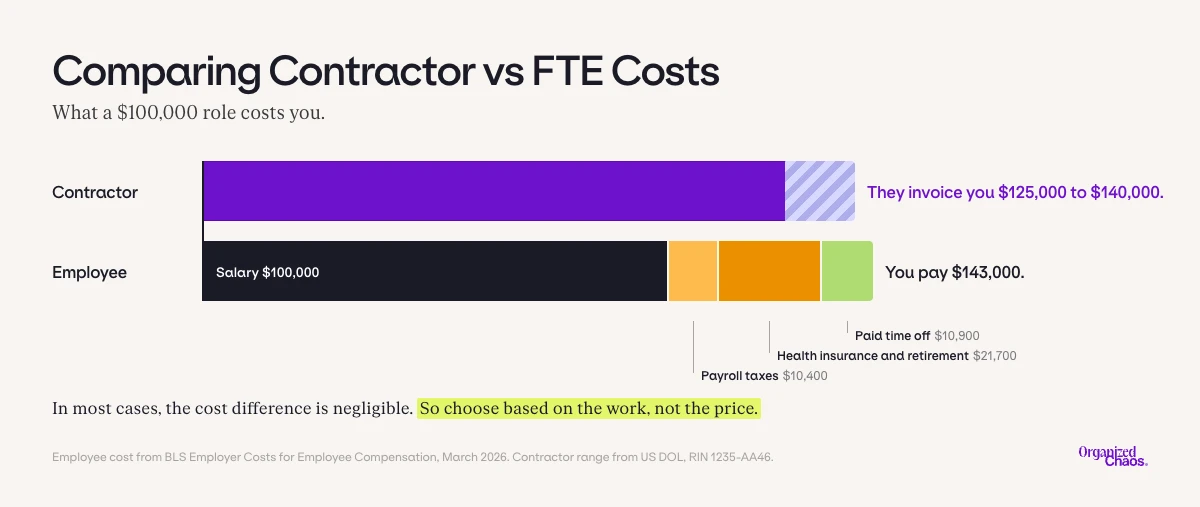
The US Department of Labor, in its February 2026 proposed rule on contractor status, notes that "some sources warn employers that classifying a worker as an independent contractor can cost between 25 and 40 percent more in hourly terms." The Department is characterising other sources there rather than publishing its own estimate, so treat it as a well-informed range. In my own client work I've seen that range run a little wider, especially with more senior roles.
On the other hand, the Bureau of Labor Statistics puts private industry total compensation at $46.60 per hour worked against $32.60 in wages and salaries for March 2026. That's 1.43 times wages before you've bought anyone a laptop, a software seat, or paid a recruiter.
Put those together and the gap between contractors and FTEs mostly closes. The contractor charges 25% to 40% above what you'd put on an offer letter, and the employee costs about 1.43 times that same offer letter once you consider the fully loaded costs. On pure cost the two are close to a wash, which means the only sensible way to decide between a contractor or an FTE comes down to the work itself. Run this comparison for specific roles at your own company rather than relying on general averages. Broad industry data can be misleading because contractors often have shorter tenures and do different types of work than full-time staff.
Contractor vs Full-Time: How to Decide
Every country I’ve worked in defines a contractor the same way. They're temporary, self-employed, and financially independent workers that you do not control.
Hire a contractor when all four of these are true:
- They're a genuine expert: You're buying a skill you don't have in-house and don't intend to build.
- They work without supervision: You describe the outcome and they decide the method. If you're telling them how and when to do the work, they're an employee.
- The scope is fixed and written: There is a specific, concrete goal or outcome, rather than an open-ended request for ongoing help.
- The work has a finish line: You can specify the date or the milestone at which this engagement ends.
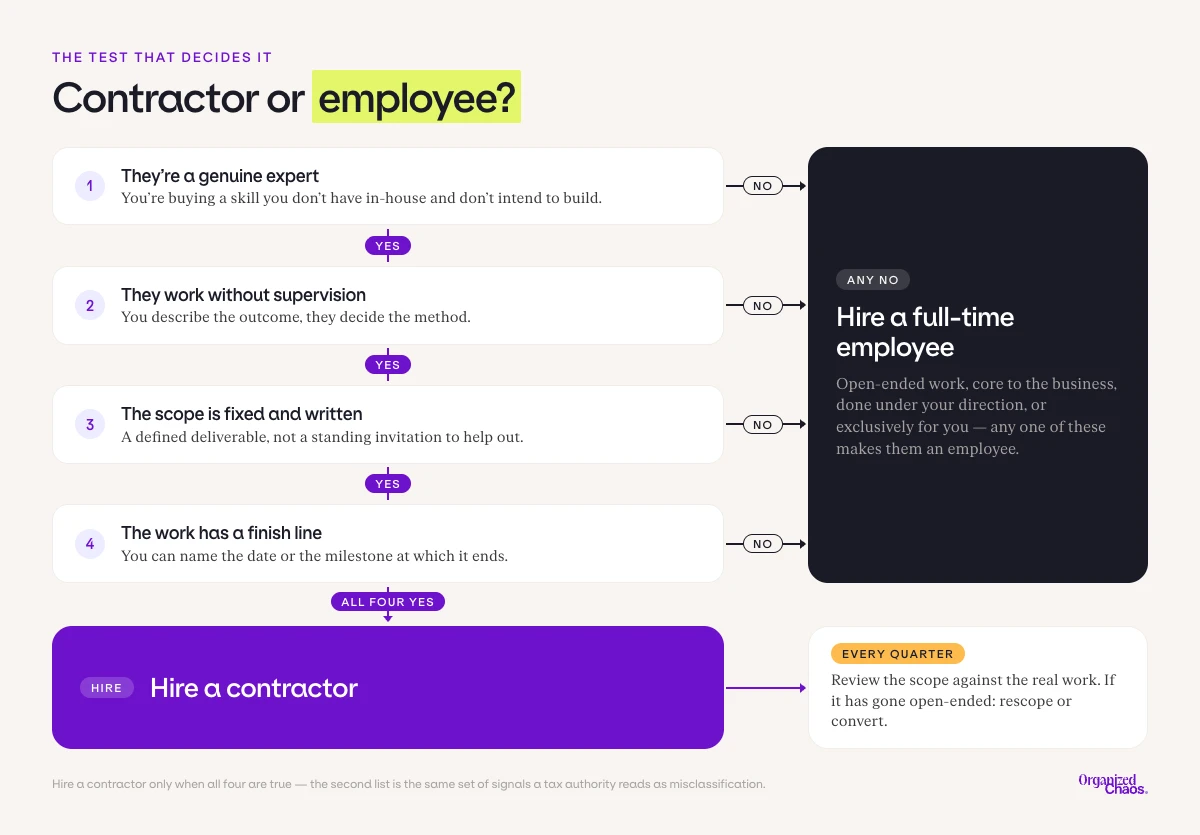
Hire a full-time employee when any of these is true:
- The assignment is open-ended: You can't specify the point at which the work stops or is no longer needed.
- The work is core to the business: It drives your roadmap, your revenue, or your ability to deliver what you sell.
- You need to direct the work: You set the hours, they work on your systems and your equipment, and you tell them how and when to do the job.
- You need them exclusively: You're their only client and you want it to stay that way.
These same indicators are what tax authorities use to identify misclassification, meaning this test helps you avoid legal issues by clarifying your hiring status.
After closing private equity funding, a health tech startup I advised had to decide between hiring a fractional Chief Product Officer or a full-time one. Because product leadership is core to a SaaS company’s roadmap and revenue, this role did not qualify as independent contract work. I recommended hiring a full-time employee. To bridge the gap, they hired a fractional leader for three months while they conducted an executive search.
Let the nature of the work drive your hiring decision. If you’re trying to justify hiring a contractor for a core, permanent, supervised role, you’ve already found your answer: it is an employee role.
The True Cost of Getting It Wrong
Founders often tell me they believe the risk of misclassification is low. They assume an audit only happens if they get unlucky, like the founder who was reported by a single contractor in Singapore.
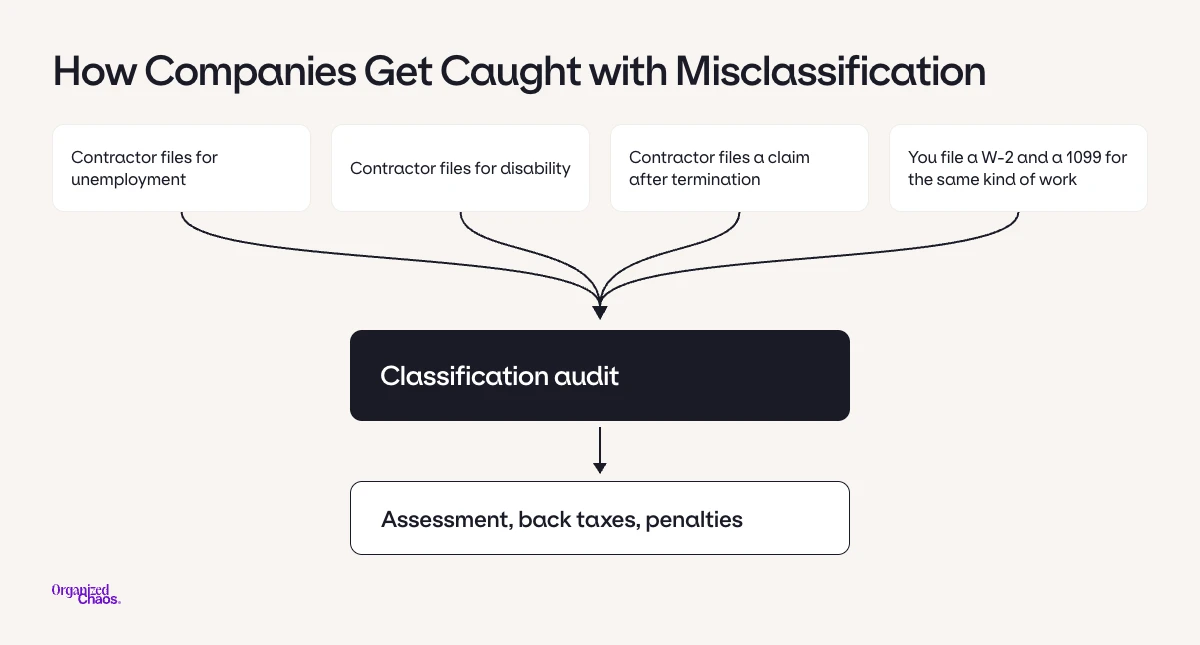
In reality, you don't control the triggers. Most audits start in one of two ways. The first is the "naive trigger": a contractor who doesn't understand their status applies for unemployment benefits, unintentionally alerting the government. The second is the "disgruntled trigger": a contractor who leaves on bad terms files a report deliberately.
I saw this happen to a consumer electronics manufacturer that gave people a choice: higher pay as a contractor or lower pay as an employee. When they fired one contractor without notice, he filed a claim. The resulting audit forced the company to pay back taxes for 23 workers over 5 years, with a final bill that amounted to $270,000.
This mechanism is standard. Agencies like California's EDD explicitly use "obstructed benefit claims" as leads for tax audits. If you pay someone on a 1099 and they claim unemployment, you are handing the government a reason to investigate you.
The cost ultimately depends on your intent. If the IRS finds you had no "reasonable basis" for your classification, you are liable for all unpaid employment taxes. In these cases, relief programs do not apply.
If the mistake was unintentional, Section 3509 of the tax code offers reduced rates, but the numbers still hurt. You will owe at least 1.5% of wages and 20% of the unpaid Social Security and Medicare taxes. If you failed to file 1099s, those penalties double. None of these discounts apply if the IRS decides you misclassified workers willfully.
Don't assume you're too small to be noticed. There is no minimum revenue or headcount that protects you from an investigation. If you have even one misclassified worker, you have a liability.
Hiring Contractors Abroad Doesn't Eliminate Risk
Founders assume a US company misclassifying someone in a foreign country is beyond that country's reach, especially with no entity and no office there.
I know a home appliances company that hired two contractors in France without registering a local business. When one worker filed for unemployment after being fired, the French government investigated. The company was permanently banned from selling in France.
French law treats misclassification as a criminal offense. It carries penalties of up to 3 years in prison and €225,000 in fines for companies. More importantly, it allows the state to shut down your business and bar you from public contracts indefinitely.
Singapore and Germany follow similar logic. Authorities look at the actual day-to-day relationship you have with the contractor, regardless of what’s in your contract. If the worker functions like an employee, the government will treat them like one and claw back years of unpaid social security contributions. While enforcement varies by country, the risk is never zero.
When Should You Convert a Contractor to an Employee?
Misclassification usually happens because of "scope drift." You hire a contractor for a specific project, the project ends, but the person stays. Soon, they are handling open-ended tasks and working under your direct supervision without a new contract, and getting paid hourly or on the old fixed fee.
To prevent this, audit your contractor agreements every quarter. If the work has become permanent or the scope is no longer fixed, you must choose one of the following options:
- Rescope the work to be temporary again
- Convert the role to a full-time employee
Conversion is usually straightforward unless you are using a staffing agency with a buyout fee. Otherwise, you simply move them to payroll and offer standard benefits. It doesn't erase past risk, but it stops the clock on new liability.
To give you an example, I helped a gaming company convert 40 misclassified contractors during COVID. By centralizing contractor hiring through HR instead of procurement, they removed hundreds of thousands in potential fines for just $40,000 in additional annual costs. If you catch this mistake yourself, there are programs like the IRS Voluntary Classification Settlement Program that allow you to reclassify workers at a much lower cost than if you were audited and fined.
Sometimes, leasing workers actually costs more than hiring them directly. I once saw a software company hire two DevSecOps engineers through a staffing vendor for a six-month project. When the project ended, they kept them on a monthly retainer. Because the vendor charged 40% more than the market rate for a full-time employee, the company was overpaying significantly. Since the engineers were needed long-term for ongoing security certifications (like SOC 2 and HITRUST), the work was permanent, so we converted them to full-time staff. By removing the vendor markup, the company saved about $60,000 annually, even after paying for benefits and bonuses. If you want the cash-side view of decisions like this, I’ve gone deep on protecting runway while you staff up.
When to Stop and Call an Employment Attorney
I'm not an employment attorney, and neither is your CFO. There are three situations where you should stop and get one on the phone.
- A contractor holds a managerial title: Do not give contractors managerial titles or authority over your employees. An advisor who coaches without giving direct orders is okay, but consult a lawyer to structure this hybrid role correctly.
- A contractor acts like an employee: If they work fixed hours, use your equipment, and take directions from you, they are likely misclassified. You should convert them to an employee or have a lawyer fix the contract immediately.
- The contract does not match reality: If the work being done differs from the written contract (especially if the project term has ended), get an employment attorney to draft a new agreement right away. This is the most common issue found during audits and the easiest to fix before legal problems arise.
If you want the broader compliance picture around all of this, I covered the foundations startups need in place in more detail.
What to Do This Week
- Audit your contractor list: Review the last quarter’s payments to identify everyone you pay who isn't on payroll. Don’t forget about inherited or legacy contractors.
- Flag high-risk contractors: Immediately identify any contractor who has a managerial title, acts like an employee (fixed hours, using your equipment, following your instructions), or is doing work that no longer matches their original contract.
- Compare contracts to reality: For each contractor, compare their original scope of work with what they actually do today. If the work has changed, decide whether to re-scope it or convert them to an employee.
- Calculate conversion costs: To see if conversion makes financial sense, estimate the "fully loaded" cost of an employee. Compare this to what you pay the contractor (including any vendor fees).
- Schedule a quarterly review: Block 60 minutes at the start of every quarter to repeat these checks. It’s a small investment that helps you avoid costly legal headaches.
To make this easier for you, I’ve created a free Contractor vs Employee Classification Checklist that uses the 20 IRS common-law factors to tell you whether you’re hiring a contractor or an employee. It only takes 15 minutes and ensures your hiring decisions are defensible.
Frequently Asked Questions
Can a contractor manage employees?
No. Giving a contractor authority over your employees is a clear sign of misclassification. If you need an advisor to coach your team, work with a lawyer to define that role properly without giving them direct management powers.
Are contractors cheaper than employees?
Rarely. While you skip taxes and benefits, contractors charge a premium that often closes the gap. Once you account for an employee's full costs, the two options usually cost roughly the same.
What are the penalties for misclassification?
The costs of a mistake far outweigh any savings. You can be liable for years of unpaid taxes, heavy fines, and even business bans. Willful misclassification doubles these penalties and removes your eligibility for tax relief programs.
What triggers a government audit?
Audits are usually triggered by a contractor applying for unemployment or disability benefits. Other common leads include formal worker complaints or inconsistent tax filings that suggest an employer-employee relationship.
When should I convert a contractor to an employee?
Convert them if the work has moved from a short-term project to a permanent, core function. Audit your contracts every quarter; if the original scope has ended but the person is still working for you, it's time to hire them or re-scope the role.
Is there less risk if the contractor is abroad?
No. Foreign governments can penalize US companies even without a local entity. In some countries, like France, misclassification is a criminal offense that can lead to permanent bans on selling your products in that market.