When Should a Startup Hire Its First HR Person?
- 06 Jul 2026
- 9 mins

A founder in my network hired her first HR person at 18 employees. She brought in an early-career HR coordinator to "own culture," paid $62,000, and felt good about investing in people early. What she actually got was someone who scheduled offsites and ordered swag, which was fine until the co-founder needed to terminate a senior engineer 10 months later and nobody on the team knew how to run a termination that wouldn't turn into a legal claim. The HR coordinator had never done one, so they paid an employment lawyer $14,000 to clean up a conversation that a skilled HR lead would have been able to handle.
A different founder waited until their headcount hit 95 people because he'd been told to hold off until the headcount "justified" a full-time hire. By the time he made it, the company had employees in 7 states, a contractor who should have been classified as an employee a year earlier, and 3 engineers on the same team paid within a $55,000 spread for the same work. He panic-hired a VP of People at $190,000 to clean up the mess, but she spent her first 6 months on remediation instead of building anything.
Both founders made the same kind of mistake. They treated the first HR hire as a headcount milestone, so one of them hired too junior and too early and the other waited for a headcount number that was not the right trigger. Both spent more money and carried more risk than they needed to.
This is a decision framework for founders sitting between 15 and 150 people who are trying to answer one question: do you need HR yet, and if so, what kind? It walks through the four triggers that matter, the cost math on a full-time hire versus a fractional one, who to hire first, and the three ways founders get this wrong. By the end you'll know which of four actions to take: do nothing or hire fractional, a full-time generalist, or a full-time HR leader.
Headcount is the Wrong Trigger
The number you'll hear most often is one HR person per 100 employees. SHRM's benchmark data puts the average at roughly 1.7 HR staff per 100 employees across all organizations, and that number climbs as companies get smaller. Organizations under 250 people typically run between 1.7 and 3.4 HR staff per 100, because a 40-person company still has to handle multi-state compliance, onboarding, comp decisions, and terminations no matter how few people that work is spread across.
Headcount fails as a trigger because it measures the wrong thing. The work HR does isn't driven by how many people you have; it's driven by how much complexity and risk those people generate and how much of your week the people work is consuming. A stable 60-person company in one state with low turnover can run lean for a while, while a 50-person company hiring across four states and running its first performance cycle is already past the line.
The 4 Triggers that Matter
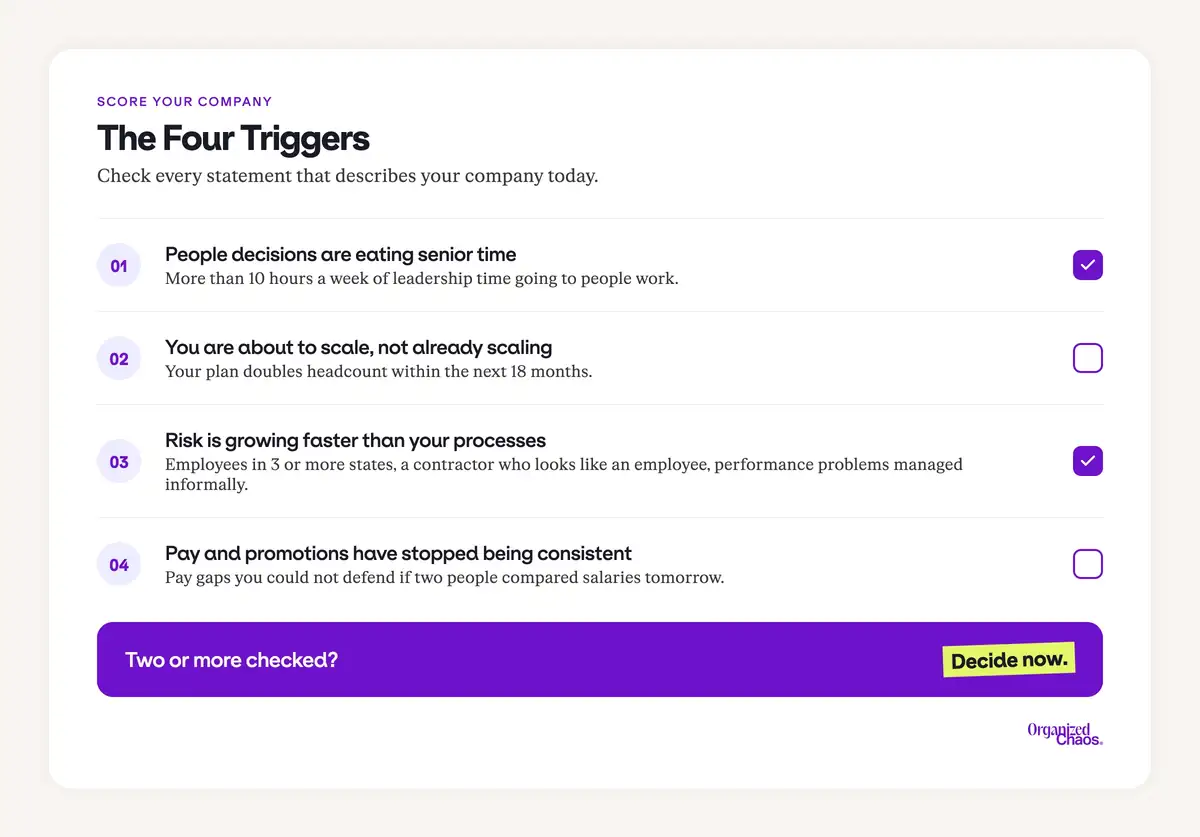
- People decisions are eating up your senior team's time. At the start, you and your co-founders handle hiring, comp, and conflict, and that works until the hours start adding up. Track it for 2 weeks and count what you and your senior people actually spend on interviews, offer decisions, comp conversations, performance issues, and the running list of HR-related things only a founder seems able to settle. Once that number crosses about 10 hours a week across your leadership team, you're paying senior salaries to do work an HR lead does better and cheaper.
- You are about to scale, not already scaling. There's a real difference between needing HR capacity and needing HR infrastructure. A 30-person company that plans to hire 30 more people in the next 6 months has a different problem than a 30-person company that's been flat for 2 years, because the first one needs systems in place before the growth starts. Onboarding, job leveling, and comp bands that get built while you're absorbing 30 hires get built badly. If you just raised capital and your plan is to double headcount within 18 months, then you're in that “about to scale” group and the clock is already running.
- Your risk surface is growing faster than your processes. This is the trigger founders underestimate until it costs them. Employees in more than two or three states, a contractor who looks a lot like an employee, a performance problem you've been managing informally for months, pay gaps you keep deferring: none of these are headcount-driven, and all of them carry real costs. The average wrongful termination settlement runs around $40,000, and defending one through trial costs between $75,000 and $250,000. One mishandled exit costs you more than a full year of competent HR.
- Your pay and promotion decisions have stopped being consistent. When two people doing the same job are paid very differently for no reason you could defend, or when promotions happen because someone asked, then you have a comp and leveling problem that compounds in the background until you fix it. Inconsistent pay is one of the fastest ways to lose your best early employees, because the day they compare salaries is the day the trust breaks.
The Cost Math Nobody Shows You
Every article on this topic tells you that waiting is expensive, but none of them show you the numbers, so here they are.
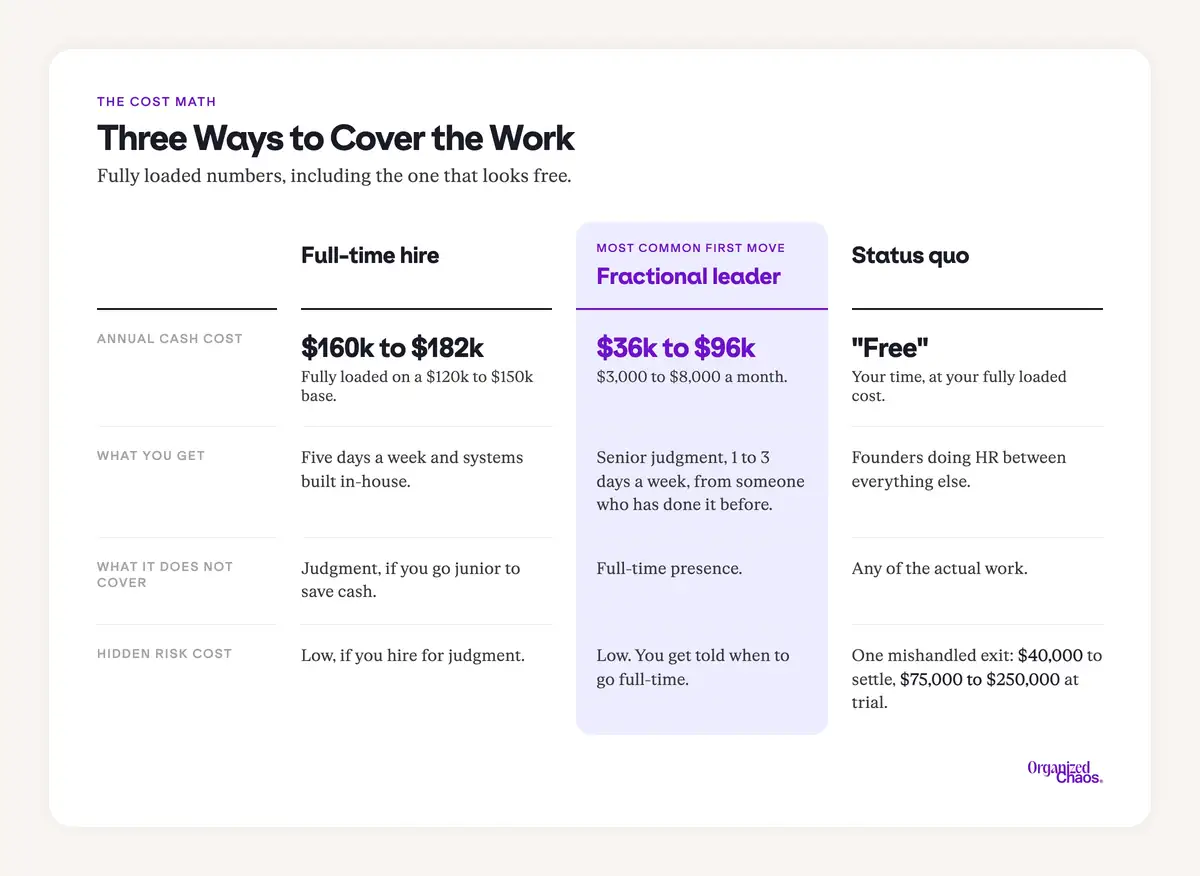
A full-time first HR hire usually starts with a generalist in the $60,000 to $80,000 range, or a capable People lead who can set comp philosophy and handle a real termination at $120,000 to $150,000. Base pay isn't the number that matters, though. Once you add benefits, payroll taxes, equity, and tools, you multiply base by roughly 1.25 to 1.4, so a $130,000 People lead actually costs you $160,000 to $182,000 a year. A full-time Head of People at the executive level runs more, $200,000 to $300,000 base, but that's rarely your first hire. The first hire is almost always a generalist or a manager.
A fractional HR leader is the option most founders don't price. At first-hire scope it runs $3,000 to $8,000 a month, which is $36,000 to $96,000 a year, and for that you get senior judgment one to three days a week from someone who has built the first HR function before. A seasoned fractional Head of People at the executive tier costs more, $5,000 to $15,000 a month, which is the level I broke down in my podcast episode on the rise of fractional leadership. At first-hire scope, the fractional person handles your immediate risk, sets up the systems, and tells you when the volume finally justifies bringing the work in-house.
The status quo, keeping it on your own plate, looks free but isn't. Price your own time at your fully loaded cost, then add the expected cost of the risk you're carrying: the odds of one mishandled termination, one misclassified contractor, one comp blowup that costs you a key employee. The status quo is usually the most expensive option because the bill stays invisible and arrives at once.
Across the roughly 50 companies I've built full HR functions for, the fractional option turns out to be the right first move far more often than founders expect. The work at 25 to 60 people is dense, but it rarely fills five days a week.
Hire for Judgment
When you do make the hire, the most expensive mistake is going too junior because it's cheaper.
Your first HR person is almost never an administrator. This is a judgment role, and the person in it has to set your compensation philosophy, build the performance process, run your first difficult termination with the right documentation and notice, know when to bring in employment counsel and when to hold off, and advise you on the decisions rather than just execute the ones you've already made. An HR coordinator with two years of experience can't carry that, and putting them in the seat alone at 50 people sets both of you up for failure. As the first and only HR person, the role usually needs someone with relevant experience who has seen what breaks and knows how to prevent it. You can hire an HR coordinator as your second or third people hire, once there's a senior person to direct them, but the first hire is where you buy judgment.
The same logic answers the generalist-versus-specialist question. Under 100 people, your first hire is a generalist, because recruiting specialists, learning and development leads, and program managers are second and third hires. If you hire a recruiter and call them your Head of People, you'll get roles filled and no systems built, and the systems are the reason you hired someone in the first place.
The 3 Ways Founders Get This Wrong
- The first mistake is hiring too junior, too early. The fix is to right-size the role to the judgment you actually need, even when that means a fractional senior person instead of a full-time junior one.
- The second mistake is waiting too long and then panic-hiring. You hold out for a headcount number, hit a compliance mess or a painful exit, and hire in a hurry at the top of the market to clean it up. The fix is to watch the four triggers I mentioned previously instead of the headcount, then hire proactively.
- The third mistake is getting the timing right but the shape wrong. You know you need help and hire a full-time HR generalist when a fractional HR leader was the correct first move, or you bring on a fractional consultant when your complexity actually justified a full-time leader. Match the shape of the hire to the volume and the risk and run the cost math before you write the job description.
Frequently Asked Questions
- Does my startup need an HR person at all? If you are experiencing two or more of the four triggers, then yes, in some form, though that form might be fractional rather than full-time. If you’re experiencing none or only one trigger, then you can keep things with a founder or an operations hire for now and revisit within 3 to 6 months (based on your growth velocity).
- How many employees before you hire HR? There's no universal number, and chasing one is a mistake. Most companies feel the pull somewhere between 25 and 50 people, and waiting past 50 with no HR owner and rising complexity is where it starts to cost real money. The trigger is complexity and time drain, not the headcount itself.
- First HR hire or fractional HR? Start fractional when the work doesn't fill a full week, which describes most companies between 25 and 60 people. Go full-time when the volume justifies five days a week, usually past 60 to 80 people or when you're scaling fast.
- Should the first HR hire report to the CEO? At this stage, yes. HR leaders who report into finance or operations tend to drift operational, while a direct line to the CEO is what keeps the role strategic, and the strategic version is the one you need from your first hire.
What to Do This Week
If you're under 20 people with low complexity, don’t do anything yet, and put a reminder on your calendar 90 days out to review the four triggers.
If you’re seeing two or more triggers, then run the cost math above on your own numbers and compare a fully loaded full-time hire against a fractional engagement against the real cost of the risk you're carrying today. The comparison gives you everything you need to make a decision.
Whatever the numbers say, decide the model before you write a job description. If you do hire, hire for judgment: someone who has done this before at your growth stage, has a generalist scope, and reports directly to you.
The fastest place to start is the Startup HR Readiness Assessment, which scores your four triggers and gives you a recommended move. If you want a second set of eyes on the decision before you spend the money, book a free HR diagnostic call and we'll work through your numbers together.
Your first HR hire shapes how your people function operates for the next 3 to 5 years. Make it as a decision rather than a milestone, and make it the right shape for the company you're running now.