

Build a Business Case for HR Investment Your CEO Will Fund
- 16 Jun 2026
- 6 mins

I have watched capable HR leaders walk into a budget meeting with a real problem and walk out with no budget approvals. Most of the time, it boiled down to the way they pitched their request.
An HR lead asks for a recruiter, an HRIS, or a training budget, and frames it around engagement, best practice, or investing in our people. The problem is that the founder (or CFO) hears a cost with no concrete business return attached and either denies the request or keeps postponing it indefinitely. How many times have you heard “Let’s look at this next quarter” but that “next quarter” never came?
In this edition, I’ll give you the 4-part method I use to turn an HR request into a business case a founder will fund, with a worked example and a template you can fill in this week.
Start With the Numbers Your CEO Tracks
Before you build anything, get clear on the 3 or 4 numbers your CEO watches most. At a startup between 20 and 300 people, that is usually runway, revenue per employee, growth velocity, and the cost of a wrong hire.
Your request has to connect to one of them in a single sentence. If you cannot draw that line, hold the request until you can.
SaaS Capital's 2025 benchmark puts median revenue per employee for private SaaS companies at about $130,000, with labor running from roughly 75% of revenue at early stage down to 50% past $100M ARR. Payroll is the biggest number on the P&L. A request that protects revenue per employee, recovers wasted payroll, or lowers the odds of an expensive mistake speaks the language your CEO understands and cares about.
Price the Cost of Doing Nothing
From my observations over the past 15 years, it’s clear that us HR folks aren’t great at articulating the price of doing nothing. An understaffed hiring function leaves roles open longer, and every open seat on a revenue team delays pipeline. A skipped HRIS project leaves your one HR person doing 10 to 15 hours a week of manual admin that breaks down once you cross 50 people.
Most HR business cases only describe the upside of implementing a specific program. But that doesn’t tell the real story of what it costs to actually do nothing. Therefore, price the status quo and present that to your founder because that is the number that will grab their attention.
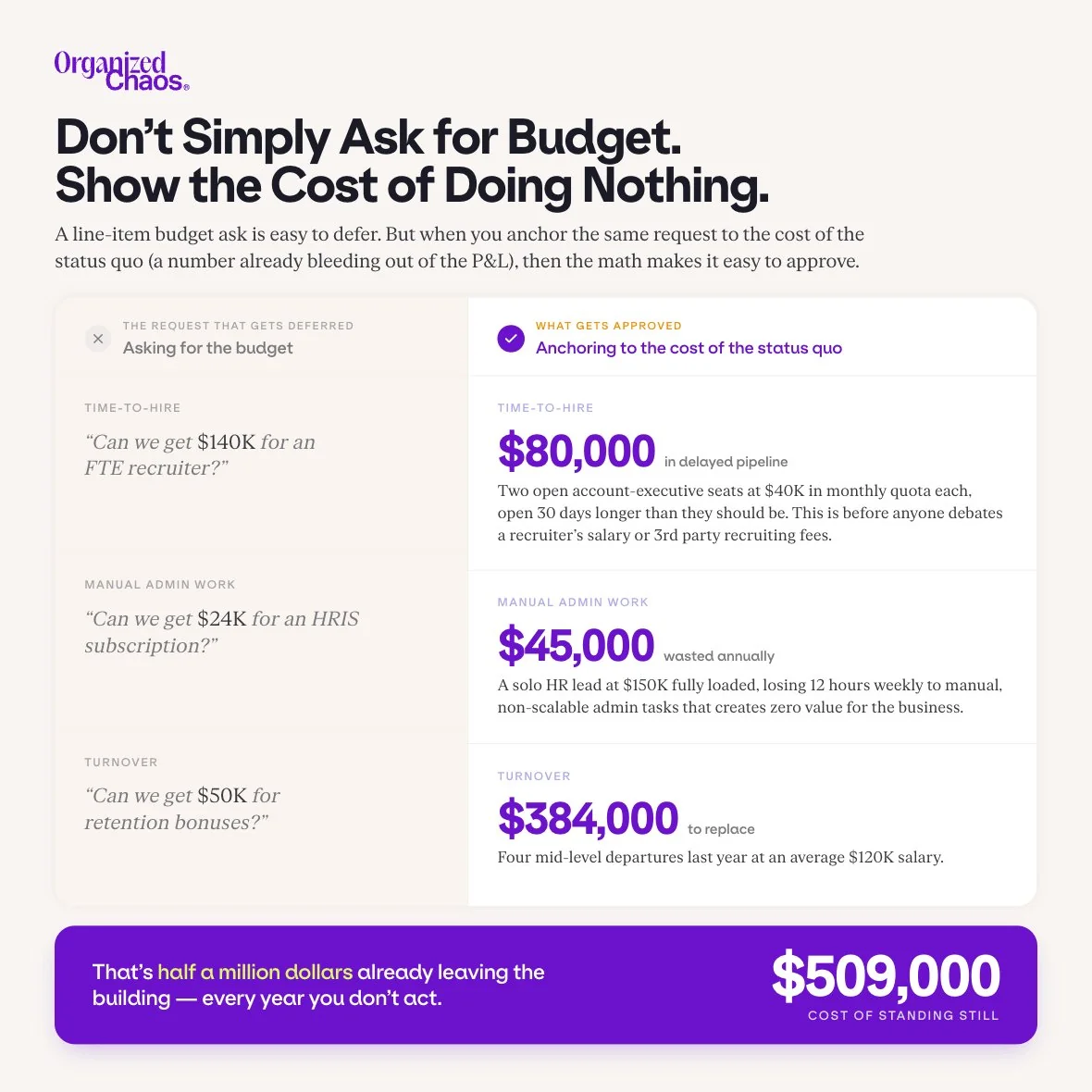
Take the problem you are solving and attach a dollar figure to leaving it alone. Here are some examples:
- Time-to-hire. Two open account executive seats at $40,000 in monthly quota each, open 30 days longer than they should be, cost $80,000 in delayed pipeline before anyone debates a recruiter's salary.
- Manual admin work. A solo HR lead at $150,000 per year fully loaded, losing 12 hours weekly to manual tasks wastes $45,000 annually on non-scalable admin that creates zero value for the business.
- Turnover. Four mid-level departures last year at an average $120,000 salary, run through Gallup's 80% turnover multiplier, cost about $384,000 to replace.
Build the Model with a Payback Period
Once you have the cost of the status quo, model the request as an investment with a payback period. This can be a simple spreadsheet with three columns:
- the cost of the investment
- the return or cost avoided
- the time to break even
When a number is uncertain, show a conservative case beside a likely case. Founders trust people who show the downside. A recruiter at $110,000 per year in base ($145,000 fully loaded), who closes 8 hires a year that would otherwise run through agencies at a 20% fee on $130,000 salaries, covers their own cost inside two quarters, and you can easily show that math.
For tools, price per employee per month so the number grows with the company. HR software runs roughly $8 to $40 per employee per month at your stage. At 100 people, a $15 per-employee HRIS is $18,000 a year against 600-plus hours of recovered admin time. Put both numbers side by side and the math will make the case for you.
Present it to Fit Your CEO
A business case dies in the delivery as often as in the math. Present it in the format that your CEO uses to make decisions. Some CEO’s are analytical and want to see your entire model, while others want the headline dollar figures and the “why”.
If your CEO is analytical, hand over the model and let them test the inputs. If they decide on instinct and stories, lead with the anonymized example of the hire you lost or the compliance gap you caught, then show the math behind your recommendation.
In short, build your business case presentation for the person across the table.
A Worked Example: The Recruiter You Cannot Get Approved
Take a 70-person Series A planning 25 hires over the next 12 months. The HR lead wants to bring recruiting in-house with one recruiter, and every prior attempt got deferred as too early.
The cost of the status quo: 25 hires through agencies at a 20% fee on an average $130,000 salary is $650,000 in fees for the year. Time-to-hire is averaging 55 days, and the two open revenue seats in that pipeline are delaying about $80,000 a month in quota coverage.
The investment: one in-house recruiter at $110,000 base, around $145,000 fully loaded, plus $12,000 for an applicant tracking system.
The return: even if the recruiter closes only 60% of the 25 roles in-house and the rest still use agencies, you avoid about $390,000 in fees against a $157,000 cost, and you break even within 5 months. Also, time-to-hire will likely drop because one person owns the pipeline full time.
This is a real example with real numbers from a past client. I helped the Head of People present the business case this way, and the recruiter was approved in one meeting after that same request had been denied twice in the past 6 months. This is the same math I walk founders through when we plan workforce against runway one hire at a time.
What to Do This Week
If you have an HR budget request that is stuck in “not yet” land, then work in this order:
- Write the cost of the status quo as one dollar figure with your assumptions shown. If you cannot quantify it, you do not yet understand the problem well enough to ask for the budget.
- Build the 3-column model. Write down the investment, return or cost avoided, and payback period. Put a conservative case next to your likely case for transparency.
- Connect the request to one number your CEO tracks, and put that number in the first sentence of your request.
- Get it onto one page with a clear ask and a decision date, and send it before the budget meeting so people read it before they react to it.
In most cases, showing the company what staying still costs then giving them a cheaper path is the easiest way to get your HR projects funded.