
Everyone Is Blaming AI for Block's 40% Layoff. The Data Tells a Different Story
- 17 Mar 2026
- 8 mins

I'm sure you've heard this news by now. Jack Dorsey cut more than 4,000 employees from Block, taking the company from over 10,000 people to just under 6,000. I wasn't planning on writing about this, but the conversation on LinkedIn and elsewhere has been dominated by fear, hot takes, and very little actual analysis. So I decided to dig into the data and share what I found, because the story the numbers tell is very different from what's being reported.
Pinning this squarely on AI is lazy analysis that misses the real lessons for startup founders and HR leaders. And those lessons matter because the decisions you make about headcount during growth will determine whether your company survives its next downturn. Let me walk you through what actually happened, why companies really do layoffs, and what this means for you.
Why Companies Actually Do Layoffs
Before we dig into Block specifically, let's establish a framework. In my experience working with startups, layoffs generally happen when one or more of the following are true.
The company over-hired and revenues didn't catch up to the increase in costs. This is the most common scenario, especially in the startup world. Revenue goes up, the leadership team gets excited, headcount explodes, and then the market shifts or growth slows. Suddenly you've got a payroll that your revenue can't support. This is exactly what I wrote about in my episode on workforce planning, where I talked about the e-commerce company that wanted to increase headcount by 50% to support forecasted growth. I recommended approving only 3 out of 45 hire requests. When revenue dropped 25% shortly after, we didn't lay off a single person because we hadn't made those unnecessary hires in the first place.
There is a market shift or disruption happening due to technological, political, environmental, or other reasons. This is when external forces change the game. Maybe AI is genuinely making certain roles obsolete. Maybe regulation changes your business model. Maybe a pandemic reshapes consumer behavior. The key difference here is that the disruption is external and real, not a convenient narrative to dress up internal problems.
The business has decided to pivot into something fundamentally different and the current headcount is no longer fit for purpose. This happens when a company decides to enter a new market, kill a product line, or completely reimagine its business model. The skills and roles you hired for no longer match where you're going.
With that framework in mind, Block's situation maps clearly to the first two reasons. Let's look at what actually happened.
The Overhiring Problem That Nobody Wants to Talk About
Block tripled its headcount from 3,900 to 12,500 between December 2019 and December 2022. Let me say that again. They went from roughly 4,000 people to over 12,000 in three years.
Dorsey himself admitted on X that he made a structural mistake during this period by building two separate company structures for Square and Cash App instead of one integrated organization. That's not an AI problem. That's an organizational design problem that he didn't fix until mid-2024.
On top of that, Block added significant operational complexity during this time by expanding into lending, banking, and buy-now-pay-later services. Each of those businesses requires compliance infrastructure, specialized teams, and management layers. More people, more complexity, more cost.
And here's the part that really tells the story. Gross profit per employee stayed flat at roughly $500,000 from 2019 through 2024, despite all that hiring. They tripled their headcount but didn't meaningfully increase how much value each employee was generating. That is the textbook definition of bloat.
The company recognized this well before the AI narrative took hold. In November 2023, Block set a headcount cap of 12,000 employees. Throughout 2024, they stayed under that cap through performance management, centralizing teams to reduce duplication, and narrowing their scope. They cut roughly 8% of the workforce in 2023 and another 8% in early 2025. This has been an unwinding in progress for over two years.
The Financial Performance Tells a Different Story Than the Headlines
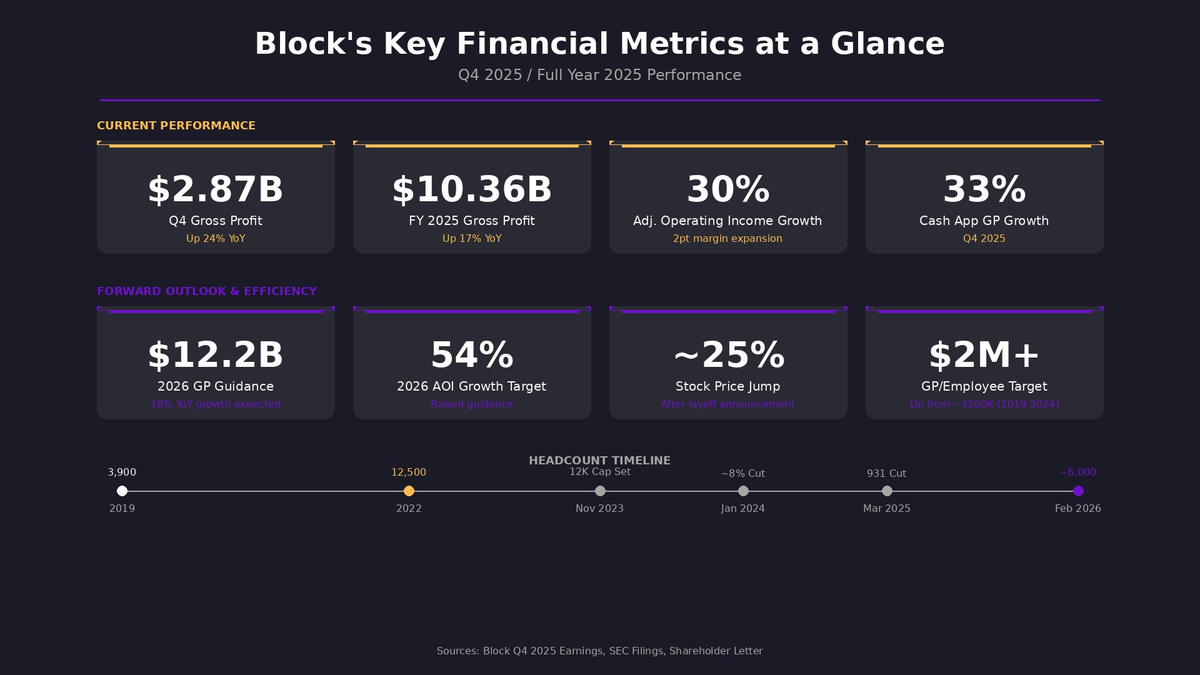
If you only read the headlines, you'd think Block was in trouble and AI was their lifeline. The exact opposite is true. This is a company operating from a position of strength.
Q4 2025 gross profit was $2.87 billion, up 24% year over year. Adjusted operating income grew 30% in 2025 with 2 points of margin expansion. Full-year 2025 gross profit hit $10.36 billion, up 17% year over year. Cash App gross profit surged 33% in Q4 alone. They're guiding $12.2 billion in gross profit for 2026 with adjusted operating income expected to grow 54%.
These are not the numbers of a company that needs to cut 40% of its workforce to survive. These are the numbers of a company that has been carrying unnecessary headcount for years and finally decided to address it all at once.
The stock popped roughly 25% after the announcement. And while the AI narrative made for a great story, markets reward efficiency and cost reduction regardless of the stated reason. If Dorsey had said "we overhired for three years and we're fixing it," the stock still would have gone up.
AI Is the Accelerant, Not the Cause
Now let me be clear. I am not saying AI has nothing to do with this. It absolutely does. But its role is that of an accelerant, not the root cause.
Block has been embedding AI across its operations for over 18 months through its internal tool called Goose, which sits on top of large language models to automate workflows and developer tasks. Since September 2025, the company has seen a 40% increase in developer productivity from AI tools. That's real. That matters.
What AI did here was give Dorsey the confidence and the operational model to make one decisive cut instead of continuing the slow bleed of incremental reductions. It provided evidence that smaller teams, armed with the right tools, could maintain or increase output. And it gave him a narrative that Wall Street would reward, which it did.
I actually agree with Dorsey's approach of making one large cut rather than dragging it out over months or years. Research consistently shows that repeated rounds of layoffs are destructive to morale, focus, and trust. Every time you do a round of cuts, the people who survive spend weeks wondering if they're next instead of doing their jobs. One decisive action, while painful, allows the remaining team to move forward with clarity instead of living in constant fear of the next round.
Block is now targeting more than $2 million in gross profit per employee, roughly four times their pre-pandemic efficiency levels. That's an ambitious but achievable number when you combine a leaner organization with AI-powered productivity gains. And I believe this is where all companies are eventually headed. Teams will get smaller. AI will handle more of the repetitive and transactional work. The employees who remain will need to be more strategic, more capable, and more productive than ever before.
That's the real story here. Companies are going to get smaller. The question is whether leaders are honest about why.
Credit Where It's Due: The Severance Package
One thing that deserves recognition is how Block handled the financial side of these layoffs. Affected employees receive their salary for 20 weeks plus one additional week for every year of tenure. Equity vests through the end of May. They get six months of healthcare coverage, they keep their corporate devices, and they receive $5,000 to put toward whatever they need during the transition.
Compare that to other major tech layoffs. When Elon Musk cut roughly half of Twitter's staff in 2022, employees reportedly lost access to their laptops before even receiving termination notices. Google's 2023 layoffs offered 16 weeks of base pay. Meta's packages started at 16 weeks plus two weeks per year of service.
Block's package is generous by industry standards and multiple observers have described it as a benchmark. I'm sure most employees at other companies would take Block's separation pay if they were given a choice between staying employed and taking the severance and leaving.
This matters for a reason beyond optics. How you treat people on the way out is how the people who stay will judge your leadership. And in a market where your employer brand travels instantly through social media and Glassdoor, the terms you offer departing employees are a talent strategy decision as much as a legal one.
What This Means for Startups
If you're a startup founder or HR leader watching this unfold, here's what you should actually take away from the Block situation instead of just fearing AI.
The overhiring problem is the real threat. Block's story is a cautionary tale about what happens when you scale headcount based on revenue momentum instead of strategic need. Revenue went up, hiring went up, and when the music stopped, they had thousands of people who weren't tied to clear business outcomes. I've seen this same pattern play out at dozens of startups. Growth masks inefficiency. It hides broken processes. It makes bad hires look acceptable because the company can afford them. Until it can't.
AI is real, but it's not replacing your entire team tomorrow. What AI is doing is making it possible for smaller teams to do more. That should change how you think about hiring going forward, not how you think about slashing your current team. Before you add headcount, ask whether AI tooling could enable your existing team to handle the workload. Before you hire for capacity, make sure it's actually a capacity problem and not a process problem.
Companies are getting smaller. This is not unique to Block. The trend toward leaner organizations powered by AI tooling is happening across the industry. The companies that figure this out proactively, from a position of strength, will have a massive advantage over those that are forced into reactive cuts when market conditions shift.
How you do layoffs matters as much as whether you do them. Block set a standard with their severance package and their communication approach. If you ever find yourself in the position of having to make cuts, the way you treat departing employees will define your company's culture and reputation for years afterward.
Closing Thoughts
Block's 40% layoff is a story about three years of overhiring, a duplicated org structure that went unfixed for too long, and a CEO who used AI as both the operational enabler and the narrative framework to make a necessary correction all at once. AI played a role, but it wasn't the cause. The cause was human decisions made during a period of explosive growth that prioritized speed over structure.
For startup founders and HR leaders, here's what to do right now:
- Audit your headcount against your strategic goals. Can you clearly articulate why every role exists and what business outcome it's tied to? If you can't, you have a problem that will surface when growth slows.
- Track your revenue per employee as a trend. If that number is flat or declining while you're adding headcount, you're building bloat.
- Before approving any new hire, ask whether the capacity problem could be solved with process optimization or AI tooling first.
- Start exploring how AI can make your existing team more productive instead of treating it as a future threat. The companies that adopt these tools early will be the ones that never need to make a 40% cut.
- If you ever need to do layoffs, do them once, do them decisively, and treat the departing employees with the kind of generosity that Block demonstrated. Your remaining team is watching.
The real lesson from Block isn't that AI is coming for everyone's job. The lesson is that undisciplined hiring during good times creates painful corrections during the inevitable reset. Build lean from the start, hire with purpose, and you'll never need to make the kind of cut that Dorsey just made.