
The Skills Gap in Startup HR
- 21 Jul 2026
- 6 mins

Whenever I meet HR folks at startups, the conversation usually gets to the same place within a few minutes: how hard it is to get alignment, and how often they're excluded from decisions HR should have a hand in.
They're good at the job they were hired for: compliance is handled, onboarding runs without drama, and managers trust them with the messy stuff. But 2 years in, and they're still not in the room when critical people decisions get made.
When someone is stuck like that, it's almost always a skills problem, and most people work on it in the wrong way. They go deeper on the skills that keep them in the back office and put off the ones that would get them out of it.
I've built and advised HR teams at 150+ companies, and the people who earned a real seat next to their founders, those who built that trust over time, were strong in the same 6 skills. You won't find most of these in HR certifications or the usual HR career path, which is a big part of why I think this gap exists.
This edition walks through all six of these skills. Read it as an audit of where your own development time is going.
The Training Trap
Start with where your development hours are going now.
Certifications get the most investment and return the least at a startup. An HR certification signals that you know the rules and the basics of running HR, which matters, but it says nothing about whether you can run a people function for a company that's doubling in size. I've written before about whether formal HR credentials are worth it for startup HR.
Deeper HR theory is the second over-investment. Knowing five performance management philosophies doesn't help when your real problem is one underperformer and a manager who won't document anything.
The third is compliance depth beyond your actual footprint. Be excellent at the compliance that touches your company. Becoming a scholar of regulations that don't apply to a 60-person business is time you're not spending on the 6 skills below.
None of this training is worthless. It’s just that the order is wrong. Most HR pros go deeper on what already feels comfortable and avoid the skills that feel foreign, which is exactly backwards for a startup career, especially if you want to have any real impact on the business.
Gap 1: Business Acumen
You can pull every report your HRIS offers and still be useless to your CEO if you can't read the numbers inside the business context. Attrition at 18% means nothing on its own. Attrition at 18% concentrated in the engineering team carrying your Q4 roadmap is a business emergency that you can attach a dollar figure to.
The HR people who get the seat talk like this: "this attrition pattern costs us roughly $640,000 a quarter in replacement and lost productivity, and it puts the March release at risk, which reduces our revenue forecast by 12%." The ones who stay outside the room say things like "engagement is down."
Gap 2: Financial Literacy
When your CEO talks about burn, runway, gross margin, and revenue per employee, you need to follow the conversation without translation and connect your work to it in the same sentence. That means reading a P&L, knowing your fully loaded cost per employee, and modeling the cost of a decision in dollars before anyone asks you to.
This is the language your leadership already speaks. Reach out to your CFO for a walkthrough of the company’s operating plan. Alternatively, take the last 3 months of financials and read them until you understand the story they tell, and ask questions.
Gap 3: Judgment Under Ambiguity
A startup will never hand you a complete data set, a precedent, or a policy that covers the situation in front of you. The skill is making a defensible call with 70% of the information, documenting your reasoning, and owning the outcome either way.
HR people coming from larger companies struggle with this one the most. They wait for certainty that isn't coming, and the decision gets made without them. It's usually a worse decision too, because it was made absent your HR expertise.
Gap 4: Workforce Management
Startups run on volatility. Funding windows open and close, revenue misses happen mid-quarter, and priorities could change with every board meeting. Inside that volatility, headcount decisions carry more runway impact than anything else you touch, because payroll is most of a startup's operating spend.
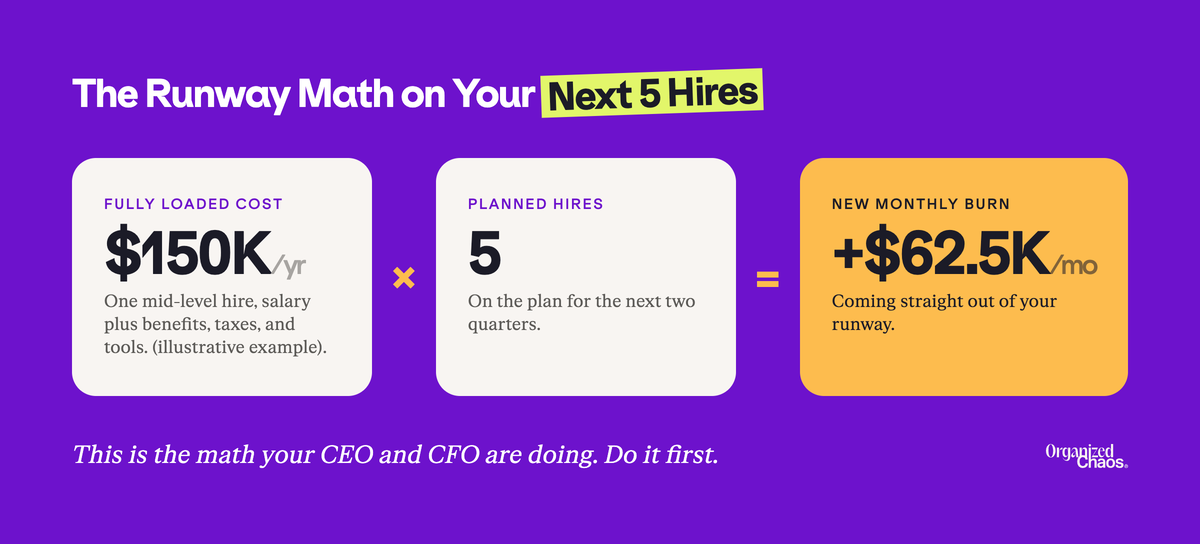
The HR person who can model what the next 5 hires do to the runway, and who can flag over-hiring before it happens, gets pulled into planning conversations early. The one who can't will find out about the layoff when they're asked to run it.
Gap 5: Right-Sizing Your HR Programs
Every stage needs a different amount of HR. The skill is building what today's stage requires while keeping it scalable for the next one, and sequencing everything else behind that: what the business needs this quarter, what can wait a year, and what should never be built at your current growth stage.
I've seen 40-person companies running a 9-box talent review when they had incomplete employee records. The programs are good to have, but not when they’re too early to be valuable, and when the HR foundations are missing. The usual cause is copying the playbook from a company 5x your size. What breaks at each stage is predictable, so build for the break that's coming, and no earlier.
Gap 6: Evaluating Leadership Capability
When you have 30 employees, a single manager touches a third of your company. A good one raises the output of everyone around them. A bad one costs you your best people, and the exit interviews won’t always give you the full story.
Most HR pros can run the mechanics of hiring, but assessing whether someone can lead people is a different skill, and it gets tested in two moments that carry real weight at a startup: hiring a manager from outside, and promoting someone into their first management role. Startups tend to decide both on weak signals like tenure, technical ability, or how much the founder trusts the person.
You need to understand whether this person can set direction without waiting for instructions, give feedback that changes how someone works, and hold a performance standard without burning the team out. A resume won't show any of that, and interviews reward people who talk well about management, which is a different thing from being good at it. You have to dig for evidence: how they handled their last underperformer, what they did when their team missed a quarter, and who they've developed and where those people are now.
Getting this right matters more in the early stages than it ever will again. Your first 10 managers set the ceiling for everyone underneath them, and a bad call takes a couple of quarters to show up and a couple more to undo. By the time it's obvious, the best people on that team are already interviewing elsewhere or have already left.
Your Audit This Week
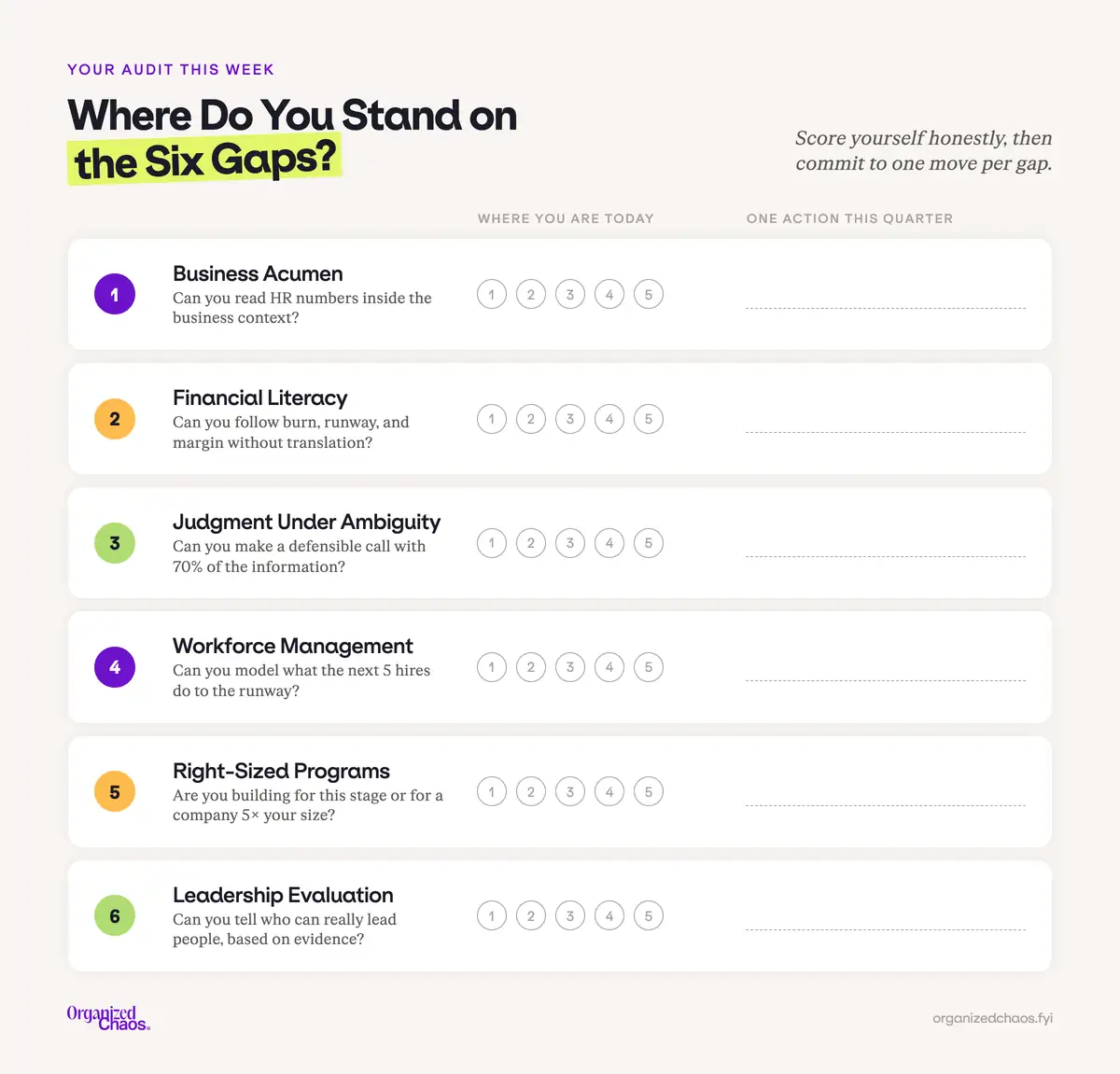
Here's what I want you to do this week. Set aside one honest hour, look at where you stand on each of the six gaps, and then work through this list:
- Write down the last 5 things you spent development time or money on. Certifications, courses, books, conference sessions, all of it counts. Then check each one against the 6 skill gaps. If nothing on your list maps to them, you've been training for a different job than the one you're in or trying to get.
- Get your hands on your company's P&L and operating plan and read them until they make sense. If your CFO or founder will walk you through them, even better, ask for 30 minutes. By the end of the week you should be able to understand what the company is prioritizing and start thinking of how your work aligns to that.
- Pick one people problem you've been sitting on and put a dollar figure on it, even a rough one: attrition, a bad hire, a team that's been stuck for two quarters, etc. Bring that number to your next leadership conversation and watch how differently it lands.
- Build a simple headcount model. One page is enough: every hire planned for the next two quarters, its criticality to the business, and what each one does to your cash runway. Don't wait for someone to ask for it. Showing up with it is the whole point.
- Make a list of every HR program you're running and be honest about why each one exists. Some you need right now, some you'll need at the next stage, and some you brought with you from a company 5 times your size. Kill or shrink at least one from that last group.
- Before your next managerial hire or promotion decision, write down how you're going to judge whether the person can lead people. If what you write down amounts to gut feel, you've found your starting point.
These 6 skills are exactly what The Startup HR Operating System was built to teach, including the parts HR certifications skip.
If this issue mentioned a gap you recognize, forward it to one HR peer who needs the same audit. Tell me which gap hit closest to home. Reply to this email and I'll read every one.