

Why Atlassian Cut 1600 Jobs While Revenue Grew 23%
- 31 Mar 2026
- 9 mins

The last edition, where I broke down the real reasons behind Block's layoffs, got a lot of great feedback and a few of you reached out asking me to keep going with this kind of analysis. So here we are. This time, Atlassian is in the hot seat. Like Block, Atlassian is not a startup, but the lessons buried in what happened there are directly relevant to anyone building and scaling a team right now. If anything, the Atlassian story hits closer to home for HR and people ops leaders because it puts compensation strategy, workforce planning, and org design failures front and center. I'll get into all of it.
On March 11, 2026, Atlassian CEO Mike Cannon-Brookes sent an email to every employee telling them whether they still had a job. About 1,600 people found out they didn't. That's 10% of the entire workforce of a company whose core product promise is helping teams work better together. The irony almost writes itself.
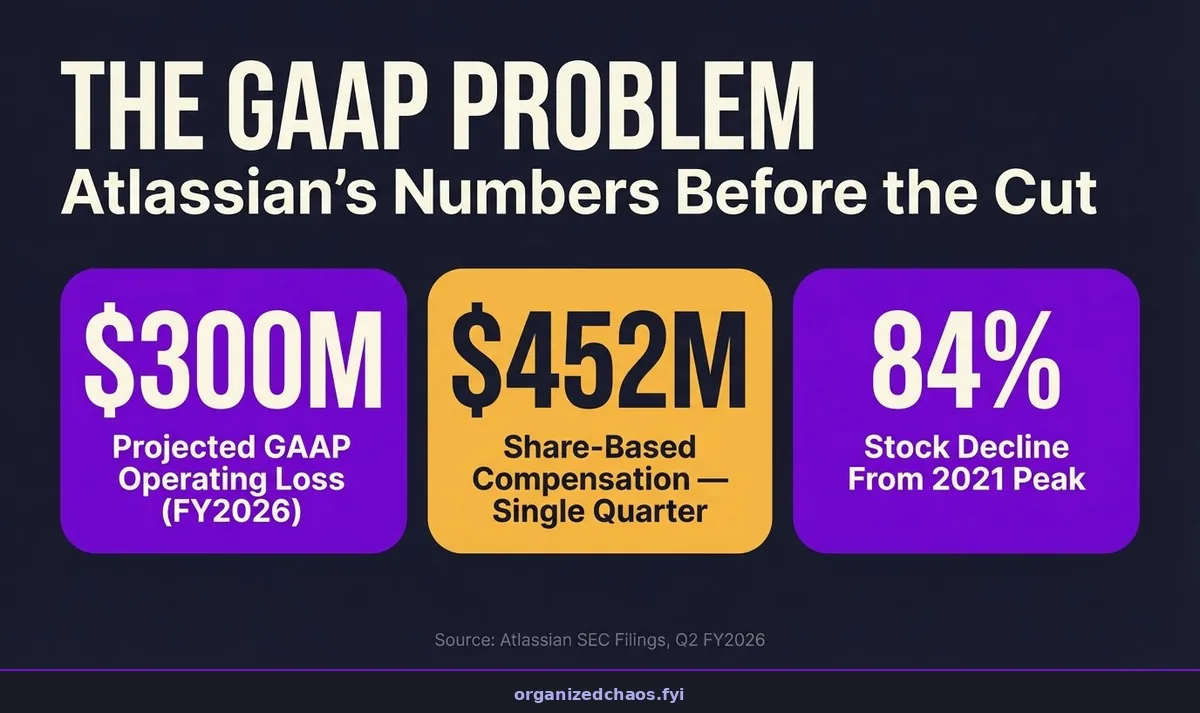
What makes this worth unpacking beyond the headlines is that Atlassian was not a company in freefall. Revenue grew 23% year-over-year. Cloud revenue crossed $1 billion in a single quarter for the first time in company history. Remaining performance obligations grew 40%. By almost every growth metric, the business was executing well. And yet, the stock had lost more than half its value year-to-date and sat 84% below its 2021 peak. The market was punishing a healthy business, and leadership responded with a restructuring that tells you a lot about where enterprise software is heading and what HR's role in these decisions should actually look like.
If you're in HR or people ops at a startup right now, this one is worth your full attention. The forces that drove Atlassian's decision are not unique to them, and the org design and HR failures embedded in this story are ones I've seen repeated at many companies over the years.
The Real Reasons Behind the Cuts
Cannon-Brookes framed the layoffs as a proactive choice: a well-performing company deciding to adapt before conditions force their hand. That framing is partially true. But the full picture is messier than the blog post lets on.
The most immediate driver was a GAAP profitability problem that had been building for a while. Atlassian's adjusted numbers looked strong, but the GAAP numbers told the real story. The company was on track to post a GAAP operating loss of roughly $300 million for the full year, with $452 million in share-based compensation consuming well over a third of its total quarterly revenue. That gap between adjusted performance and actual profitability had been widening, and investors had stopped giving it a pass. The market was no longer willing to reward growth alone. It wanted proof that the business model could produce real, durable profits.
The stock collapse created a second problem. At 84% down from peak, issuing new equity to fund AI investment would have been punishing to existing shareholders. So the only credible path to self-funding the AI and enterprise push, without going back to the market cap table, was to cut costs from the inside. Cannon-Brookes said exactly that in his post. It just lands differently when you lead with above metrics.
The third driver is the one with the deepest long-term implications. Atlassian believes AI is changing how much human labor it takes to build and maintain software. More than 900 of the 1,600 cuts came from engineering and R&D. That is not a cost-cutting pattern that goes after administrative overhead, but rather a strong belief that AI tooling has reduced the headcount required to do core product work. I've written about this exact dynamic before in the context of how startups think about hiring for capacity versus capability. Atlassian is essentially applying that same logic to their own workforce: if AI makes each engineer significantly more productive, you now have a capacity surplus. The response to a capacity surplus is almost always headcount reduction.
What the Org Structure Changes Signal
The layoffs got most of the attention, but the leadership restructuring that came with them is where the real strategic signal is, and it deserves equal scrutiny.
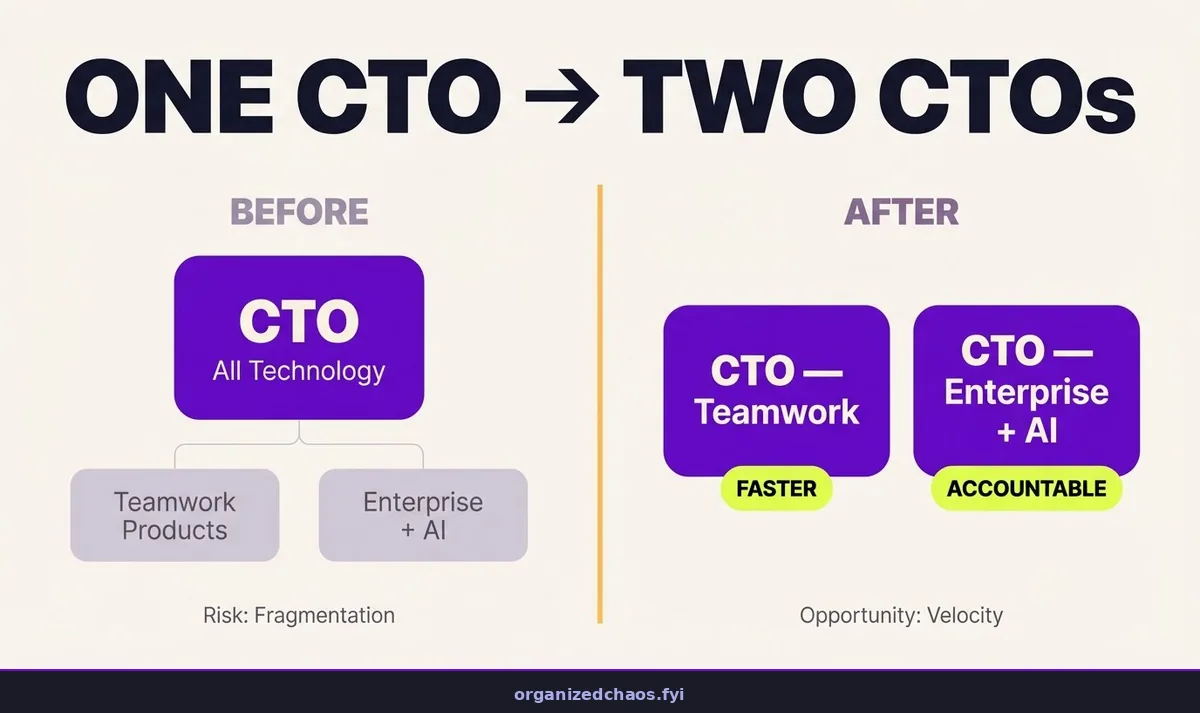
Atlassian replaced a single CTO with two: one focused on Teamwork products and one focused on Enterprise and AI. A new CFO just stepped in yesterday. These are not cosmetic changes to the org chart. Splitting the CTO role is an admission that the old structure was not built to run two genuinely different businesses at the speed the market now demands. Enterprise sales and AI product development have different customers, different cycles, different technical requirements, and different success metrics. Running both through one technology leadership layer, especially at Atlassian’s size, was creating drag.
There is an org design lesson here worth sitting with. When companies reach a certain size and complexity, the instinct is to preserve unified leadership in the name of cohesion. But cohesion and speed are not the same thing. Atlassian's reorganization is a bet that dedicated, accountable leadership by business area will produce faster decisions. Such a move always brings a risk of fragmentation, but if done right, the upside is increased velocity. Given how fast the AI competitive landscape is moving, they clearly decided the velocity bet was worth it.
This is also consistent with a broader shift happening across the industry. As I covered in my episode on the six trends reshaping HR, we are seeing the entire software sector rethink what its leadership structures need to look like in an AI-first environment. Atlassian's org redesign is a live example of that trend playing out in real time at scale.
The geography of the cuts adds another layer. Roughly 40% of the reductions landed in North America, 30% in Australia, and 16% in India, which maps closely to where Atlassian has its heaviest engineering concentration. The cuts were not distributed evenly for optics purposes. They landed where the cost basis was heaviest relative to the AI-productivity adjusted need. That was a deliberate workforce planning decision.
Where HR May Have Fallen Short
I want to be careful here because I do not have full visibility into how Atlassian's people function operates internally. But based on what is publicly available, there are patterns worth naming.
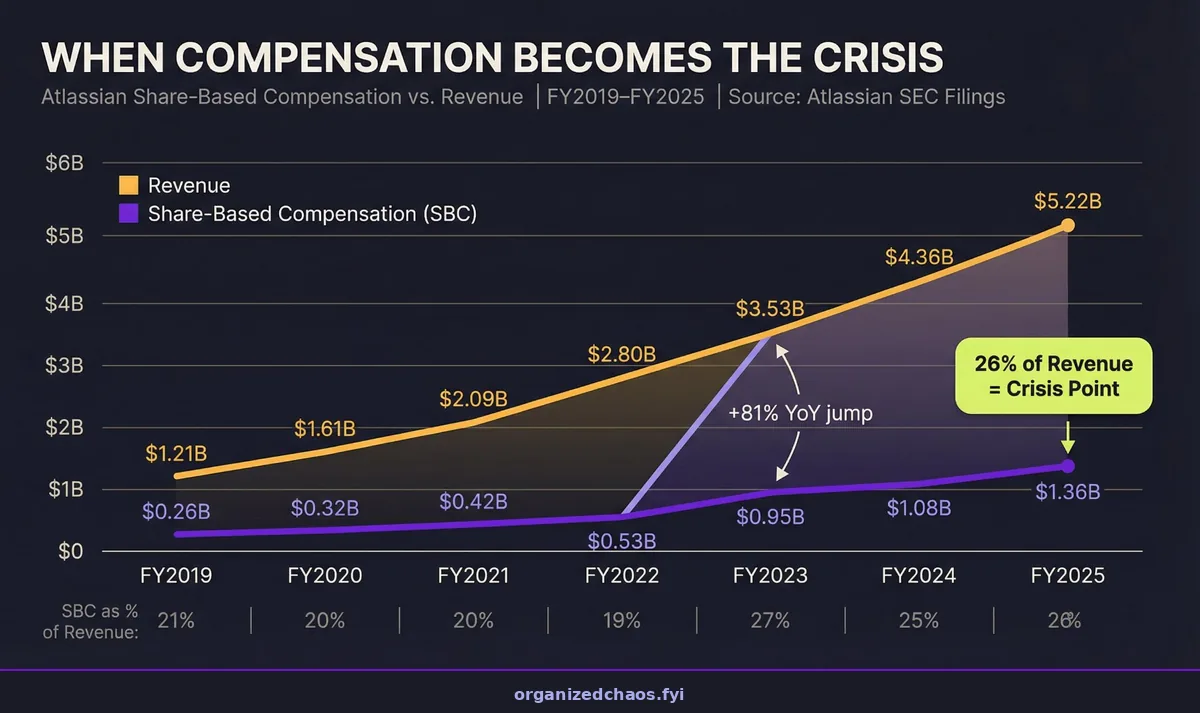
The GAAP profitability problem did not appear overnight. A share-based compensation structure that consumes 40% of quarterly revenue while the company carries a nine-figure GAAP operating loss is not a surprise that materializes in a single fiscal year. It builds slowly, and the people function sits at the center of compensation design decisions. If HR was not actively flagging the long-term sustainability of that structure against multiple market scenarios, that is a gap. HR leaders who want to operate as genuine strategic partners need to be in these conversations with the CEO and CFO well before investor patience runs out, not brought in after the financial narrative has already been set. Compensation strategy is not purely a finance function. It is a people function, and HR leaders who understand total rewards at a strategic level should be stress-testing those models against multiple market scenarios before they become a crisis.
The second area is workforce planning. A 1,600-person reduction that concentrates heavily in engineering tells me that headcount in that function may have grown beyond what the actual work required, especially given how significantly AI coding tools have accelerated individual engineer output over the past two years. Most workforce planning models look at historical headcount ratios and revenue-per-employee trends. Very few build in assumptions about what happens when the tools your employees use make each person materially more productive. I covered this in detail in Ep. 40 on workforce planning, where the central argument is that most capacity problems at scaling companies are actually process and efficiency problems in disguise. The same principle applies here, just at a much larger scale. That conversation should have been happening in HR well before a restructuring forced it into the boardroom.
The Opportunity HR Has Moving Forward
This is where it gets genuinely interesting, because the restructuring Atlassian just did opens a set of people challenges that HR is uniquely positioned to own.
The first is culture preservation after a significant reduction in force. Atlassian is a distributed, remote-first company. The employees who remain are processing a major disruption to their psychological safety and team cohesion without the benefit of being in the same room and reading each other. HR's job in the next 90 days is not to deploy an engagement survey. It is to design deliberate connection points, communicate clearly about what the new org structure means for remaining employees' roles and growth paths, and equip managers to have honest conversations with their teams. Organizations that handle this well come out with a stronger culture on the other side. The ones that send a "thank you for your resilience" message and move on see their high performers quietly start looking elsewhere.
The second opportunity is taking ownership of a fundamentally different workforce planning model going forward. The old model was reactive: revenue goes up, headcount goes up. What Atlassian is now building toward is a leaner workforce architecture that accounts for AI productivity multipliers, role criticality, and the distinction between capability and capacity gaps. HR has the opportunity to own that framework going forward. The question is whether the people function has the analytical capability to do it, or whether it continues to show up after the strategic decisions have already been made.
The third opportunity sits in the skill mix shift itself. Cannon-Brookes was explicit that the cuts were guided by a forward-looking view of the skills needed to thrive as an AI-first company. That means there is an active capability gap analysis sitting behind this restructuring. HR should be the function that turns that analysis into a talent acquisition and development strategy: which capabilities do we build internally, which do we hire for, and which do we rent through contractors or fractional arrangements? That is not a question engineering or finance should be answering on their own.
What This Means and What to Do About It
Atlassian is not an edge case. By early March 2026, global tech sector layoffs had already exceeded 45,000, with AI consistently cited as a primary driver. The combination of investor pressure, AI-driven productivity shifts, and the need to demonstrate real profitability is going to force similar decisions at other companies over the next 18 to 24 months. The question is whether HR at those companies is ahead of it or behind it.
The critical lessons from this case:
A strong top line does not protect you from a broken cost structure. Atlassian grew revenue at 23% and still had to cut 10% of its workforce because the profitability model was unsustainable under new market conditions.
Org design needs to match the actual pace of the business. Unified leadership structures feel safe until they become a bottleneck. Splitting the CTO role is a clear signal that speed and accountability at the product level matter more right now than organizational tidiness.
AI is not just an external competitive threat to plan around. For companies like Atlassian, it is an internal productivity assumption that changes how many people you actually need to do the same amount of work. HR needs to be in that conversation from the start, not brought in to manage the aftermath.
If you are in HR at an early-stage startup right now, here is what this means for you:
Run a workforce plan that includes productivity multiplier assumptions. Before you approve the next round of headcount, model what happens if your engineering team's output per person increases 30% over the next year because of AI tooling. Do you still need all those hires? The workforce planning framework in Ep. 40 gives you a practical starting point for building that discipline into your process.
Audit your compensation structure for sustainability across multiple market scenarios. If your equity-based compensation obligations are scaling faster than your revenue, that is a problem that will catch up with you when market conditions shift.
Define what an AI-first skill profile looks like for every critical function in your company. Do not wait until you are forced into a reduction in force to figure out which capabilities matter. Build that picture now and use it to guide both hiring and development decisions. If your hiring strategy is still built around the same assumptions you had two years ago, it is already out of date.
Establish a clear threshold for when a capacity problem should be solved with people versus process versus technology. Most capacity problems at scaling startups are process problems in disguise. Adding headcount to a broken process just makes the process more expensive without fixing anything.
The companies that navigate this well will be the ones where HR was already running these conversations before the pressure arrived. That is the opportunity sitting in front of you right now.