Bolt Cut Its HR Department. The Problem Is the CEO.
- 21 May 2026
- 10 mins

When a CEO tells a stage full of executives that he fired his HR team because they were "creating problems that didn't exist," the room is supposed to nod along. Ryan Breslow got that moment last week at Fortune's Workplace Innovation Summit. "Those problems disappeared when I let them go," he said.
I've spent years inside the people function at fast-growing startups, and I've watched founders say a version of this more times than I can count. The team got soft, the hires got entitled, or HR got in the way. Many founders and CEO’s that I’ve heard these stories from put the problem somewhere outside the executive office. Breslow's version is just louder and the numbers behind it make it worth pulling apart.
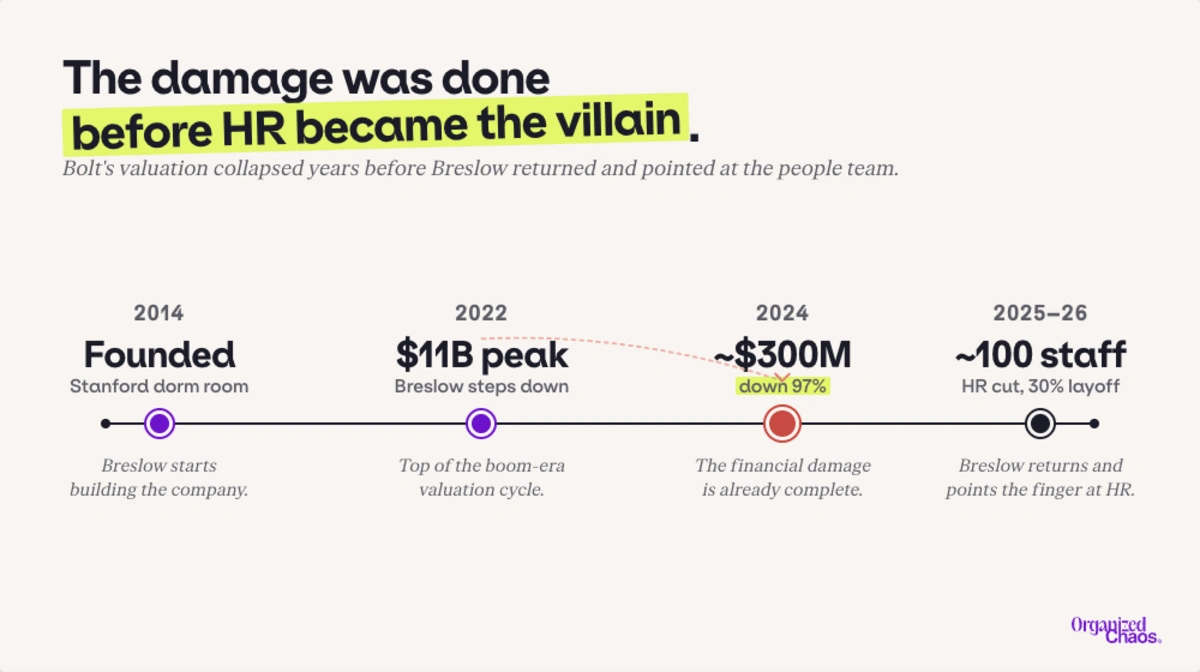
This is a CEO who founded Bolt in a Stanford dorm room in 2014, scaled it to an $11 billion valuation in 2022, stepped down that same year, and watched the company fall to roughly $300 million by 2024. That is a 97% collapse. He came back in 2025 to run what he calls "wartime," cut around 30% of staff, and now leads a company of about 100 people. To his credit, he owns the financial wreckage. He has attributed the downturn to poor decision-making and overspending; common reasons for companies who go through these types of downturns. That is the honest part that Breslow shared publicly.
The dishonest part is everything he said about people. Specifically, it’s the gap between owning the money problems and disowning the culture problems.
Where Breslow Deserves Credit
I want to be fair to the parts of this that are defensible, because I can write the easy version of this article and pretend everything Breslow did was wrong, but that’s not true.
A returning founder who walks into a bloated, comfortable company and decides to run lean is doing something reasonable. Bolt, like many companies that raised at 2021 valuations and staffed up expecting massive growth, is carrying costs it cannot support. Cutting headcount in that situation can be the responsible call. I've argued for exactly this kind of discipline when I've talked about workforce planning that protects your cash runway.
Shrinking a large HR team down to a small people operations function at 100 employees can also be reasonable. I run a whole content library on building lean people operations, and I tell founders all the time that a 200-person company does not need a 10-person HR department. So if the criticism here were simply "he cut HR," I'd be arguing against my own playbook.
My criticism is quite different. Breslow took full ownership of the financial mistakes and took zero ownership for the culture he is now complaining about. He built that culture, set the incentives, and hired the leadership team. The people he calls “entitled” are simply responding to the company he designed!
Culture Starts Where Breslow Won't Look
Here is what Breslow said at the summit.
"There was a sense of entitlement that had festered across the company, with people who felt empowered, felt entitled, but weren't actually working hard."
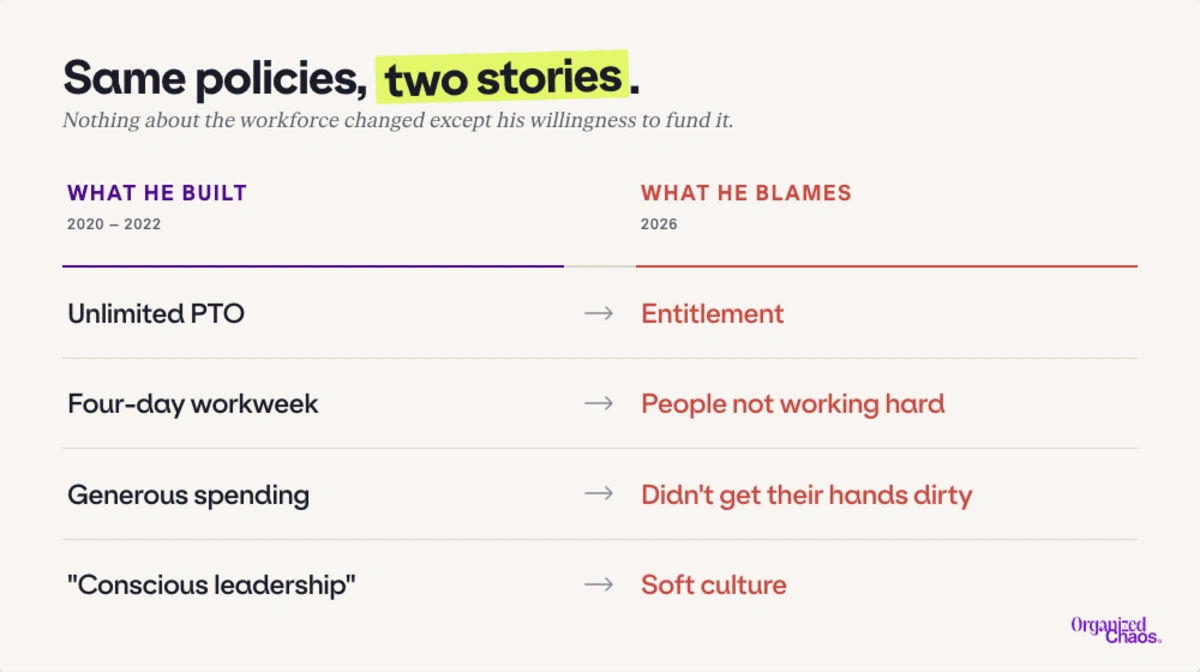
He gave employees hired under the old structure 60 days to adapt, and by his own count 99% couldn't, so he cleared out nearly the entire leadership team. He killed the 4-day workweek and unlimited PTO. He described himself as "a pioneer of conscious leadership" who had to bring the company "back to a very gritty place."
Sit with one question while you read it: who created the conditions he is describing?
He did because he is the CEO. The buck starts and stops with the CEO. The 4-day workweek and unlimited PTO were his policies. The free-spending boom years he now criticizes happened on his watch and on the watch of the leadership he hired. "Conscious leadership" was his brand, the thing he marketed himself on. Employees showed up to a company that told them, through every policy and every dollar, that this was how the place worked. They optimized for the environment he created, and that is exactly what people do.
Calling the result "entitlement" is how a founder avoids admitting the hard truth: I designed a culture I could no longer afford, and I blamed the people living in it. Culture is the one part of running a company that a CEO cannot delegate, cannot outsource, and cannot pin on a department. It comes from what leadership rewards, tolerates, and models. When a CEO looks at his own company's culture and sees only other people's failings, that is the clearest sign about the quality of their leadership.
The HR Cut Repeats the Same Blind Spot
Breslow says HR was "creating problems that didn't exist." He has never said what those problems were. There are two ways that I interpret this, and both reflect badly on him.
My first interpretation is that his HR team genuinely was low-value, running process for its own sake, and was disconnected from the business. This happens, and I've written about why so much of HR scopes itself into administrative irrelevance. If that's what Bolt had, the question becomes why a CEO who claims to be a visionary leader hired and kept a useless function for years, and why his answer was to eliminate it rather than fix it. Strong leaders rebuild weak functions. They don't just tear them down and blame it on the people.
My second interpretation is worse. The "problems that didn't exist" were real problems Breslow didn't want surfaced. Bolt has been dogged by reports that it clawed back employee paychecks and left some contractors unpaid, which he denies. A 30% layoff, a comp reset, the end of PTO and the end of the 4-day workweek, all carry real legal and human risk. A functioning people team raises those risks out loud. To a CEO in a hurry, an HR team that keeps flagging these types of risks and legal exposure can feel like it's creating unnecessary obstacles. It’s a common reaction I see from many early-stage founders.
Then there's his actual theory of HR, which he stated plainly. In his words, "those HR professionals have really important insights when you're in a peacetime and when you're at a larger company." On LinkedIn he wrote that:
"HR is the wrong energy, format, and approach, while people ops empowers managers, streamlines decision making, and keeps the company moving at lightning speed."
Look closely at what he actually changed. He kept a people function, made it smaller and more junior, and renamed it People Ops. He took the function he says failed him, gave it a new name, and called it a day. It's the same rebrand-as-theater pattern I've written about before, and Bolt is the cleanest live example of it I've seen.
The way he draws the line between HR and People Ops gives him away. He frames HR as the slow, big-company, peacetime function, and People Ops as the lean, fast one that keeps managers moving. A capable people function does the same core work at any size. It protects the company from people risk, it brings rigor to hiring and firing decisions, and it forces leaders to close the gap between the culture they claim and the one they truly run. A CEO who reduces all of that to a question of energy and speed is telling you he has never watched the function work well, or that he watched it and didn't understand what he was seeing. Either way, he doesn't understand what he just cut.
His theory is completely backwards. The riskiest, highest-stakes people work a company ever does is the work Bolt is doing right now: Mass layoffs, compensation resets, rebuilding an entire leadership team, and resetting a culture under financial pressure. The idea that strategic people work is a luxury for calm, well-funded companies tells you that Breslow thinks of HR as the soft stuff, the perks and the vibes, rather than the discipline that keeps a company out of legal and operational trouble while it's bleeding. The function he says he doesn't need in a crisis is the function built for crises.
The Part HR Has to Own
I won't let my own profession off the hook here, because there's a lesson in this for every HR leader reading it.
If Bolt's HR team had real strategic value and still got cut without a fight, someone failed to build a relationship with the CEO. That is a hard thing to say to people who were probably working in good faith. It's also true. A people leader who can't connect their work to runway, revenue, and risk in language the CEO respects will always be the first line on the budget when things get tight. I laid out the entire playbook for this in my guide on partnering with your CEO as an HR leader, and the core of it is simple. You earn the seat by speaking the business's language before anyone asks you to.
Breslow owns most of the blame for how Bolt got here. The HR team owns the smaller, quieter failure of never making themselves impossible to cut.
Does Your Startup Really Need an HR Department?
This is the question Breslow's whole story baits you into asking, so I'll answer it directly. Every company past its first handful of employees is already doing HR. Someone is running payroll, writing offer letters, handling a harassment complaint, managing a departure, and keeping you on the right side of employment law. The only real decisions are at what stage you put a dedicated person on it, and how senior that person needs to be.
For most startups under about 25 people, you don't need a dedicated HR hire. A founder or ops generalist plus a solid payroll and HRIS provider covers the basics, and I've laid out when outsourced or fractional support makes more sense than a full-time seat. Somewhere between 25 and 50 employees, the people work gets too heavy and too risky to sit on someone's side desk, and that's usually when your first dedicated hire earns their salary several times over. Past 50, going without a capable people function is a ticking time bomb waiting to go off.
So does Bolt need HR? At roughly 100 employees, running a 30% layoff, resetting compensation, killing benefits, and rebuilding its leadership team, the answer is obviously yes. The legal and operational exposure in that list alone demands experienced people capability.
In my view, Breslow just decided he'd rather have a smaller, and likely more junior team that won't push back, and he renamed it People Ops. I've written before about why that relabel is a meaningless play on words, and Bolt is the clearest example that proves my point.
If you’re a founder, you just need to ask yourself: How much HR do you need, how senior should it be, and what should it actually own at your stage? A company that answers those questions well builds a lean function that earns its keep. A company that answers them badly either overstaffs HR with administrators who generate process, or guts it down to people who do what they’re told and stay quiet.
What Founders Should Take From This
If you're a founder and your honest reaction to all this was "my team got entitled too," I want you to sit with a more uncomfortable possibility first.
Entitlement in a workforce is almost always a leadership output. People calibrate to what you model, reward, and tolerate. When the culture curdles, the first audit should be of your own incentives, your own hiring bar, and your own example, before you conclude the people are the problem.
So here is what I'd do, in order:
- Write down the 3 behaviors in your company that frustrate you most right now. Next to each one, name the policy, incentive, or hire that taught your team to behave that way. If you can't break the chain back to a leadership decision, look harder. It's almost always there.
- Take an honest look at your people function. If it feels like it's slowing you down, figure out whether it's disconnected from the business, scoped wrong, or under-led, before you decide the function itself is worthless. A weak HR team and a worthless HR function are different problems with different fixes.
- Finally, treat your HR or People Ops cost the way you'd treat any other material expense. Make it justify itself in business terms. If it can't, that's a scoping and leadership problem you need to solve, and eliminating the department won't solve it. It'll just hide it until the next crisis, the same way it's hidden at Bolt.
Breslow says his smaller, more junior team works harder and that customers are happy again. Maybe that's true today. But a leader who can't find himself anywhere in his own company's culture problems isa leader who will produce those problems again. The headcount is a quarter of what it was. Breslow’s blind spot is exactly the same size.
If you're a founder and any of this sounds familiar, that's usually the moment to get an outside read before the pattern repeats. My short HR Sprint is built to find where your people function and your leadership are actually misaligned, fast. And if you're an HR leader who never wants to be the line item a CEO cuts in a panic, The Startup HR Operating System is where I teach you how to build the kind of function that earns its seat and keeps it.