
How to Set Goals for AI-Augmented Employees
- 18 Jul 2026
- 7 mins

A client of mine, a 60-person software company, came to me with a performance problem earlier this year. Their support team had adopted AI tooling, ticket resolution volume had tripled, and on paper everyone was crushing their performance goals.
The numbers didn’t look so good when we looked at how the work was actually distributed. Two customer support reps had settled into approving whatever the AI produced, and their closed-ticket counts looked heroic. A third rep was handling every escalation the AI couldn’t resolve. Think the angry enterprise account threatening to churn, the edge-case bug that took two days to trace, or the refund that needed a human’s judgment call.
Here is why she looked like the worst performer on the team. The performance goal sheet measured tickets closed per week, and every ticket counted the same. AI had turned routine tickets into 15-minute work, so her teammates were closing 300 or more a week. Escalations still took hours or days each, so she closed about 40. She was also reviewing AI-drafted replies on high-risk accounts before they went out, which wasn’t accounted for in any of the goals. Measured purely on ticket resolution count, the person doing the hardest and most consequential work finished last!
The goals were the problem. They were written for a team that worked without AI, and that team no longer existed.
If your employees use AI to do a meaningful share of their work, and at this point most knowledge workers do, the goals you set 18 months ago now measure the wrong things. This guide gives you a working framework for how to set goals for AI-augmented employees: what to measure, how to re-baseline targets without destroying trust, and how to run the review cadence now that productivity assumptions shift more frequently.
Why AI Breaks Traditional Goal Setting
Traditional goals often focus on volume like tickets closed, posts published, or calls made. When AI makes this work faster and easier, volume is no longer a reliable measure of performance. This creates three immediate problems:
- Stale targets reward the wrong behavior: When goals are based on outdated "manual" speeds, the whole team can easily hit 200–300% of their target. This makes it impossible to distinguish between high performance and simple tool usage, while encouraging employees to prioritize easy, high-volume tasks over difficult, valuable work.
- The most important work becomes invisible: AI handles routine tasks, leaving only the complex, high-judgment work for your best employees. Because count-based metrics treat every task as equal, the people tackling the hardest challenges appear to be the "worst" performers because they produce lower volume than those sticking to easy, AI-automated tasks.
- Verification is ignored: Since AI output is usually correct, checking it feels like wasted time, especially when goals incentivize pure volume. This discourages employees from reviewing AI work, which inevitably leads to more errors, liability risks, and poor-quality output reaching your customers.
The 4-Part Goal Framework for AI-Augmented Roles
To measure actual value, rewrite your goals to focus on four distinct categories:
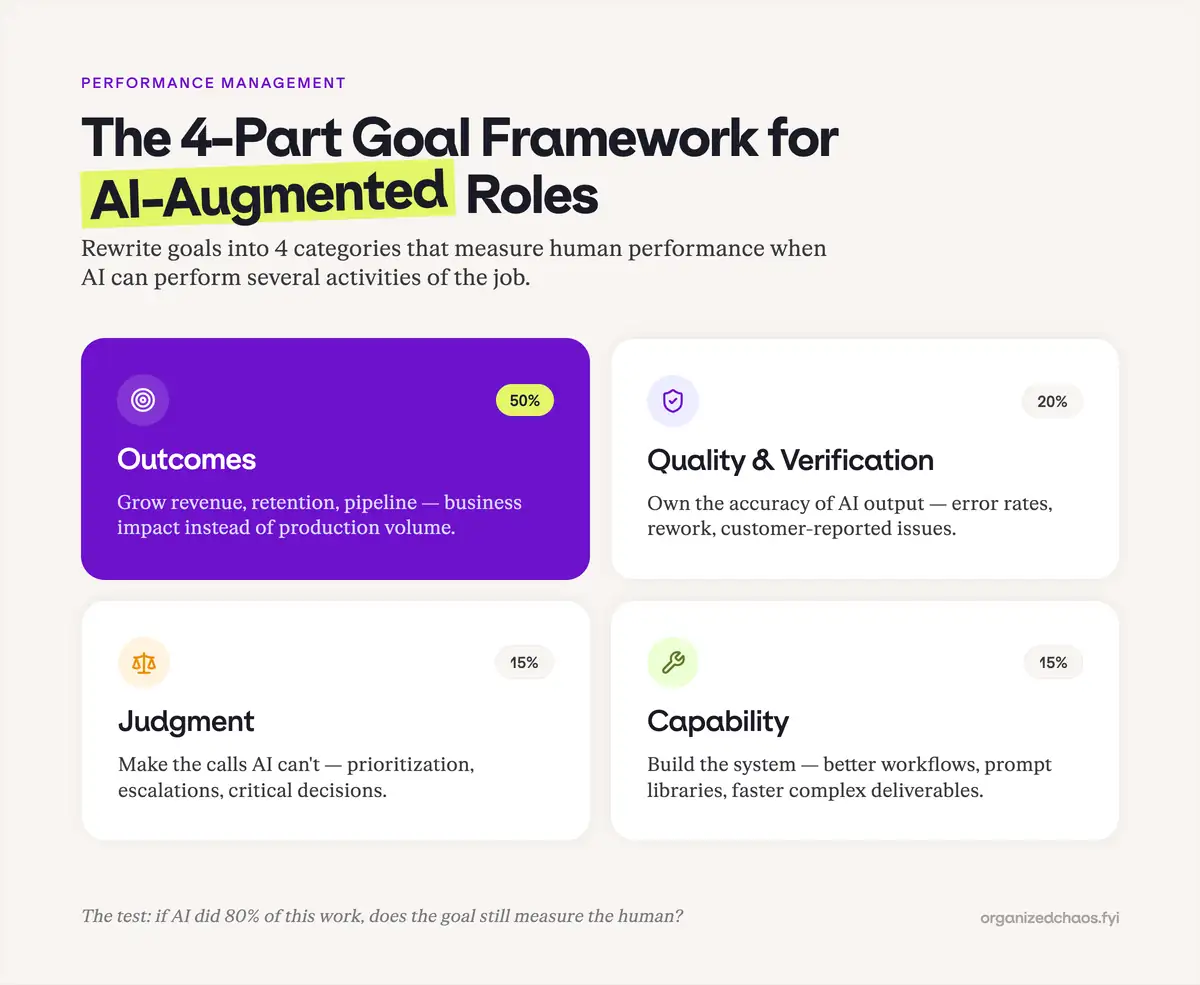
- Outcome goals (the priority): Move away from production volume. Instead, measure business impact (e.g., customer retention, pipeline generated, or defect rates). Ask: "If AI did 80% of this work, does this goal still measure the human's value?"
- Quality and verification goals: Require employees to own the accuracy of AI output. Set targets for error rates, rework, or customer-reported issues to ensure that someone is actively verifying work.
- Judgment goals: Specifically reward the work AI cannot do, such as prioritization, handling escalations, and making critical decisions. These can be measured via manager reviews of observable behaviors.
- Capability goals: Treat AI fluency as a core skill. Set goals around improving workflows, building prompt libraries, or reducing the time needed for complex deliverables.
How to Re-Baseline Targets Without Breaking Trust
Simply raising targets because "AI makes you faster" feels like a pay cut. Use this approach to reset expectations fairly:
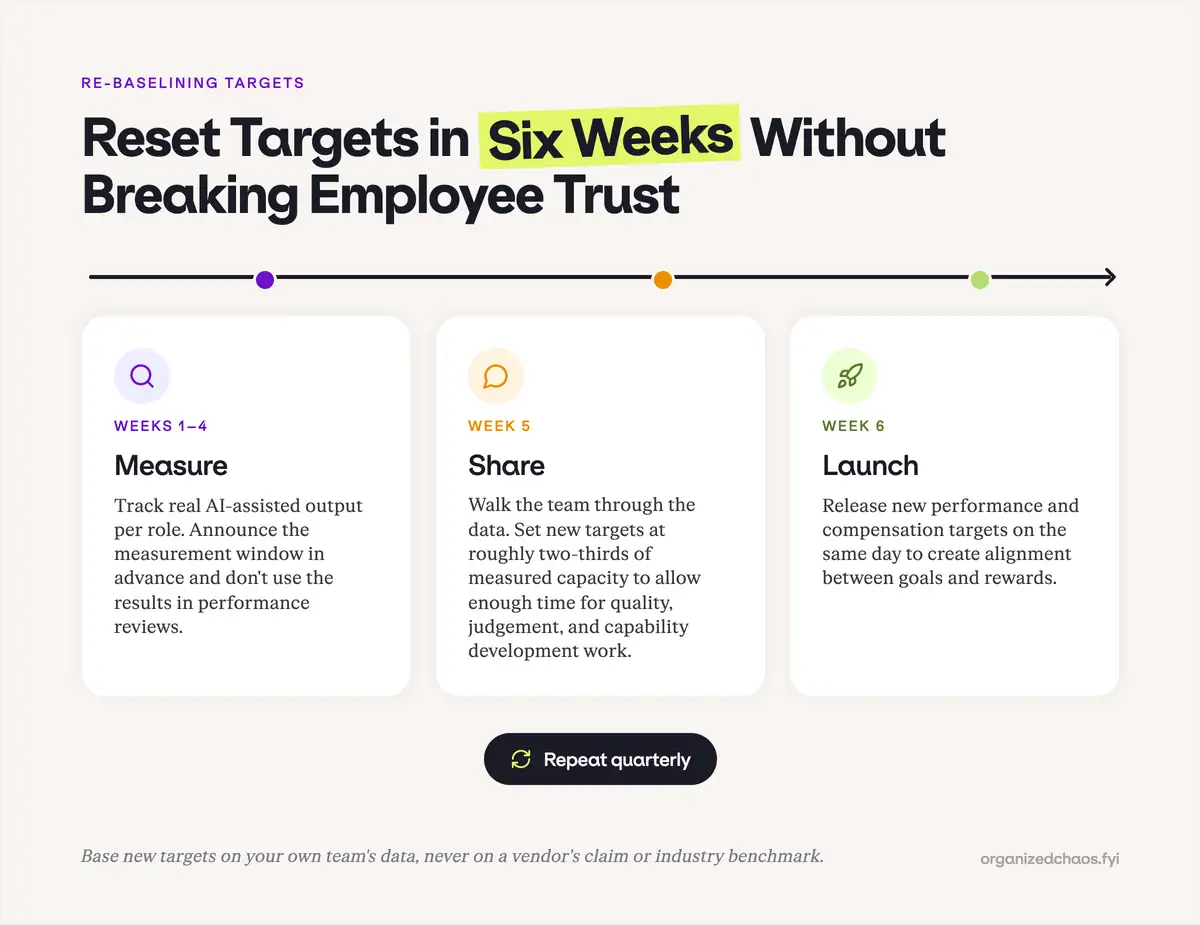
- Measure first, act later: Track actual AI-assisted output for 4–6 weeks before changing goals. Announce this window in advance to avoid the appearance of surveillance, and guarantee that this data won’t impact current performance ratings. Base new targets on your own team’s data, not vendor claims.
- Set targets below max capacity: If the team’s average output increases, set the new goal at roughly two-thirds of that capacity. This accounts for the time required for quality checks and handling complex issues. Clearly explain that the "gap" between capacity and the goal is dedicated to quality and high-judgment work.
- Update compensation alongside targets: If bonuses or promotions are tied to old targets, update these thresholds at the same time you change the goals. If you don't, employees will see the change as a pay cut and may leave. Rushing this process is costly; doing it carefully builds long-term trust.
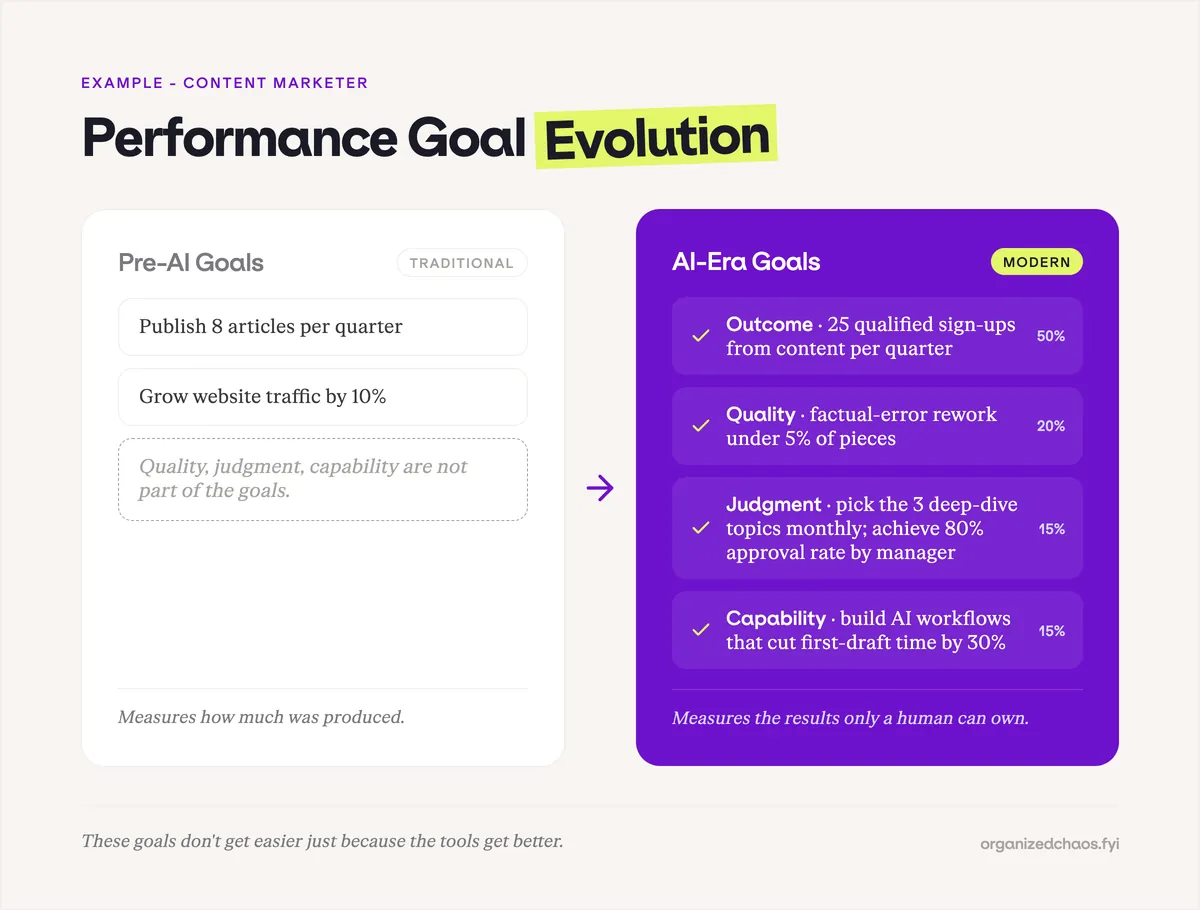
Here is how you can change a content marketer’s goals with AI.
The old goals only measured how much work was produced. The new goals focus on results. They do not get easier just because you have better AI tools.
Review Cadence: Quarterly Re-Baselining
Most goals assume work stays the same, but AI changes things quickly. Keep your big business goals annual. However, you should reset volume and skill goals every three months. This keeps goals meaningful. It also helps you plan your team size and budget accurately.
FAQ
Should I set AI usage targets?
No. Do not force people to use AI. Instead, set goals for results. If the tools help, people will use them. Only mandate usage during a short trial for a specific new tool. Also, avoid setting targets based on token usage. Token usage measures activity, not output, and cannot differentiate between useful work and "spinning your wheels", like burning 10,000 tokens just to get the AI to understand a simple prompt.
How do I measure productivity when AI does the work?
Focus on the final results, like revenue or customer satisfaction. Track how much work is being done internally to help set future targets. Do not make raw volume your main goal.
Do higher productivity numbers mean I need fewer people?
Maybe. Check your hiring plan before making changes. More work per person might mean you can grow faster without hiring. It depends on whether you want to increase profits or launch new projects.
What to Do This Quarter
- Check your current goals. Ask if they still matter if AI does most of the work.
- Track how much the team produces with AI for one month. Tell them this data won’t affect their current reviews.
- Change goals to focus on 4 areas: outcomes, quality, judgment, and new skills.
- Meet with the team to explain the new data and targets. Update any bonus rules at the same time.
- Schedule quarterly check-ins to update targets as tools improve.