Leaving a PEO: When It Makes Sense and When to Do It
- 10 Nov 2026
- 12 mins

Last year, I advised a 70-person software company that was using TriNet as its professional employer organization (PEO). The company was paying TriNet $140 per employee per month in admin fees, and they sometimes added charges without warning. For example, it once billed the company a $1,500 technology fee out of the blue, and the fee was due on the next payroll a few weeks later!
When we compared the numbers, TriNet's benefits were 10% to 12% cheaper than the quotes we got from brokers. The admin fees we would stop paying were almost equal to that difference, so leaving TriNet was roughly cost-neutral. The company left anyway, because the admin fees kept growing with every new hire and TriNet was creating too much work for its HR team.
Leaving a PEO only makes sense if someone on your team can run payroll, benefits and compliance at least as well as the PEO does today. If you have that person, rate your PEO on 3 things: its service, how well its benefits fit your employees, and what it costs compared with your other options.
If cost is your only problem, a saving under 5% is rarely worth the switch. In my experience, most companies should start looking at this at around 70 to 75 employees.
Why the 70-Person Company Left TriNet
The company left TriNet for two main reasons. First, costs were rising. Admin fees grew with every new hire, reaching over $100,000 a year at 70 employees. Although TriNet's benefits were still cheaper than getting coverage independently, the savings did not justify the high fees.
The second reason was operational. Employees complained constantly about TriNet's platform because onboarding, offboarding, and day-to-day tasks were difficult to complete on it. Simple changes took weeks. For example, updating paid time off (PTO) accruals or adding a new PTO policy for a specific location required opening a support ticket and waiting weeks for TriNet to handle it. TriNet also made administrative errors that the internal HR team couldn't correct on its own.
The company had 3 HR staff members: a Head of HR, an HR Generalist, and a Recruiter. The Head of HR and HR Generalist spent intermittent time managing TriNet and working with them to fix mistakes. Consequently, the company was paying TriNet for tasks its own HR team had to handle anyway.
To make matters worse, TriNet did not integrate with any of the company's other software systems. Building any dashboard or report required the HR team to manually export spreadsheets from TriNet and import the data into another system.
When to Stay on Your PEO
About 6 months ago, I was consulting for a 30-person software company whose Head of HR wanted to leave its PEO because she thought the benefit rates were too high. The HR team also wasn't happy with the PEO's HR information system (HRIS). She asked me whether they should switch to another PEO or bring HR in-house.
We looked at 3 options: staying with the same PEO, switching to another PEO, and bringing HR in-house. I put them in touch with a few other PEOs to get quotes, and the best one came in only 1% cheaper. We also priced out what running HR in-house would cost. That option would have doubled the cost of benefits. Because of this, the company would have had to cut back on a benefits package that most of its employees said was the strongest they'd ever had.
The company also couldn't change some of its processes the way it wanted to. However, at 30 people those processes didn't come up very often, so fixing them was a nice-to-have. Staying with the current PEO was an easy decision, because there was no operational need to leave and the numbers didn't support it.
Companies with fewer than 50 employees rarely outgrow their PEO. The financial benefits usually start to make sense at around 70 to 75 employees. By the time a company reaches about 100 employees, staying on a PEO usually no longer makes sense, as I explained in my guide to in-house vs outsourced HR.
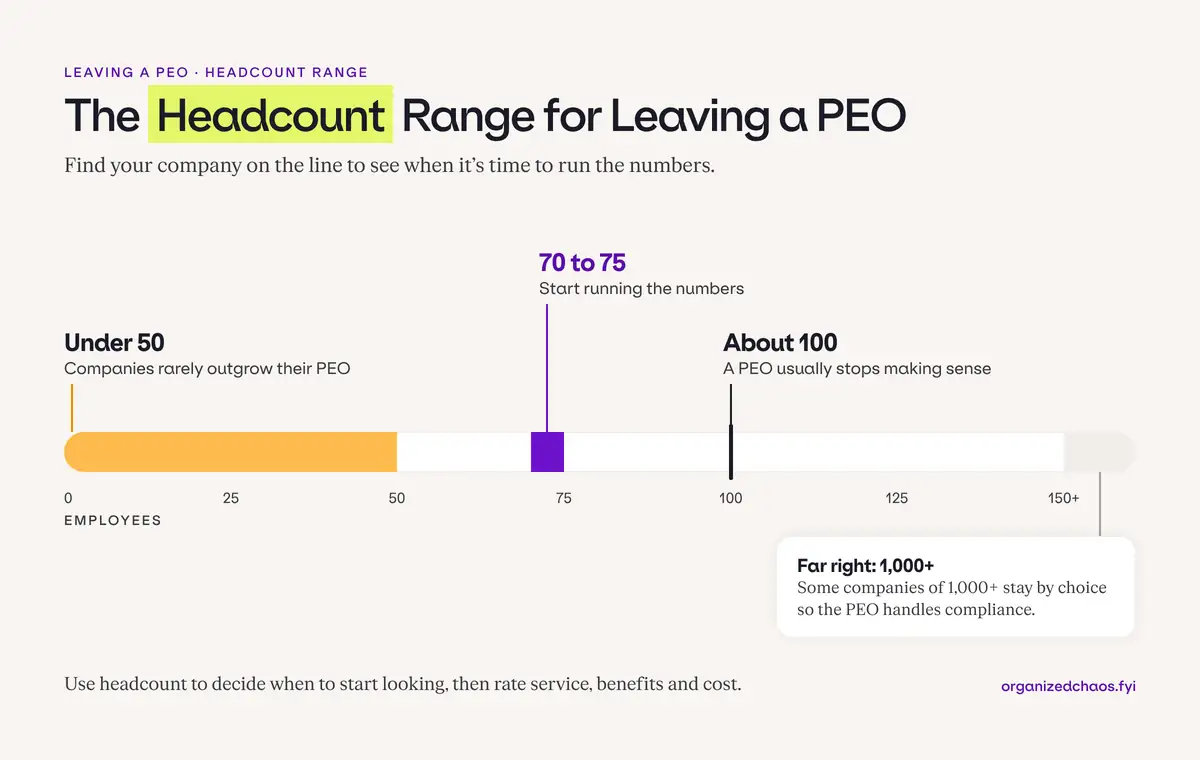
Even so, some companies choose to stay on a PEO much longer. I've worked with companies of over 1,000 employees that stayed on their PEO. They preferred paying higher fees so they wouldn't have to manage compliance themselves, allowing their HR teams to focus on hiring and employee development instead.
How to Tell If You've Outgrown Your PEO
Before you look at anything else, make sure you have someone in-house who can run payroll, benefits and compliance well, and who wants to do that work. If you don't have that person, leaving your PEO is never a good choice, because your team will have to take on all of that work without the skills to do it.
If you do have the right people, rate your PEO on these 3 things:
- Service: Check how quickly your PEO responds and how often it makes mistakes with payroll, benefits, and compliance. If simple changes take weeks or your team constantly has to fix the PEO's errors, you are paying for work your own team ends up doing. Poor service is a strong reason to leave, even if you just switch to a different PEO.
- Benefits: Determine whether your employees are happy with their benefits. If they aren't, figure out if the issue comes from the specific plans you chose or because the PEO doesn't offer options that fit your team. If it's just your plan selection, you can fix it without leaving. If the PEO lacks the right plans, that's a reason to look at other PEOs or bring benefits in-house.
- Cost: Compare your overall PEO spending against what it would cost to switch to another PEO or to bring HR completely in-house.
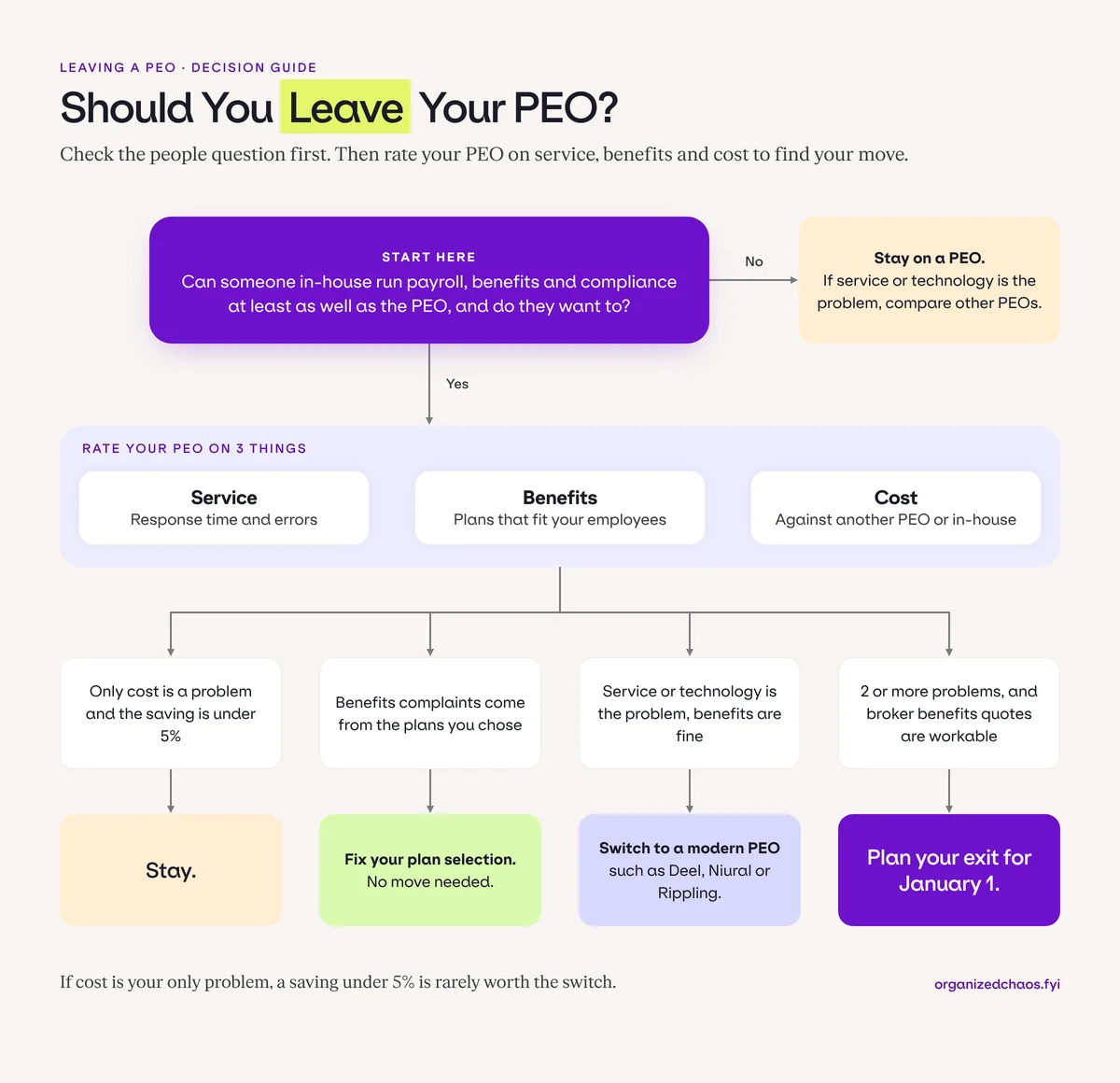
If cost is the only issue you face, make sure the savings justify the effort of switching. In my experience, companies rarely leave a PEO for cost alone if the savings are under 5%. However, if cost is just one of several problems, the case for leaving becomes much stronger. For instance, at the 70-person company, the costs were roughly even that year, so the decision came down to rising admin fees and poor service.
What Leaving a PEO Costs
Benefits usually make up the largest expense in this decision. Most companies join a PEO to get better healthcare and perks. Because PEOs negotiate with insurance companies on behalf of thousands of employees, they get lower rates than smaller companies can get on their own. Leaving a PEO might mean offering a weaker benefits package, which can make hiring harder.
Reach out to a benefits broker early to get a quote, since benefits costs will usually determine if leaving a PEO saves money. If your company is too small to get similar plans on its own, staying with the PEO might be best. If you can get good plans, compare the extra cost of those benefits against the PEO administration fees you'll save. Finally, factor in the cost of new HR software and the staff needed to manage it.
| Cost item | Staying on your PEO | Bringing HR in-house |
|---|---|---|
| Admin fees | Charged per employee, every month | None |
| Benefits | PEO's group rates | Broker rates, often higher for a small company |
| HR tech | Included with the PEO | Payroll and HRIS you buy and set up |
| People | The PEO handles payroll, tax filings and compliance | Your HR team does that work |
| How costs grow | At the same rate as headcount | Slower than headcount |
PEOs charge per employee or take 3% to 15% of total payroll. Setting up payroll and an HRIS on your own usually costs $5,000 to $25,000 or more upfront, plus $5 to $25 or more per employee each month to run them.
Admin fees increase faster than other costs because you pay them for every employee you hire. In comparison, the cost of your own HR software and HR team grows much more slowly as headcount increases.
Consider a Modern PEO Before Leaving
I used to think PEOs offered poor HR software. Traditional PEOs adapt slowly, and their systems rarely integrate with other tools startups use.
However, newer PEOs like Deel and Niural offer software that syncs directly with existing startup HR tools. This lets you keep a PEO's benefits and compliance support while using your preferred software.
Rippling handles this especially well. Its PEO includes its own HRIS. If you exit the PEO later, you can keep using the software and pay only for the HRIS fees, avoiding a full rebuild of your tech stack. If outdated technology is your main concern, switching to a modern PEO might fix the issue without requiring a complete exit.
The Best Time to Leave a PEO
January 1 is the best date to leave a PEO because your payroll taxes and W-2s start fresh with the new tax year. If you leave mid-year, your employees will get two W-2s. Annual tax limits (wage bases) also reset on the transfer date, which means you could pay certain payroll taxes twice.
Employees who earn more than the Social Security wage limit will also have too much tax withheld that year. They can claim the extra amount back as a credit on their federal tax return, but expect many questions from them about this.
If you're making this decision early in the year, consider two things before moving. First, check if the savings are large enough to justify moving mid-year instead of waiting for January. Second, ensure your HR team has time to explain the changes and support employees. If savings are small, wait until January 1 to make things easier for everyone.
If the IRS certifies your PEO as a Certified Professional Employer Organization (CPEO), wage limits for Social Security and federal unemployment taxes carry over during a mid-year exit. Employees will still receive two W-2s, but you won't pay those federal taxes twice. Check if your PEO is certified before deciding on a mid-year move.
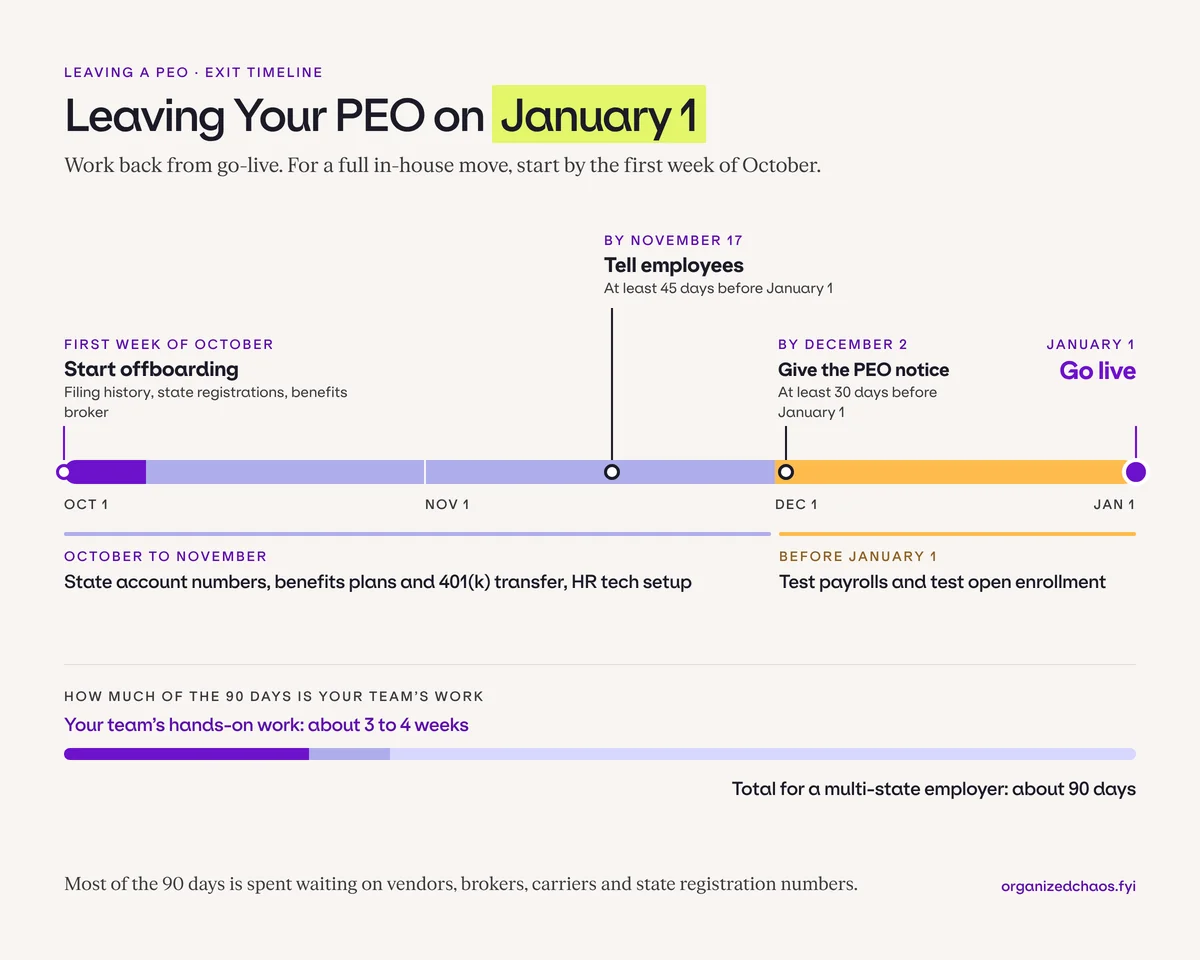
Some vendors claim leaving a PEO takes 8 to 12 weeks, while others estimate 4 to 6 months. In practice, moving payroll and re-enrolling in benefits requires about 3 to 4 weeks of work from your internal team. Most of the overall timeline is spent waiting on external vendors, brokers, carriers, and state registration numbers.
Quarterly tax filings also matter because you want your PEO to complete the full previous quarter and your new provider to pick up from there. If you plan to move everything in-house by January 1, start the PEO offboarding process by no later than the first week of October. Setting everything up typically takes about 90 days for a multi-state employer, and the process gets more complex as you add states and employees.
How to Leave a PEO
- Get your filing history: Ask your PEO for all state quarterly reports. Confirm the final quarter in which they’ll handle your taxes and compliance. Check your contract for notice requirements, and give notice at least 30 days before your leave date.
- List your state registrations: List every state with employees and check whether each tax account is under your company name or the PEO's. Usually it is under the PEO as the legal employer. If you already have your own tax account in a state, you do not need to register there again.
- Register in the remaining states: Register as an employer in every state where taxes run through PEO accounts. Track response times for account numbers, as your new payroll system needs them to file taxes in those states.
- Hire a benefits broker: Work with a broker to choose your benefits, including medical, dental, vision, and workers' compensation. Transferring your 401(k) plan is usually simpler. Your broker can refer a partner to handle the transfer using standard reports from almost any 401(k) system, or you can work directly with a provider like Human Interest or Guideline (now part of Gusto).
- Decide how HR will run before you choose software: Outline how you want HR processes to run before picking software. Choosing software first forces you into its default workflows, repeating the same issue as being on a PEO. My minimum viable HR tech stack podcast episode explains what you need at each growth stage.
- Communicate to employees early: At least 45 days before the transition, explain what is changing and why to employees. Show them how to request time off, view pay stubs and W-2s, and update their W-4s on the new platform. Provide step-by-step guides and hold office hours to answer questions.
- Test everything before you go live: Run test payrolls to verify calculation accuracy. Conduct a test open enrollment to confirm plan options, costs, and coverage. Open the system to employees only after verifying that everything works properly.
Frequently Asked Questions
How Many Employees Should You Have Before Leaving a PEO?
Start looking at around 70 to 75 employees, because that's usually when the financial case starts to work. Companies with fewer than 50 employees rarely outgrow their PEO. Rate your PEO on service, benefits and cost to make the final call.
Can You Leave a PEO Mid-Year?
Yes, but January 1 is much easier. If you leave mid-year, your employees get two W-2s. You can also end up paying some payroll taxes twice, unless your PEO is a CPEO.
How Long Does It Take to Leave a PEO?
Plan for 3 to 4 weeks of work for your team. If you're a multi-state employer bringing everything in-house, plan for around 90 days in total. The full process can take anywhere from 8 weeks to 6 months, mostly because you're waiting on vendors, brokers, insurance carriers and state registrations.