
How to Hire a VP of Sales: A Guide for Startups
- 11 Mar 2026
- 14 mins

At some point, every founder hits the same wall: they're still the best salesperson on their team, they're closing deals they shouldn't be closing, and they have no idea how to get out of the way.
You’ll get off the ground with an effective sales rep or two, but scaling your company into seven or eight figures requires a focused and effective sales force, and that can only come with the right sales leadership.
Who is the ideal VP of Sales? And when does it make sense to hire one anyway?
In this guide, I’ll walk you through what a VP of Sales does, the qualities that make a potential hire an ideal candidate for a startup, and how to interview applicants so you can select the right one for your company.
What Does a VP of Sales Do?

A VP of Sales is a big hire and one that’s easy to get wrong if the timing or expectations are off.
Like many leadership positions in an agile startup, the day-to-day responsibilities will vary (sometimes wildly), but most days will look like a combination of the following:
- Forecasting how much the sales team will sell this quarter and at what margin.
- Creating a hiring and management plan that supports the forecast, and identifying options for the CEO that could drive more growth or reduce costs.
- Managing direct reports, which includes holding one-on-ones, delivering feedback, setting goals, and supporting deals as needed.
- Collaborate with other departments, including Product, Finance, HR, Operations, IT, and the C-suite.
- Aggregating and providing industry intelligence to the organization.
- Advising the executive committee on competitors' position in the marketplace compared to ours, including pricing/features/go-to-market strategy
This can be boiled down to two core responsibilities: set a target, and hit it.
Hitting the target is easy to understand, but a good VP of Sales will know how to set a reasonably aggressive target that motivates the team while advancing growth. A rep blowing out their number is a cause for celebration, but a VP of Sales who sets consistently low targets that the sales team outperforms shows a lack of judgment in forecasting and may be stunting growth. The rest of the company’s investments hinge on sales forecasts, making this a uniquely strategic role that goes far beyond sales coaching and deal management. Low targets can lead to under-resourced departments that fail to support new customers, resulting in growing pains, punted projects, and even layoffs down the line.
When to Hire a VP of Sales
A VP of sales definitely won’t be your first sales hire.
Founders typically lead sales and build a sales team by delegating tasks. This gives you the runway to build momentum, clearly define your ICP, and achieve the coveted “product-market fit.” Then, you can expect to scale by adding individual contributors like BDRs and SDRs to execute on the sales process you’ve built.
When you reach 2-3 of the following, it’s time to start thinking about bringing in some sales leadership:
- The founder/founding sales rep regularly closes deals.
- You know your ICP and why they buy.
- You’re seeing early traction and some repeatability.
- You’re ready to build a team and scale beyond founder-led sales.
- Don't hire a VP of Sales to validate your market. Do hire one when you know what's working and need someone to turn it into a machine. But even then, make sure you're matching the profile to the actual stage, not just the title.
- Your sales team needs more leadership and training than the founder can provide.
It will vary by industry; sometimes you need a VP of Sales earlier on, while in some instances the founder may feel comfortable leading sales well past the bullets above. As with any hire, assess your current team's capabilities and make a judgment call.
How to Write a Job Posting for a VP of Sales
Your job posting will dictate the type of candidate that you attract and bring into your hiring funnel. Bland, generic job postings may appeal to a broader audience, but they won’t necessarily attract the right hire your team needs.
A good job posting begins with a job description that outlines the role's responsibilities and duties. Start by describing the role, the challenges the hire will face, and the skills they will need. Then write your job posting, which you will use to market the role and attract ideal candidates.
When writing a job posting, I like to start with the following:
- A company description: Go beyond the basics and use clear, descriptive language to give your prospective candidates a taste of what your company culture is like.
- Summarize the role: Include a brief description, key responsibilities, and the type of experience you’re looking for. Make sure to define the role's success and the team structure as well.
- Skills: Is your sales process driven by inbound or outbound? How many reps do you have? What is the forecast for hiring? What tools does your sales team use? The answers to these questions will dictate what skills you need. We’ll cover specific skills shortly!
- Benefits and location: Include where the job is (if it’s not remote), expectations for in-office work, and benefits that come with the job.
- Compensation: I’m an advocate for being upfront about compensation. Pay will depend on location and experience. According to Everstage, you can expect to offer base salary ranges at the following stages for your company:
- Seed to Series A: $140k - $180k
- Series B/C: $180k - $220k
- Late-stage: $220k - $300k+
And from there, I consider the following when writing the job description:
- Assess the needs of my team
- Define the ideal candidate profile I want to hire
- Note the roles and responsibilities
Compile all of these into a doc and refine, and you’ve got a job description ready to publish.
Building an Incentive Structure for a VP of Sales
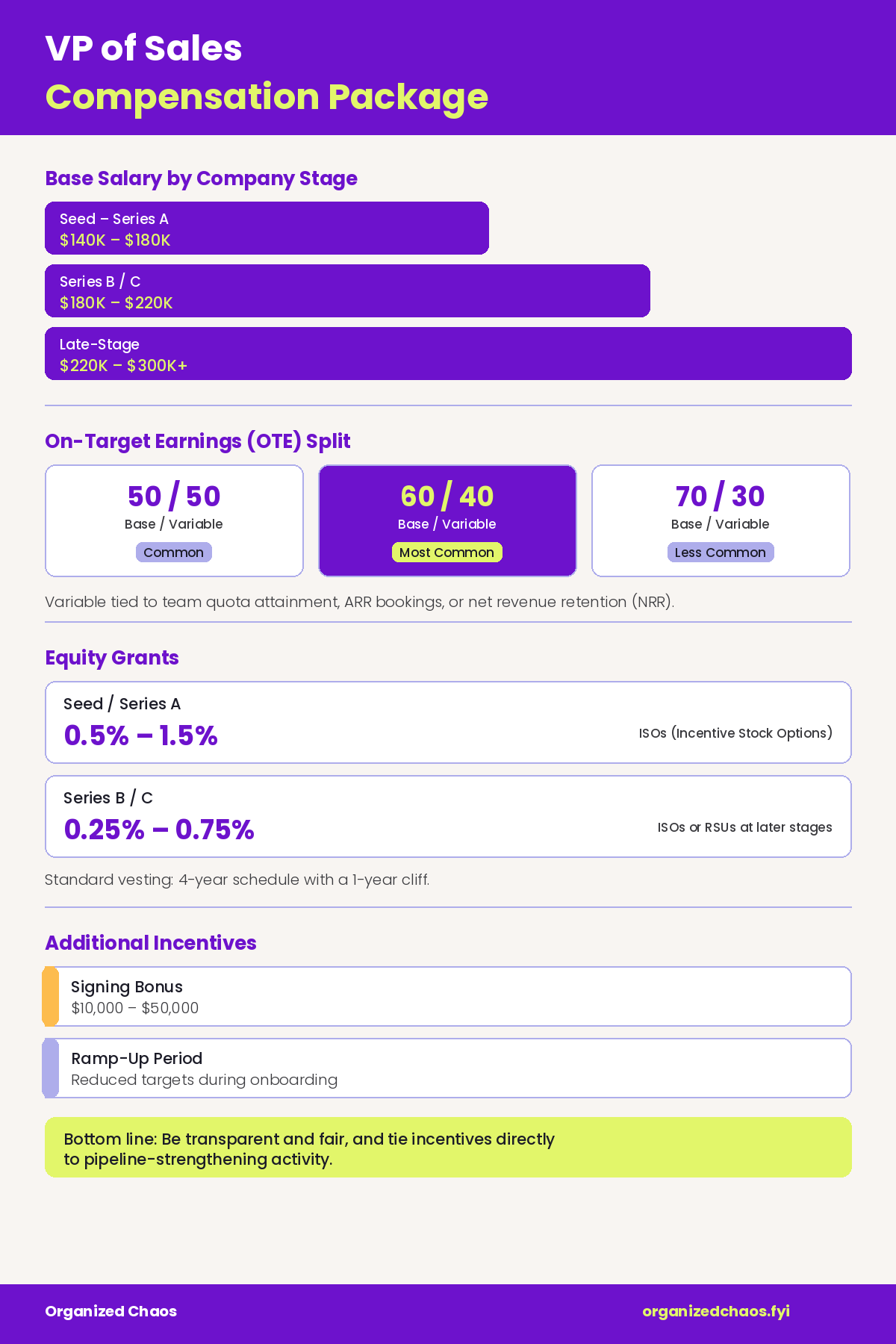
VPs of Sales don’t sell in the same way that BDRs/SDRs do, so they won’t earn commissions like your average sales rep, but they should be offered the following performance incentives:
- On-Target Earnings (OTE): A VP role hinges on the sales team's success, often on quota attainment, but sometimes on ARR booking targets or net revenue retention (NRR). Compensation should be based on accurate forecasting and the team’s capability to hit quota. A typical VP OTE split is 50/50 or 60/40 (base/variable) or even a 70/30 split in some cases, though it’s less common, with the variable component tied to team quota attainment or another KPI.
- Equity: In the early stages, equity can be a strong incentive and key part of a VP’s compensation. Grants typically vest over four years with a one-year cliff and will be structured as ISOs (incentive stock options) in the early stage or as RSUs at later stages or for public companies. Equity grants will vary by stage. It’s common to see the following:
- Seed/Series A: 0.5% to 1.5%
- Series B/C: 0.25%-0.75%
You may want to consider a ramp-up period to allow your new sales leader to adjust and set the team's strategy, along with a signing bonus (often in the range of $10,000 to $50,000).
The bottom line on commission structures is to be transparent and fair about how it works, and to keep it directly tied to rewarding activity that strengthens your pipeline.
The Hiring Process for Hiring a VP of Sales: What to Expect
Interviewing is a key step in any hiring process, but many companies aren’t using their interviews strategically.
This especially goes for VP of Sales interviews, where you can gauge whether a candidate is truly the right fit for your company. When interviewing a candidate, I recommend involving multiple team members to provide diverse, informed perspectives.
At a high level, the typical VP of Sales interview process looks like this:
- A recruiter screen: Ensure the candidate meets the minimum requirements for the role and is likely to be a good fit for the organization. Focus on their expectations for the role, basic skill questions, personality fit, and their interview timelines.
- Leadership: The CEO or CRO will likely need to be involved early, given the key role this hire plays. In either case, leadership will want to assess cultural fit, alignment with the vision, and whether the candidate can sell themselves.
- Presentation/Case Study: Often structured as a 30/60/90 plan, the aim of this is to understand what a candidate will do in the first 30 days to better understand the company, the first 60 days to diagnose gaps, and the first 90 days to begin building and scaling the team.
- A “meet the team” interview: This could be a full-day or a half-day, depending on the size of your company and sales/marketing organization. This is typically made of two parts:
- Presenting the case study mentioned above.
- 1:1 interviews with potential colleagues to assess the candidate’s skills, thought processes, business sense, and approach to sales.
The Take-home Project
It’s worth noting a quick point about the case study/presentation take-home project: you’re asking for the time and effort of a seasoned professional, so it’s only fair to compensate them for the effort. I’ve always been an advocate for paying candidates who make it to this stage for the time put in.
This is your chance to gauge whether the person you’re interviewing is a good fit for the role, and not just a good fit on paper. Make expectations clear upfront: what the task is, how to submit it, and when it's due. You're not looking for perfection; you're looking for curiosity, coachability, and how they think on their feet. If feedback is part of the process, make sure you deliver it and give them a chance to respond constructively, as that’s where you’ll really see their potential.
After the interview process, you will review the candidate’s performance with your team to make a final hiring decision.
You may want to include the following as you evaluate and compare candidates:
- A post-interview panel to discuss, followed by a decision by the hiring manager.
- Reference checks to ensure the candidate has good character and standing, and to make sure you haven’t missed anything across the hiring process.
- Make an offer!
You’ve got a high-level view of the interview process, so let’s get to the brass tacks next. I’ll show you how to interview candidates, assess their skills, and ensure you hire the best fit for your company.
How to Interview a VP of Sales
Interviewing a VP of Sales is a matter of identifying a candidate who can help you get a handle on your pipeline, build trust with prospects, and adapt quickly in a fast-moving environment.
I like to split the VP of Sales interview into two parts:
- Seeking out the required skills (again, these should be based on your company’s needs)
- Specific questions to assess those skills and competencies
You want to invite the candidate to share real-world examples that reveal their technical skills, ability to drive growth, and communication style.
Let’s walk through each one.
Skills to Look for
When hiring a VP of Sales, it’s important to look for the following key skills:
- Team building: Look for someone who can recruit, hire, and develop reps to build your sales force. In the early days, this hire will play a key role in shaping your sales culture from the ground up.
- Coaching and developing talent: Can they go beyond managing quotas, but actually develop reps and help them improve?
- Building processes and scaling teams: Look for a candidate capable of building and scaling a sales process that continues to work as the team grows.
- Forecasting: Beating forecasts consistently just means that you’re underestimating. Look for a VP who sets aggressive yet realistic forecasts and can back up predictions with data. Remember, your company’s growth and investments hinge on accurate forecasts, so do not gloss over this one!
- Multichannel fluency: Today’s outbound motion isn’t just cold calls; it’s email, LinkedIn, video calls, and even texting in some industries. Look for a leader who understands how to vary messaging across platforms and coach reps across channels.
Now, let’s get to some sample questions to ask.
Questions to Ask a VP of Sales Candidate
The exact questions you ask during the interview process will depend on the specific hire you are looking for, but for a starting point, I recommend breaking questions down into the following categories:
- Sales leadership
- Revenue management
- Strategic sales planning
- Talent acquisition and development
Whenever asking questions, no matter the scope, I try to focus on outcomes rather than inputs in earlier-stage companies and startups. In HR terms, we call this the Competency-Based Interviewing framework – what I believe is the right way to interview, especially in the startup phase. Each employee can have an outsized impact on your success; therefore, prioritizing outcomes over “just getting the work done” is essential.
Sales Leadership
Leadership capabilities are the backbone of this role, so I recommend asking the following questions:
- Tell me about a time you had to realign your sales team's strategy to address a significant market shift, and what specific actions you took to ensure buy-in and execution.
- Describe a situation where your team was underperforming against key metrics, and walk me through the diagnostic process you used to identify the root causes and the steps you took to turn performance around.
- Tell me about a time you had to decide whether to make significant concessions on pricing or contract terms to close a high-stakes deal. Walk me through how you evaluated that tradeoff, what you ultimately decided, and how you brought stakeholders along with you.
- Give me an example of how you've coached a high-potential but underperforming sales representative to reach their full potential, detailing your approach and the ultimate outcome.
- Tell me about a time you recognized your team's sales approach was becoming less effective. How did you identify the gap, what did you change, and how did you get your team to actually execute differently?
Revenue Management
Your company’s success and growth hinge on accurate, reliable, and properly aggressive forecasts. Gauge revenue management skills by asking the following questions:
- Describe a time you had to significantly adjust your revenue forecast mid-quarter due to unforeseen market shifts. What specific data points drove your revision, and how did you manage the situation from there?
- Tell me about a time you inherited or identified a pipeline that wasn't converting as it should. What did you diagnose as the problem, and what did you do about it?
- Tell me about a revenue strategy you built that took more than a year to fully play out. What was your thesis going in, how did you keep it on track when things shifted along the way, and what ultimately happened?
- How did you approach a situation where your team was consistently missing its revenue targets despite strong pipeline activity? What diagnostic steps did you take, and what specific interventions did you implement to course-correct?
- Tell me about a time you made the call to walk away from revenue, such as a deal, a customer segment, or a channel, because it didn't align with where you were taking the business. What made you pull the trigger, and how did you defend that decision?
Strategic Sales Planning
The VP role is both strategic and pragmatic. Ask the following questions to gauge strategic thinking and skills:
- Tell me about a time you had to develop a new sales strategy for a challenging market segment. What was your process for defining the strategy, and how did it play out?
- Tell me about a time you realized your team was consistently losing deals in a specific area, whether it was a competitor, a segment, or a stage in the cycle. What did you change and what happened?
- Walk me through a time you had to realign your sales process to support a new product launch. What trade-offs did you face, and how did it land?
- Give me an example of when you had to develop a sales strategy with incomplete market data. What steps did you take to navigate the ambiguity, and what was the ultimate result?
- Tell me about a time you needed something significant from another department to execute your sales strategy, and they weren't on board. How did you handle it?
Talent Acquisition and Development
You’re not just hiring a VP to set targets and act as a coach; you need someone who will build and develop a sales culture that propels your company forward. Ask the following questions:
- Tell me about a time you significantly improved the onboarding process for new sales hires. What was broken, and what did you change?
- Describe a situation where you identified a critical skill gap within your sales team and developed a strategy to address it. What was the outcome?
- Tell me about the hardest sales hire you ever had to close. What made it difficult, and what did you do to land them?
- Tell me about a time you had to balance leading your sales team's strategic goals with your own direct involvement in closing a critical deal. How did you manage your priorities, and what would you do differently?
- Tell me about a time you had to decide whether to step into a deal yourself or let a rep own it, knowing they might lose it. What did you weigh and what did you do?
What Makes Someone a Good Fit for a Startup VP of Sales Role?
Nearly every tech company calls itself “agile and fast-paced,” but this is especially true for early to mid-stage startups. What’s more, a VP of Sales will be an integral part of your growth strategy.
Keep in mind that even the most seasoned sales leader may not be the right fit for a startup environment. Beyond the core skills listed above, look for someone who:
- Brings a self-starter mentality: A seasoned professional capable of working independently. They can run their inbound and outbound processes by taking initiative and proactively engaging with prospects.
- Equally strategic and pragmatic: A good VP should balance the strategic 90-day mindset with what is happening with each rep at any given moment.
- Demonstrates adaptability: Capable of shifting gears quickly and confidently. You want a candidate who doesn’t lose focus or get rattled when objectives, priorities, or strategic direction change.
- Possesses resourcefulness and resilience: They ask insightful questions, explore new tools and ideas, and approach challenges with creative problem-solving. They also know how to roll with the punches.
Hiring Is Just One Part of HR: Download the Startup HR Survival Guide for the Rest
A VP of Sales is a critical hire for your company, and represents a leap forward from founder-led sales to a well-oiled sales machine that can prime your company for growth.
Hiring is a key piece of your startup’s success, but it’s only one element of a robust and effective HR strategy.
The most successful startups know that their path to scaling from seven to nine figures will be made possible by the practices they follow to attract and retain top performers. I mapped out this and more in my Startup HR Survival Guide.
In this free guide, you will learn:
- How HR can drive growth
- How to hire
- How HR evolves as your company grows
- And more!
Fill out the form below to download the free guide and put your company on the path to hypergrowth.