
Airbnb's People Team Restructure: What It Actually Changed
- 15 Sep 2026
- 8 mins

You may have heard that Airbnb split its HR department between finance and communications, or seen HR peers ranting about it on LinkedIn. The ongoing narrative is that Airbnb took a full HR department and split it up between two other teams. But that story is not true.
Airbnb has not had a standard Chief Human Resources Officer since 2021. For that entire time, the HR team reported to a finance leader. On September 1, Airbnb moved the talent team to communications. The compensation and performance teams stayed right where they were in finance.
Dividing HR work between two leaders or functions is more common than you might think at large organizations. But it is also the least important part of this story for a business with 40 or 200 employees. Your company will probably never split up a department like this. However, you can still lose the same key benefits people are worried Airbnb will lose. And you can lose them without reorganizing, making an announcement, or making a clear decision at all. I saw this exact issue cost one client over a million dollars.
What Airbnb Did on September 1
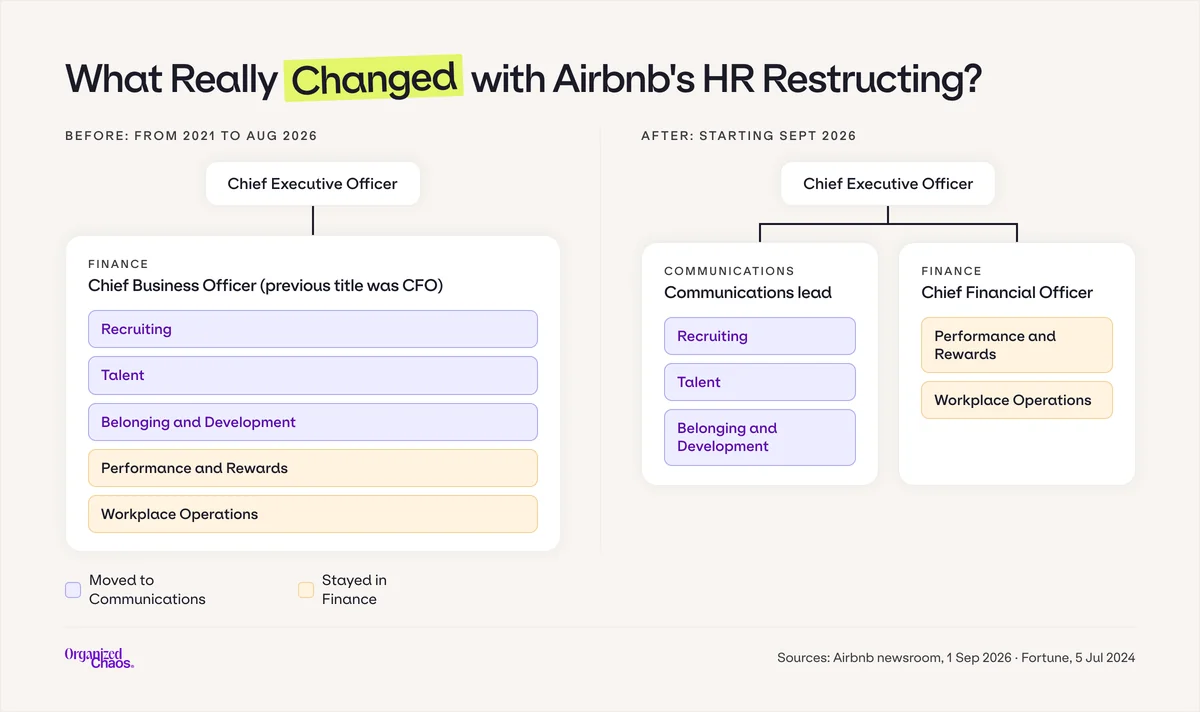
Fallon O'Connor has led communications at Airbnb for 11 years. On September 1, she was promoted to CEO Brian Chesky's core leadership team for the first time. In this new role, she now leads Communications, Recruiting, Talent, and Belonging and Development. Meanwhile, CFO Ellie Mertz took over Performance and Rewards as well as Workplace Operations. Chesky explained this choice clearly in a company memo. He wrote that recruiting, talent, and belonging build company culture, so they should be led by someone who understands that culture best.
Dave Stephenson will leave Airbnb at the end of this year. He started managing Employee Experience alongside his role as CFO back in 2021. He kept managing it when he became Chief Business Officer in 2024. This means a finance leader ran Airbnb's entire People team for five full years, but none of the recent critics have mentioned that fact.
What Airbnb actually changed is which executive leads each part of the team. It shifted those responsibilities between two leaders who both report directly to the CEO. This is completely different from what Bolt did when it eliminated its HR department and blamed an entitled work culture. Airbnb kept every single part of its People team; it simply changed who oversees each area.
The Main Thing I Am Watching
In the old setup, one finance leader oversaw both team planning and the hiring budget. Now, recruiting reports to a communications leader. At the same time, the team in charge of pay and reviews stays under finance. These two groups must work together, but they now report to different bosses.
Here is the sign I will look for. Airbnb grew from about 7,300 workers at the end of 2024 to about 8,200 at the end of 2025. That is a 12% increase in one year. If the company hires too many people and has to lay off staff later, it means splitting the team might have broken a link that used to work.
That is the full Airbnb story. Now let us look at what this means for you.
What It Cost One Company in 2022
In 2022, I advised a 3-year old company that built software for web architecture. At this company, the Finance team had always managed pay, payroll, and rewards. The HR team oversaw performance management, but Finance made the final decisions about pay. The company used this system for years, and it worked well.
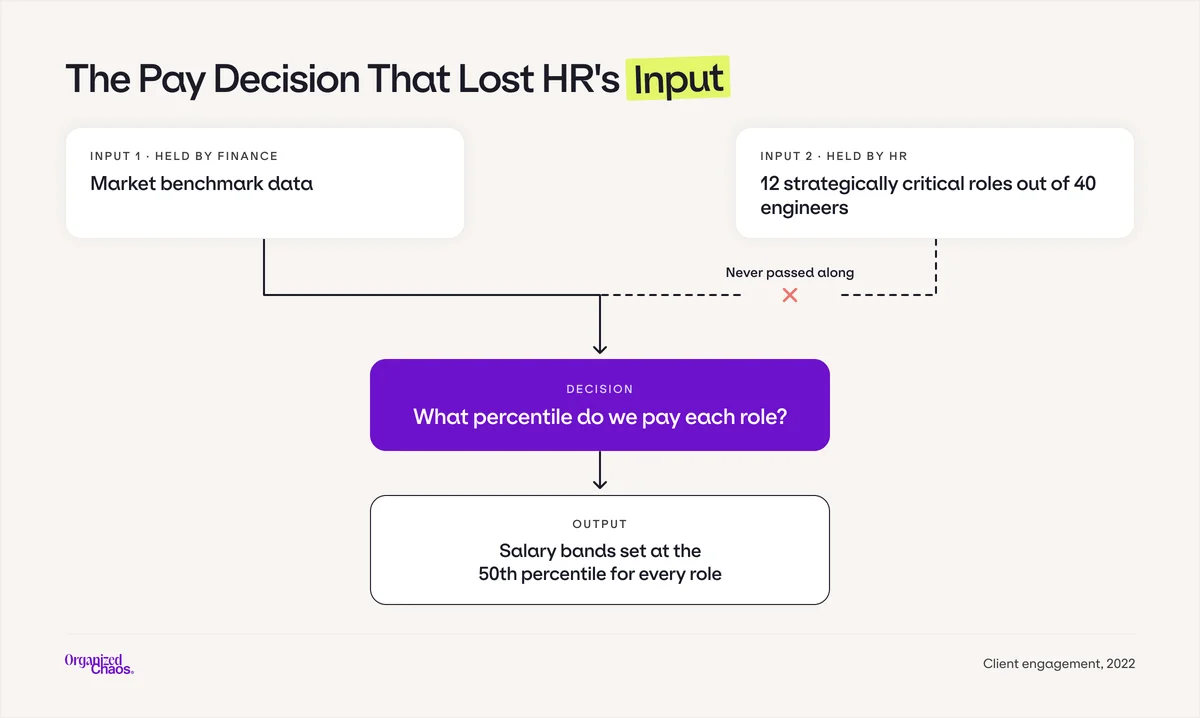
Then, the Finance team decided to use market data to benchmark jobs within the company. They decided to pay the market average (the 50th percentile) and not a penny more, instead of trying to pay above market where needed. Their logic was simple: if you pay market rates, you will attract and retain good talent.
A compensation expert would have questioned that idea right away. Market rates are only one piece of information to consider when setting pay. Where you choose to set pay compared to the market must be a strategic choice. It should depend on how important a role is for adding value to customers or reaching company goals. This business relied heavily on senior backend engineers, specifically system architects. The engineering department had around 40 people. Twenty of them worked on the backend team, and 12 held roles that were considered strategically critical.
No one in Finance knew who those 12 people were. That information existed in HR because the team had designated all the strategic roles in the company, but it was never passed along to the people making the pay decisions.
Within twelve months, the average time to hire someone grew from about 45 days to nearly 70. The time it took for a new hire to get fully up to speed went from 45–60 days to over 90. The company lost 6 employees it wanted to keep, and every single one of them said that they left for a better offer.
At the same time, tech salaries went up fast after the pandemic. Because of this, the company was unable to attract the same level of talent and settled for the best they could afford.
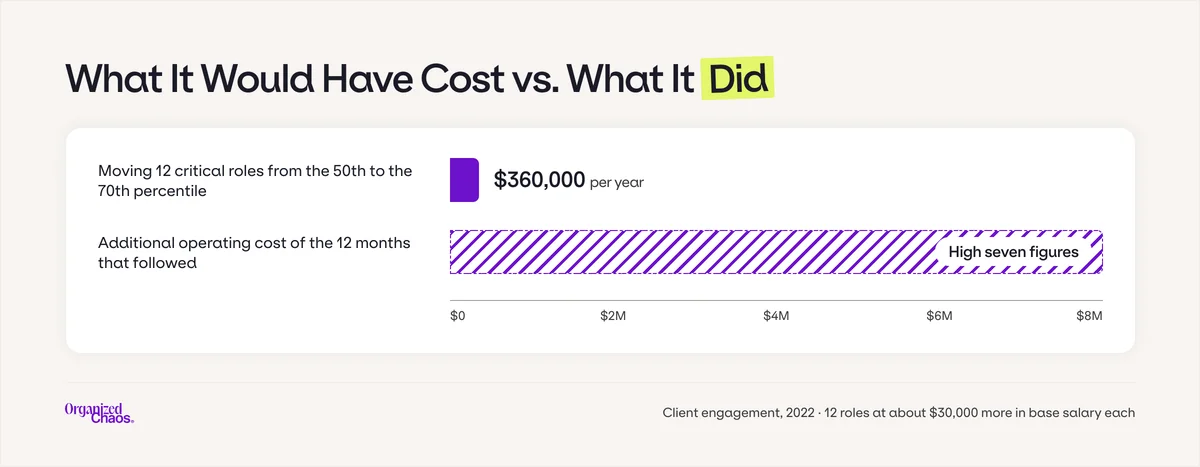
Raising pay for those 12 key roles from the 50th percentile to the 70th percentile would have cost about $30,000 per person in base salary. That comes out to roughly $360,000 a year. I estimate that losing those workers instead cost the company in the high seven figures. That figure includes hiring costs, lost productivity, unfilled job openings, and lower work quality from replacement hires.
Finance wasn't acting unusually. The most recent major survey on this topic showed that 96% of companies set their target pay at the 50th percentile, and only 25% adjust that target for essential roles.
All that happened is that compensation decisions lost a critical piece of information, and that mistake cost the company more than its entire HR budget.
Decisions Change Hands Without Anyone Announcing It
This is the main lesson you should take from Airbnb. It has nothing to do with splitting a department.
Every people decision in your company relies on specific information. Often, the person who has that information is not the person making the final decision. For example, setting pay ranges requires knowing which roles are most critical. Creating headcount plans requires knowing which jobs carry the heaviest workload. Making promotion decisions requires performance details that are documented in your personal notes, not in a manager's memory. In a smaller company, most of this is not written down, but it works anyway because the person with the information is usually involved in some way.
Then the setup changes and no one treats it like a change. A founder signs a job offer over the weekend because the candidate had another deadline. A new VP of Engineering arrives and starts setting job levels on their own. That makes sense to them because it is what they did at their last job. Finance builds next year's hiring plan in a spreadsheet in November and shows it to you in December. A manager has a performance chat with an employee and tells you about it afterward.
In every case, a decision shifted to new hands, either formally or informally. None of these changes were official reorganizations. Yet all of them can cause you to lose key information, just like critics worry will happen at Airbnb.
What to Check This Week
You can do all of these steps in a single afternoon. None of them require any active organizational changes.
- Write down the 5 key people decisions where a mistake can be costly. These typically include pay ranges, team growth plans, promotions, departures, and similar.
- For each decision, identify the decision maker today. Look at who signed off on the last decision, and compare that to what’s documented (i.e., who was supposed to make that decision).
- Write down the information that each decision needs, and check if decision makers have access to it. This is the most important part of the exercise. In the example I shared earlier, my client’s HR team had a list of critical roles with pay strategy recommendations for each, but that information never made it to finance.
- For any decision missing your input, create a document for it and share with the decision maker. A short document listing critical roles saved next to compensation files works better than a recurring meeting. Make the information accessible to decision makers.
- Set reminders for moments when control of decisions shifts. Key triggers include bringing in a new executive, losing a leader, changing software tools, or starting annual budget planning. These are the most common events that lead to decisions changing hands. Run through this check again whenever one of these events happens.
People easily notice changes to the organization chart, which is why team structures get so much attention. However, missing information and leaky processes are what actually cause financial losses, and those gaps can develop without any official org structure changes.
If you want to learn how to design org structures and processes that work well for startups, take a look at the Startup HR Operating System. This is my flagship course, where I teach HR professionals the exact methods I have used at more than 150 growing companies since 2011.