

How to Manage an Underperforming Employee at a Startup
- 18 Aug 2026
- 8 mins

In 2022, I was the VP of HR at a 65-person gaming peripherals company when the CMO called me and said he wanted to fire his Paid Ads Specialist (let’s call her Jennifer).
The problem was that nothing he told me supported his request. Jennifer’s last performance review, from 4 months earlier, was excellent, her peers consistently praised her work, and the CMO had never raised concerns about her work with me or with anyone else. So I kept asking questions.
Before taking any action, you have to determine if an employee is actually underperforming or if they were never given clear guidance. These two situations often look the same when a manager complains, but they require very different responses. When I spoke to Jennifer, she told me she felt like she wasn't being managed; she was just guessing what her manager wanted instead of receiving clear direction.
Why Underperformance Usually Starts With the Manager
In about 6 out of 10 cases where a manager wants to fire an employee, the manager is actually the primary issue. This is my personal estimate from having been in hundreds of these conversations over the years.
These problems usually exist on both sides, but the manager has more influence. They control the direction, standards, feedback, and support that make good work possible. The remaining cases are typically split between employees who aren’t a fit for the role and managers who have no business managing people.
Public data supports this. Gallup found that among employees who quit, only 18% of those who spoke with their manager in their final months said that manager explained what it takes to be effective. Many managers simply aren't defining what "good" looks like.
Many managers are struggling themselves. Gallup’s State of the Global Workplace report showed manager engagement dropped from 27% to 22% by the end of 2025. This 5-point decrease is the sharpest decline ever recorded.
Is it the Employee or the Manager?
Both situations sound identical when they land on your desk. To find the root cause, you have to look past the complaint and audit the management.
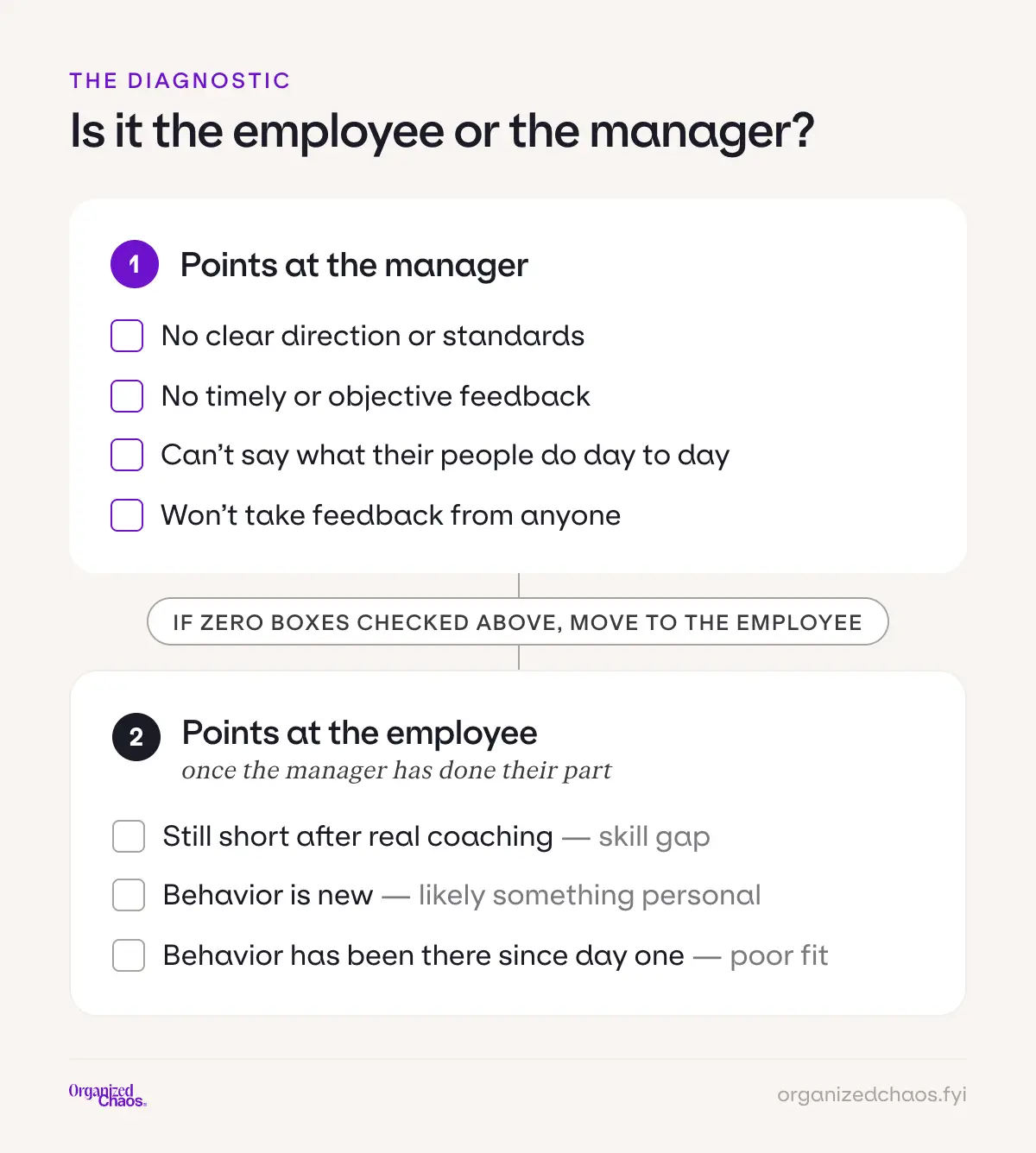
Always run the manager diagnostic first. If even one of the following manager signs is present, then the problem is likely leadership, not the employee.
4 Signs the Manager is the Problem
- No clear standards: The manager hasn’t defined what success looks like for the role or the department.
- Vague or late feedback: Feedback is either non-existent, delayed, or focuses on the person instead of the work.
- Disengagement: The manager can’t explain what their team members actually do day-to-day.
- Defensiveness: The manager refuses to take input or evolve their own approach.
3 Signs the Employee is the Problem
Only move to this list if the manager has provided clear expectations, specific feedback, and active coaching.
- Persistent skill gaps: Performance continues to fall short of the goal even after targeted training and support.
- Sudden behavioral shifts: New issues with attitude or reliability often point to outside factors needing a human conversation.
- Chronic poor fit: Issues present since day one are usually hiring mistakes that cannot be coached away.
The Manager Fix
The CMO’s situation had a positive end. I met with him to walk him through the gap between his expectations and Jennifer’s understanding. I coached him on setting clear standards and supporting her growth.
Within 60 days, he completely changed his mind about her. She was eventually promoted twice, under the same CMO, and now leads her own team at the same company, 4 years later.
Success depends on how you deliver feedback. Stick to the facts. Separate the person from their performance in the role. Tell the manager what to do differently and define the support you will provide. With the CMO, I started with the root cause and tied it to his specific actions before moving to the solution.
You may feel hesitant to coach senior executives. Use documented evidence to make your case. When I see a pattern, I attach research on what that behavior costs the business. CEOs listen when you connect the problem directly to business results.
Some managers refuse to change and won’t take your coaching. In 2023, at a SaaS company where I was the acting fractional Chief People Officer, the CTO came to me wanting to put one of his employees on a performance improvement plan (PIP). He had never told that person their work was falling short, had never coached them, and had never provided any support beyond assigning them work. He also had a "sink-or-swim" reputation and the highest turnover in the company.
I refused to write the PIP, because the facts pointed at a manager who lacked the fundamentals of people management rather than at an employee who couldn't do the job. He was convinced that his way was the right way and that a startup has no time to onboard, coach or support anyone, and he wouldn't entertain trying something different even as an experiment. Eventually, the company ended his employment within 45 days.
When the manager is the founder, you have more reason to speak up because the problem is no longer contained within one team. The method doesn't change. Work with them privately, come across as a coach and an advisor rather than someone attacking them, give them guidance, then track the progress and adjust.
Back in 2017 I told the founder of a luxury goods company that he was holding his company back, and that he should hire a CEO in his place and move himself to another part of the business. This was a founder who was micromanaging their team into the ground. He was outraged and yelled at me that day, as I expected he would. But 6 months later, he called and said he was willing to give it a try, and the CEO who came in helped the company triple its revenue in 2 years and take the business global. Some founders refuse to change, believing their past success justifies their current approach, and you’ll have to accept that and move on. Others are open to feedback and willing to grow.
The Employee Fix, and When to Stop
I used to believe the common HR philosophy that any employee can succeed given the right conditions, and that underperformance is always the manager's fault. I no longer believe that is universally true. Sometimes, employees lack the skills for the job, refuse to perform as expected, or are staying primarily for the pay and flexibility.
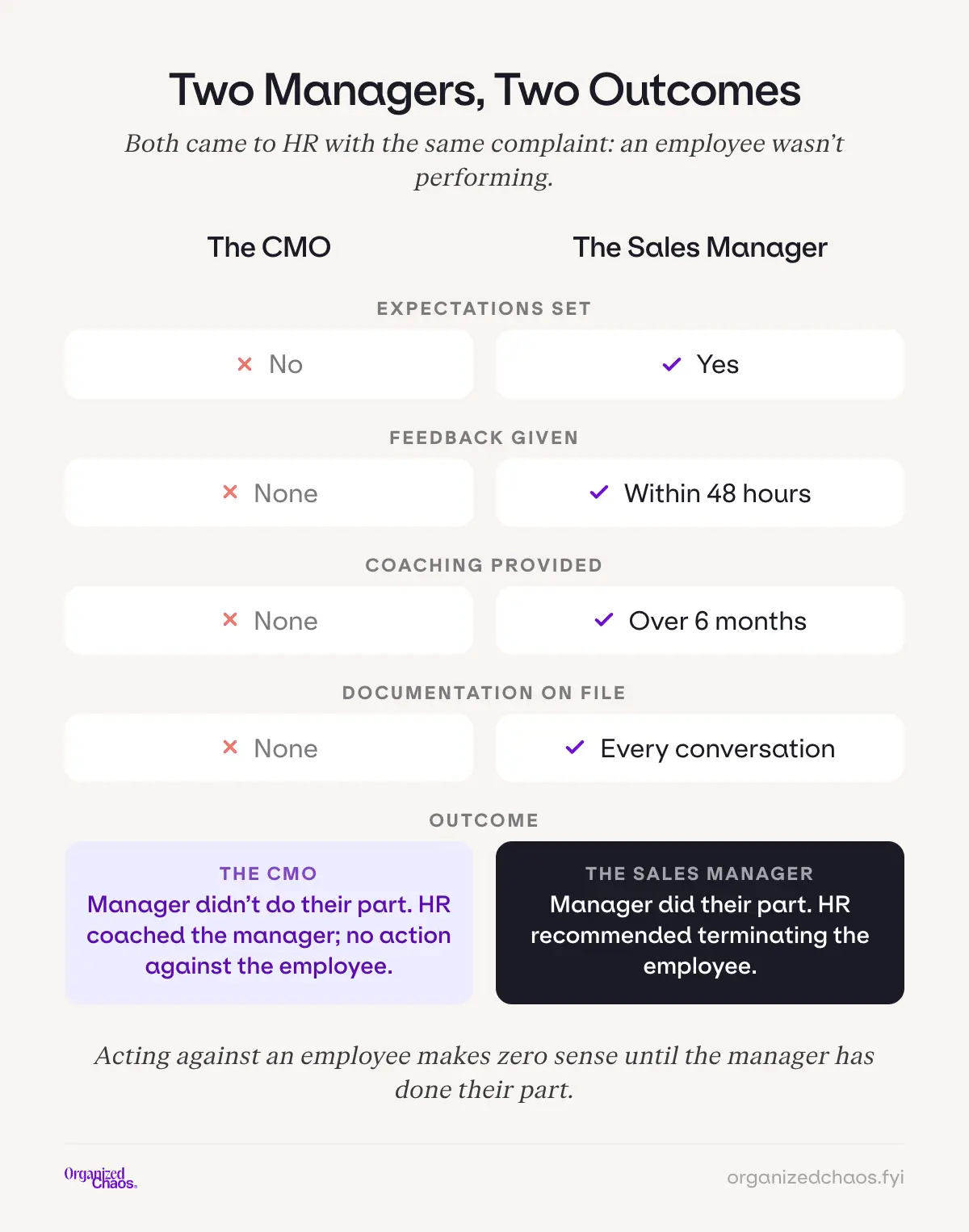
Recently, a Sales Manager asked for help regarding a sales representative. He had done everything right over the previous six months:
- Expectations: He was explicit about performance standards and role expectations from day one.
- Feedback: He provided specific feedback within 48 hours of each incident, supported by concrete examples.
- Coaching: He ran multiple coaching sessions with this individual to help them improve.
- Documentation: He documented every conversation and emailed a summary to the rep afterward.
- Support: He provided the support he promised, including regular check-ins on sales calls and after-sales follow-up.
Despite this, the sales representative only improved slightly and failed to meet the critical requirements of the role. I recommended termination rather than a PIP. The performance gaps were too wide to bridge, so putting the employee on a PIP when the outcome is already clear is dishonest to the employee and a waste of everyone’s time.
What This Costs the Company
Every month an underperformance case sits unresolved, you are burning cash on partial output. In a 65-person startup, this hits your burn rate hard.
Look at the CMO’s situation: because he never clarified what the job required, the company paid a full salary for a fraction of the output for months. He had an employee who was guessing what he wanted instead of doing her job.
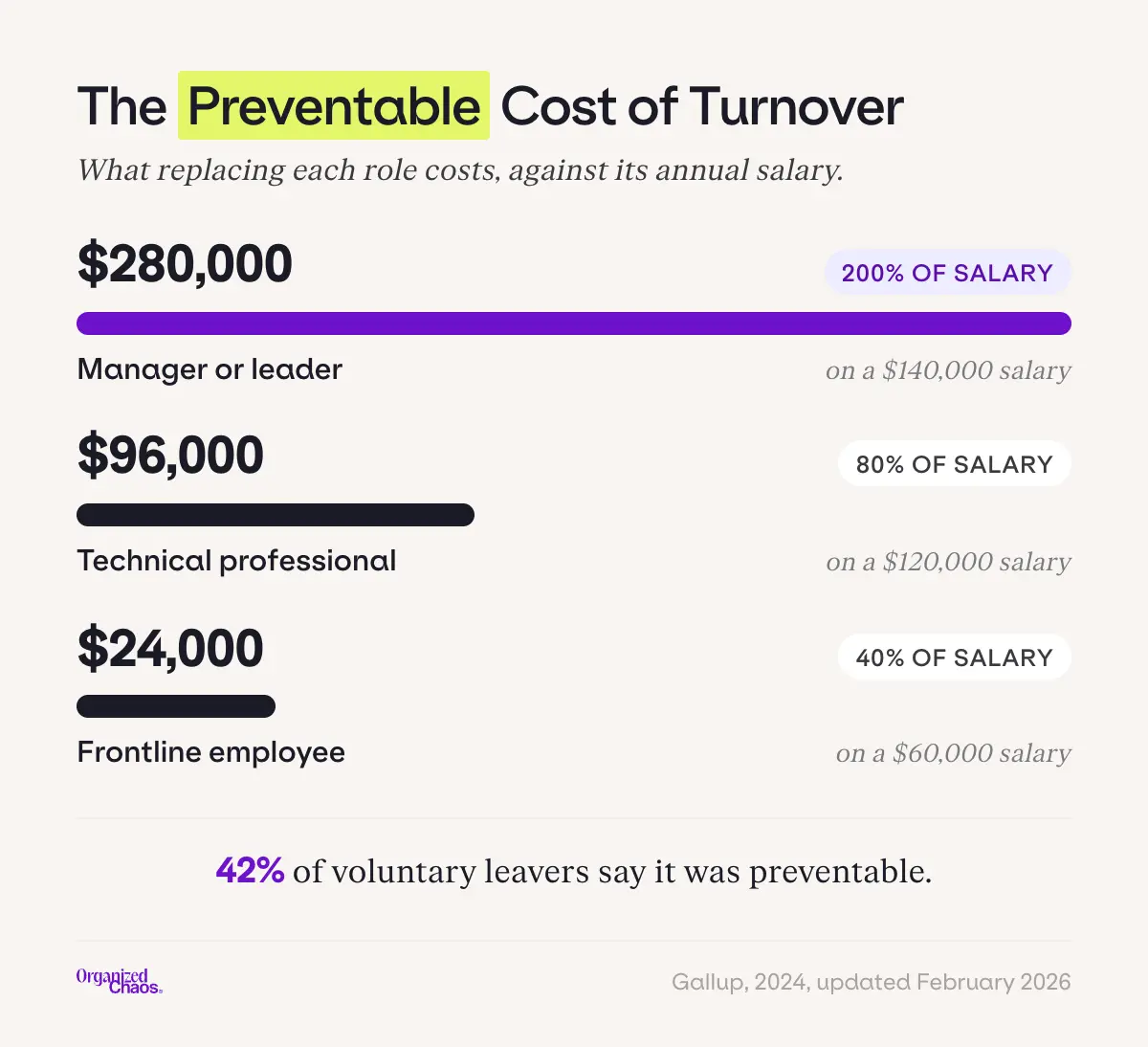
Then there is the cost of turnover. Gallup estimates that replacing a manager costs 200% of their salary, a technical professional 80%, and a frontline employee 40%. Research shows 42% of voluntary departures were preventable, and 45% of employees received no proactive management in their final three months. You are paying high replacement costs for exits that a simple conversation could have prevented.
Accountability often fails higher up the chain. Gallup found that only 30% of managers say their own leaders hold them to high performance standards. However, those who do feel held accountable are three times more likely to be engaged (51% vs 17%). Before you blame a manager for not setting a standard, check if anyone above them ever set one for them.
These costs are invisible in a board meeting, but they accumulate: missed quarters, bloated hiring plans to cover for underperformance, and cash wasted replacing people who would have stayed. At a startup, where every role is critical, this inefficiency is the difference between a company that grows and one that stalls out and runs out of money.
Your 7-Step Sequence
Here's the sequence I run, from the first conversation through to a recommendation.
- Investigate the origin. Ask what led to this request. Get specific examples and a clear timeline to determine if you are dealing with a one-time incident or a long-term pattern.
- Audit previous management actions. Find out exactly what the manager has already done. Have they raised the issue with the employee? What did they say, what changed afterward, and what support was provided?
- Review documentation and witnesses. Collect all documented evidence that supports the underperformance. For verbal incidents or misconduct, interview anyone else who witnessed the behavior to get an objective view.
- Provide an immediate preliminary view. Tell the manager in which direction you’re leaning and specify what information you still need. Waiting a week to speak makes it look like you are avoiding a difficult decision.
- Apply the diagnostic. Score the situation against the 4 manager signs and 3 employee signs. If even one manager sign is present, you should address leadership issues first.
- Choose your path. If you’re terminating, coordinate the timing and talking points with the manager and attend the call. If you’re coaching, explain your reasoning, guide the manager through a feedback session, and set a firm date to reassess progress.
- Document in the personnel file. Regardless of the outcome, document every step in the personnel files for both the manager and the employee. Maintain your own detailed notes throughout the process.
This approach relies on a strong performance system; one where you have clear standards, regular feedback, and everyone knows exactly how they are measured. I covered how to set that up in build a performance review system your team trusts.