
Redeploy, Reduce, or Reinvest: What Startups Should Do With AI Productivity Gains
- 02 Jun 2026
- 6 mins

Over the last 6 months, I’ve had many workforce planning conversations with founders who are all gravitating towards the idea that AI is making the team faster, so that means they can reduce their headcount. We’re all seeing the headlines. Not a week goes by without a massive layoff headline that is attributed to AI. But these headlines are somewhat misleading.
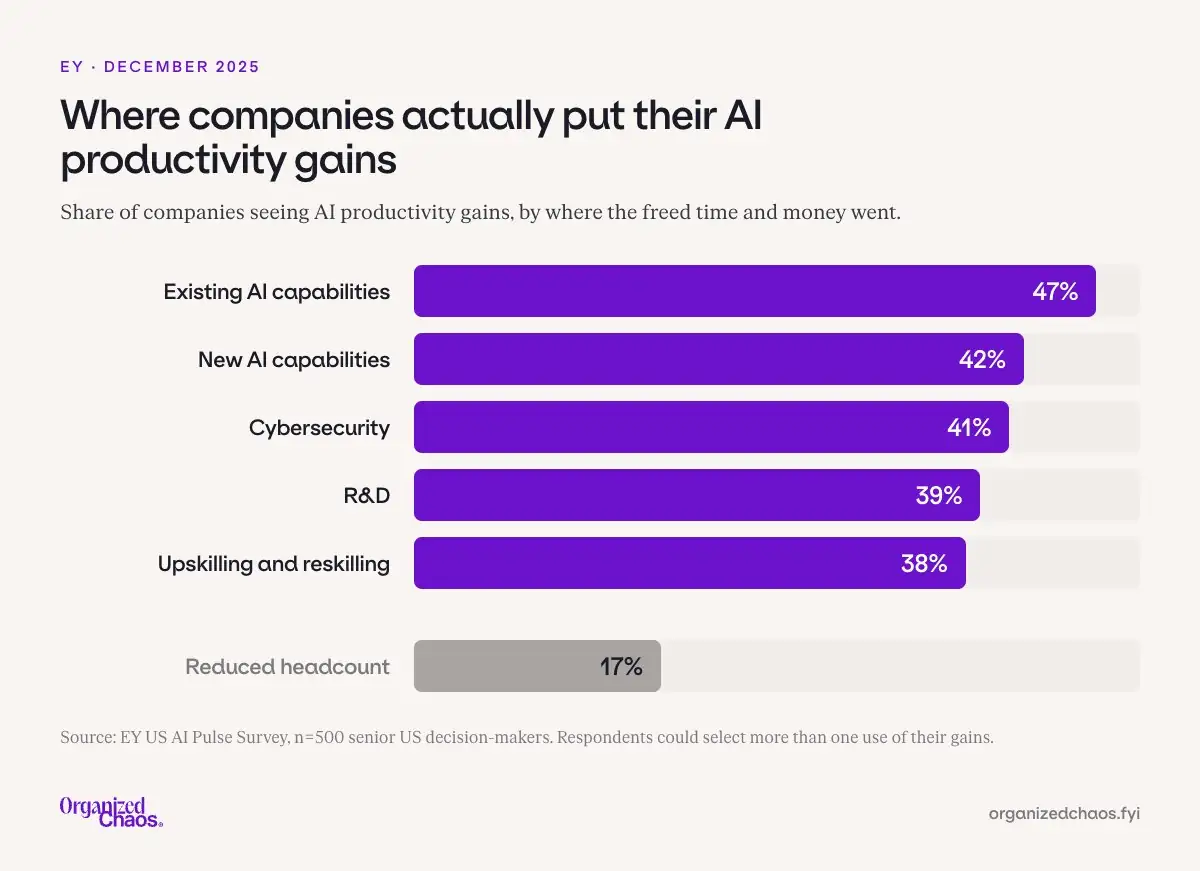
EY's December 2025 survey of 500 senior US decision-makers found that only 17% of companies experiencing AI productivity gains used those gains to reduce headcount. The other 83% put the savings into existing AI capabilities (47%), new AI work (42%), cybersecurity (41%), R&D (39%), and upskilling (38%). Gartner predicts that 50% of companies which cut customer service staff for AI will rehire by 2027 under different job titles, and Gartner's own February 2026 survey shows only 20% of customer service leaders reduced headcount due to AI in the first place.
The headcount cut is the easiest call to make but one of the most expensive to reverse. If your team just hit a 20% productivity bump with Claude, this piece gives you the framework for what to do next.
The 3 Options On the Table
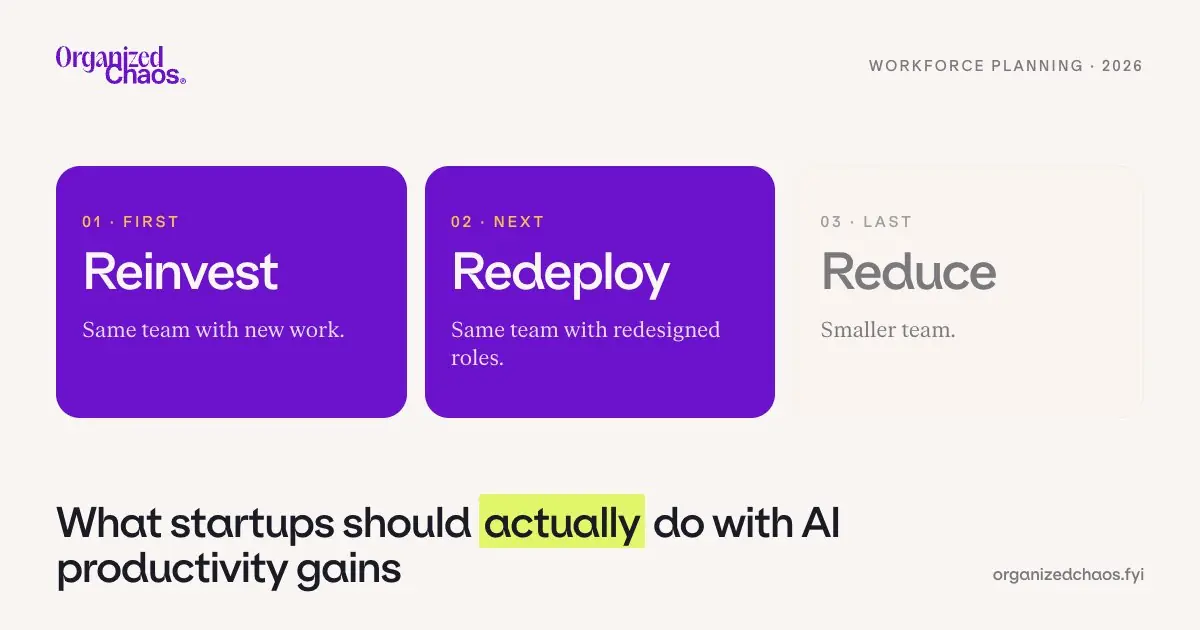
- Reinvest. Keep your headcount unchanged and direct the freed time into work that was not feasible before the productivity gain. That work can be a new product, a platform reliability push, or faster customer iteration cycles. This is what 47% of EY respondents are doing.
- Redeploy. Keep the people and change what they do. For example, you can move customer support hours into expanding customer success, or you can move junior engineering time off maintenance work and onto greenfield builds. This is the bucket Gartner calls Reposition, and it is the prevailing option inside consulting, technology, and professional services firms.
- Reduce. Cut roles when 3 conditions are met: the function genuinely shrinks rather than speeds up, the productivity gain has held for at least 6 months with clear and measurable outputs, and the savings account for the rehire round-trip cost (i.e., you end up hiring the position back later).
This is the order that I recommend you follow. If you flip that order, then you’re likely adding a reversal cost into your runway because you’ll likely need to rehire some of these roles in the near future.
5 Questions Before Any AI-driven Headcount Cut
Here are 5 questions I want you to ask leadership, hiring managers, and anyone involved in making headcount decisions before any role gets eliminated because of AI.
- Is the productivity gain real or self-reported? A 6,000-executive survey reported by Tom's Hardware showed that 80% of companies have seen no organizational productivity gains from AI despite billions invested. The median executive in that survey uses AI tools for only 90 minutes a week. Demand evidence in the form of measurable output such as closed deals or resolved tickets, because you shouldn’t be making these decisions based on anecdotes.
- Is the role shrinking or just speeding up? A senior engineer who codes 30% faster with AI still does code review, mentoring, and judgment work. A customer service rep that is resolving 40% of tickets with AI still handles the hardest 20% that drive your customer retention. Faster hours inside a role do not always equal fewer FTEs.
- What is the rehire round-trip cost if you reverse course? A reversal costs you severance, recruiting fees, the productivity gap during the vacancy period, ramp-up time on the new hire, and the culture impact on the staff who witnessed the cuts.
- Where will those hours actually go? If you can't specify the work that will use them, then the team will fill the time with whatever shows up in their inbox.
- What does the 24-month plan look like under each option? Model your headcount and burn rate in 3 ways: cut now, redeploy now, and reinvest now. Make sure to include the rehire risk in your cut now scenario. Bring the model to your next leadership meeting before you cut any roles.
Practical Example: 100-person Series B Engineering Team
Take a 100-person Series B startup with a 30-person engineering team. Each engineer costs $300,000 fully loaded, which puts total engineering payroll at $9M annually. Let’s assume that the AI tools they’re using deliver a verified 20% productivity gain on output. The founder has 3 options:
- Cut 6 engineers (20%). On paper, that move saves $1.8M annually. Apply a 35% rehire probability over 18 months at an average $120,000 round-trip cost per reversal, and the expected reversal cost ends up at roughly $252,000. If you add retention damage on the surviving 24 engineers, which typically shows up as 2 to 4 voluntary attrition events in the following 12 months at another $120,000 each, then the realistic net savings probably come in at $1.1M to $1.3M. The hidden (and bigger) cost shows up in the 2027 senior talent market, which tightens every quarter due to the decrease in hiring and training of junior talent.
- Redeploy the equivalent of 6 engineers' worth of time. Deploy the freed 20% of engineering capacity onto new work, like platform reliability push or a new product. Headcount stays at 30 at $9M annually. Let’s say that new work ships in 6 to 9 months. At a 7% incremental ARR contribution on a $20M ARR base, that move generates $1.4M in year one alone. The Reduce option is only better if the redeployed work generates less than $252,000 in value.
- Reinvest the time into faster roadmap velocity. Keep all 30 engineers and accept the productivity gain as faster shipping on the current roadmap. The cash runway stays the same, but gains in pipeline acceleration show up in shorter sales cycles, faster delivery against commitments, and lower churn from quicker bug response. This scenario is the hardest to model with precision, but if the company has a competent team, it rarely comes in worse than break-even against the Reduce path.
The Reduce option wins only when the productivity gain has held for 6 months across the entire team or your runway pressure is severe enough that you cannot wait for Redeploy or Reinvest revenue to materialize.
Action Items for This Quarter
If you are scaling between 20 and 500 employees, here is what I recommend:
- Audit AI tool adoption inside your team this month. Define one metric per function that proves the gain is real, whether that is shipped PRs, closed tickets, deals worked, or copy produced. If you cannot name the metric, treat the gain as unproven and do not act on it.
- Run the 5-question test on every role currently flagged for elimination. If any question returns "I do not know," delay the cut by 60 days while you get the answer.
- Build a 24-month workforce model with three columns: Reduce, Redeploy, Reinvest. Cost out the rehire round-trip in the Reduce column. Bring it to your next board meeting.
- If you lead HR solo at a startup, get this framework in front of your CEO this week. You want to be proactive with this conversation and guide your CEO’s headcount decisions with data.
Many founders assume that an AI productivity gain automatically translates to a headcount reduction. I ask you to treat it as a decision worth modeling, similar to the example I shared above. The financial loss from a premature and hasty layoff costs more than the short-term savings it generates.