
Should Startups Hire Junior Engineers in 2026?
- 26 May 2026
- 10 mins

Over the last few months, I have heard a version of the same sentence from at least a dozen founders and c-suite executives:
“We’re only hiring seniors now because AI does the work that juniors used to do.”
Most of these folks sound proud when they say it, and their boards are nodding along because it looks cheaper on financial statements. That’s true in the short run. But I’ll argue that will not be the case 3 years down the line.
In this edition, I want to walk through the data that founders and executives are quoting, the data they are not quoting, and the framework I use with clients to decide whether the next role on the org chart should be a junior, a mid-level, or a senior. As always, my argument is operational and grounded in facts rather than ideological, and the numbers I’ll reference come from the same sources that CFOs pay attention to.

The Math Founders are Running
The folks who are preaching this “no junior hires” movement are using a similar argument. A junior software engineer in the US earns roughly $70,000 to $100,000 in base salary, and the fully loaded cost lands somewhere between $90,000 and $130,000 in year one. A senior engineer mentoring that junior spends an estimated 20 to 30% of their week on code review, pairing, and unblocking, and at at a senior base of roughly $190,000, the fully loaded cost runs $240,000 to $265,000 once you add the standard 1.25 to 1.4 times multiplier for benefits, taxes, and overhead. That mentorship time has a real dollar value which adds to the true cost of the junior hire.
On the other end, AI coding tools now handle most of the work juniors used to be hired to do. Hackernoon argued in late 2025 that AI has hit cost parity with junior developers, and the productivity data backs the claim to some extent. Google has reported that 25% of its internal code is AI-generated, Microsoft has reported around 30%, and a Redwood Research analysis put the broader committed-code number near 50%. Boilerplate, unit tests, CRUD endpoints, and documentation are the categories where AI is strongest, and those categories overlap heavily with what juniors used to do in their first year.
These inputs makes sense if your time horizon is the next 12 months. AWS CEO Matt Garman recently called the strategy of replacing junior employees with AI "one of the dumbest things" he had heard, and he gave 3 reasons:
- Junior employees are usually the most fluent with AI tools, which makes them more useful.
- Junior salaries are the smallest line item on the engineering budget, so cutting them does not produce serious savings.
- Most importantly, if you stop hiring juniors today, your talent pipeline will collapse in a few years.
What the Junior Hiring Data Shows
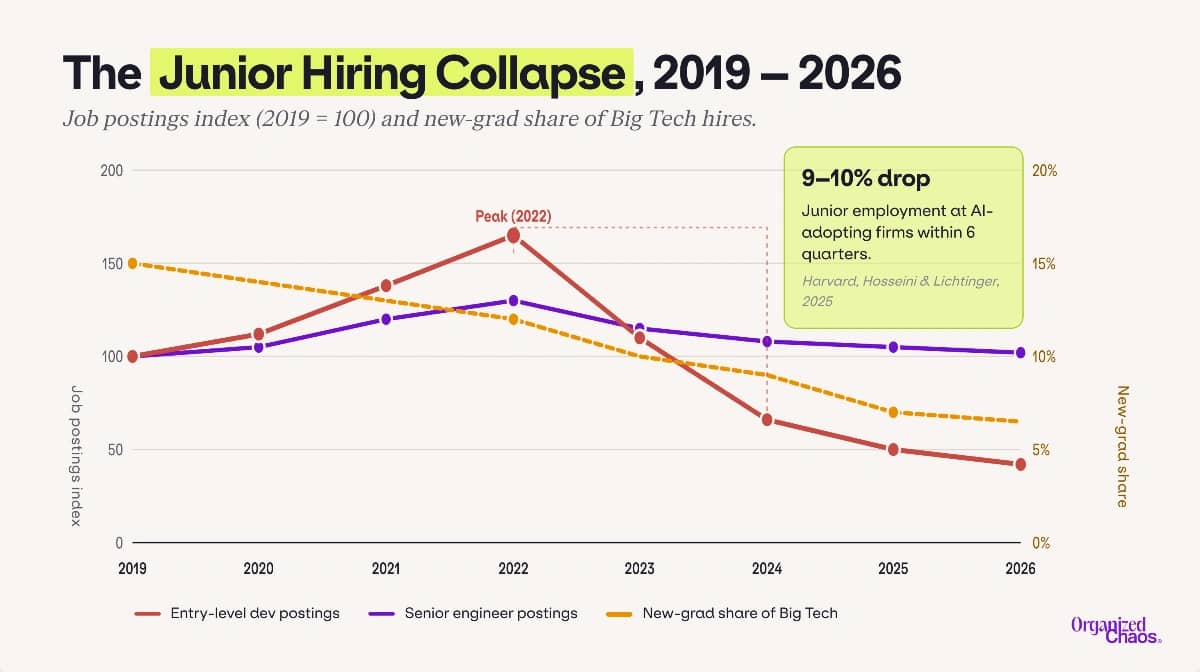
The decline in junior hiring is sharper than most founders realize, and there is strong evidence from academic and labor-market data. A Harvard study by Hosseini and Lichtinger that tracked 62 million workers across 285,000 US firms between 2015 and 2025 found that companies adopting generative AI saw junior employment decline by 9 to 10% within 6 quarters while senior employment kept rising. The decline was concentrated in AI-exposed occupations and was driven by slower hiring rather than layoffs.
The labor-market data lines up with the academic finding. Job postings for entry-level developers dropped 60% between 2022 and 2024, and new grads represented only 7% of hires at large tech companies in 2025, which is a 78% reduction from 2019 levels. Employment specifically for software developers aged 22 to 25 has fallen 13% since late 2022, according to Stanford Digital Economy Lab analysis of ADP payroll data. CS graduate unemployment now sits at 6.1%, which is one of the highest rates of any major in the US.
The data point that usually gets buried is who actually uses AI most. The 2025 Stack Overflow Developer Survey found that 55.5% of early-career developers report using AI tools daily, which is the highest daily-usage rate of any experience band. Senior developers report lower daily usage. If you are cutting the cohort that uses AI most fluently because AI is your reason for cutting them, then you have a contradiction in your hiring strategy.
What AI productivity Data Says About Cutting Juniors
Morgan Stanley research published in late 2025 shows companies adopting AI reporting an 11.5% productivity gain and a 4% net headcount decline over the past 12 months. Productivity is rising at roughly 3 times the pace of headcount reduction, and that is one of the reasons why founders and executives are obsessed with the senior-only hiring strategy.
EY's December 2025 survey of large employers found that only 17% of organizations are using AI productivity gains to cut headcount. 47% are investing in expanding existing AI capabilities, and 42% are building new ones. Most of these companies aren't cutting jobs. It's easy to get fooled by the Meta, Amazon, and Oracle headlines. Those companies are laying off people to fund massive AI spending. They sit inside the 17%.
But then you have the regret data. Orgvue surveyed 1,000 C-suite executives at large US and UK employers and found that 39% had made employees redundant because of AI. Of those, 55% said they regretted the decision. The top regrets were lost institutional knowledge, damaged morale, and product quality issues that surfaced after the cuts.
There is a counter-example worth studying. Egnyte kept hiring junior engineers through the AI shift and uses AI to accelerate their ramp-up, with the company reporting that new hires reach independent contribution faster than the historical baseline because AI handles the rote work that used to occupy a junior's first few months. Now, AI does the boilerplate work while the junior focuses on judgment and ownership. This allows the senior to get back some of the mentorship time that the prevailing argument counts against the junior in the first place.
The 2027 and 2028 Senior Shortage that is Coming
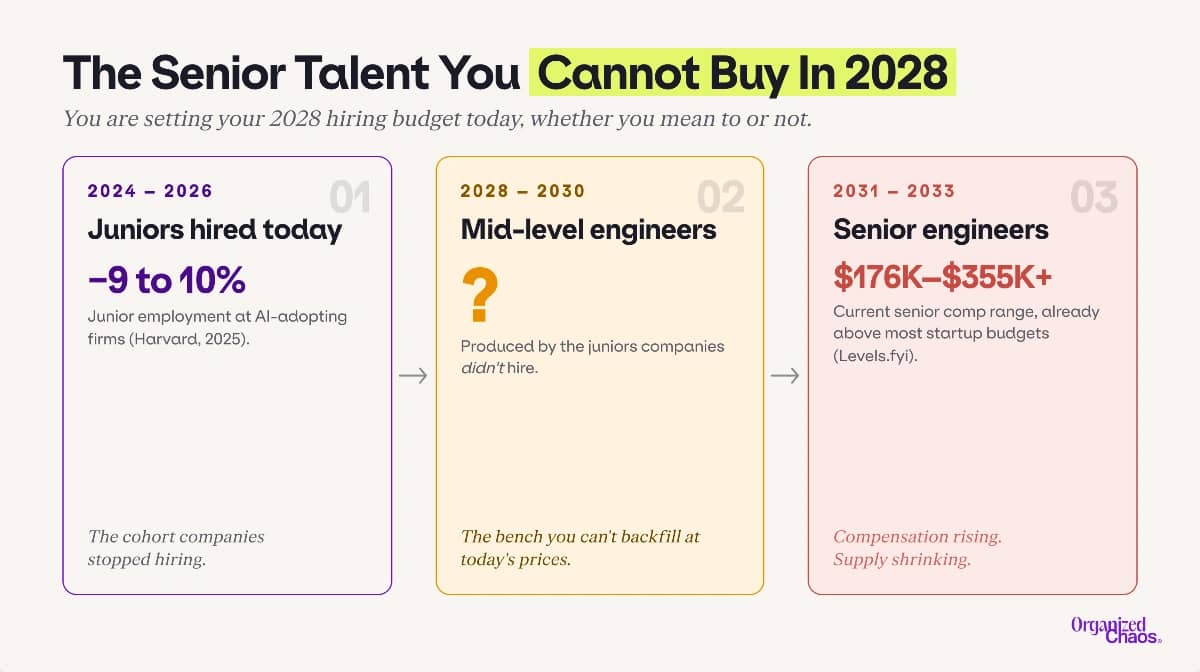
Every senior engineer started as a junior, and the journey usually takes 4 to 7 years. If you're cutting juniors today, you're also betting that mid-level talent will sit there next year at today's prices.
Median job tenure at startups runs about 2 years, according to Carta's analysis of its anonymized employee database. Engineering teams skew somewhat longer than the median, but turnover is still highest in the first 2 years, and roughly half of all startup employees are no longer at the company after 3 years. An all-senior engineering bench turns over every 24 to 36 months, and every time a better-funded competitor poaches one of yours, you're stuck with a vacancy. The mid-level talent that used to backfill those seats at a reasonable price won’t be there to save you. Senior software engineer compensation in the US currently ranges from roughly $176,000 to $355,000 on the Levels.fyi data, which is already higher than budgets I see in most startup hiring plans.
The other piece is the cost of the senior team that you cannot retain over time. I broke down a similar dynamic in the Atlassian newsletter, where the company cut 1,600 jobs despite 23% revenue growth and the root cause was a compensation structure that had drifted out of alignment with the workforce plan. Companies that build their org chart entirely around senior talent inherit two problems:
- Compensation inflates faster than revenue.
- The people doing the work see no upward mobility because the bench above them is fully staffed.
The senior-only org you are building today produces a compensation problem you will inherit in 2027 and a hiring problem you will inherit in 2028, and both problems are easier to prevent than to solve.
The Hidden Cost of "No Juniors"
I have led HR for 150+ startups and small-to-medium businesses since 2011, and the founders who freeze junior hiring usually believe they're buying focus and runway. But that’s not what the operating data says.
The senior engineers absorb the work juniors would have done, which means they spend roughly 15 to 20% more of their week on tasks that sit below their pay grade. Code review of automated tests, on-call rotations, internal tooling maintenance, postmortems, and runbook updates all still exist even when AI handles more of the writing. Boredom is one of the leading causes of senior attrition, and the fastest way to lose your best engineer is to give them a job that contains things they were doing 5 years ago.
This type of cost shows up in attrition, in lost institutional memory, and in the velocity hits. You will not see this if you look at a P&L statement, so it floats under the radar.
A 4-question Test to Run Before Your Next Requisition
Run every open role through these 4 questions and document the answers.
- Does AI genuinely remove the junior task set for this role, or does it speed up tasks that still require human judgment? Front-end work, simple CRUD endpoints, and documentation are mostly automated. Anything involving judgment about user experience, data integrity, or trade-off decisions still benefits from a learner sitting next to a senior.
- Do you have senior bandwidth for mentorship in the next 6 months, and have you priced it as an investment rather than a tax? If your seniors are already running at 110% capacity, hiring a junior right now is irresponsible. If they have 5 to 10% slack and would actually be more engaged with someone to teach, you are buying retention and pipeline at the same time. Price the mentorship at 15% of senior time and track ROI over a 24-month period.
- What is your 24-month senior acquisition cost projection at current market trajectory? Pull your last 12 months of senior offers, look at the trend line on accepted compensation and recruiter fees, apply a conservative inflation assumption, and compare that to the year-one cost of hiring and developing a junior into a mid-level. Most companies have never done this exercise. My Skills-Based Hiring for Startups podcast episode walks through the assessment framework I use to evaluate junior candidates on skills rather than years of experience, which makes this calculation more relevant.
- What is your retention math on both options? Juniors who get good mentorship at startups tend to stay long enough to grow into mid-level and senior roles internally. Senior hires at well-funded startups churn closer to the 2-year median. Building a team that lasts requires a deliberate junior pipeline, and the retention data backs that up. My podcast episode on the 50-employee wall covers the structural break points where this retention issue starts to bite.
If you can answer all four questions and the spreadsheet still says senior-only, hire the senior. The point is to make the decision on real numbers rather than on narrative.
What to Do This Quarter
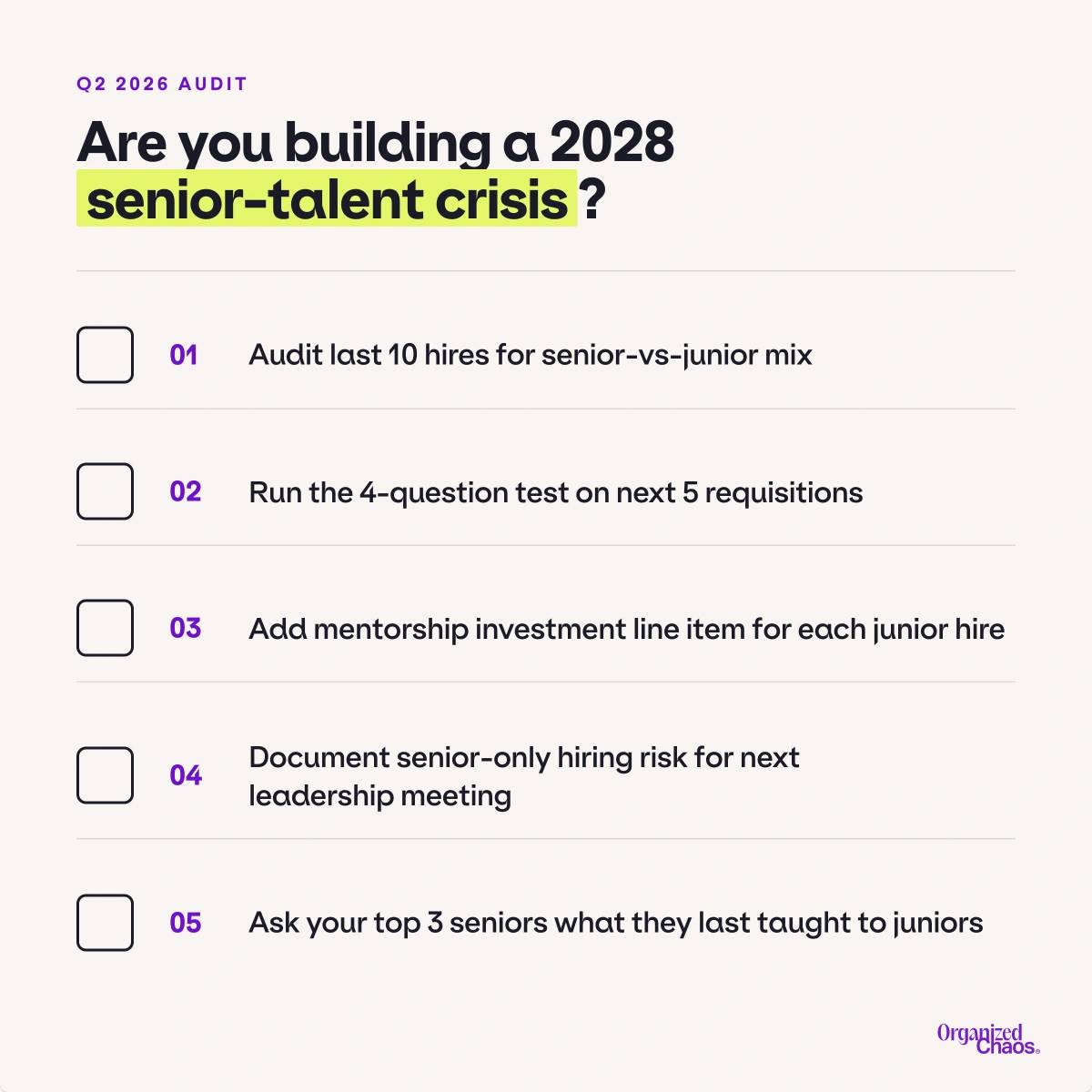
Here are 5 concrete actions, in order of priority.
- Audit your last 10 hires and count how many were senior, calculate the all-in cost, and pull the year-over-year trend on senior compensation. Write the result on one page and put it in front of your CEO and your board.
- Run the 4-question test on your next 5 open requisitions and document the answers. If a role gets approved as senior-only, write the rationale down so you can revisit it in 12 months.
- Add a mentorship investment line item when you’re calculated fully loaded cost for any junior hire. Assign a named senior, block 5 hours per week on their calendar, and treat it as a real investment rather than something a senior will figure out on top of their normal load.
- Document the senior-talent acquisition risk in your next leadership update if you decide not to hire any juniors this year. This is a real risk, and documenting it forces a conversation with your leadership team before it evolves into a talent crisis over time.
- Ask your top 3 senior engineers about the last time they taught a junior something they were proud to teach. If they can't answer, you have an attrition problem coming in the next 2 quarters.
Closing
The dominant founder position on junior hiring in 2026 makes sense in the short term, but is expensive in the long term. The AI productivity gains and the cost parity with juniors are real, and I’ve seen them firsthand. The senior shortage you're creating for 2028 is also real, and it will cost more than the juniors you’re skipping over today.
If you want a second set of eyes on your hiring plan before your next leadership or board meeting, I run a free HR diagnostic call exclusively for newsletter subscribers. Bring your senior-only assumption and we'll pressure-test it against the framework in this piece, or bring whatever other HR problem is on your plate.