
How to Vet a Startup HR Job Before You Accept
- 07 Jul 2026
- 5 mins

Ryan Breslow, Bolt's CEO, went on stage at a tech conference recently and said he'd fired his entire HR team for "creating problems that didn't exist." The clip traveled, and it reopened the old argument over whether startups need HR at all.
I read that story from the side of the table you're on. Underneath a CEO blaming HR in public, you'll usually find a role that was scoped to fail from the day it was written: wrong level, wrong mandate, or wrong reporting line, and then the person in the seat carries the blame for a gap they were never resourced to close.
I wrote about the founder's version of this decision, whether and when to make the first HR hire, in a recent article. This piece is for the HR person who might take the job. Here's how to tell whether a startup actually needs you, and how to avoid walking into the role that gets scapegoated.
Is the Company Ready for You, or Just Nervous?
There's a real difference between a company that needs HR and a company that thinks it should have HR because it just raised an investment round.
The four signals a founder should be watching: senior time lost to people issues, an imminent scaling wave, a rising multi-state risk surface, and pay decisions that have stopped holding together, are the same four you should be testing for in the interview.
So when you ask "why now, and why this role," listen closely to the answer. "We're at 50 people and figured it's time" is a vanity hire waiting to happen, and that founder will lose interest in HR within a quarter. "We've got people in six states, two managers in over their heads, and a comp structure I can't defend anymore" is a company that needs you and knows why, and that founder will back you when tough decisions need to be made. The difference between those two answers is the difference between a job and a trap.
Read the Role Before You Accept It
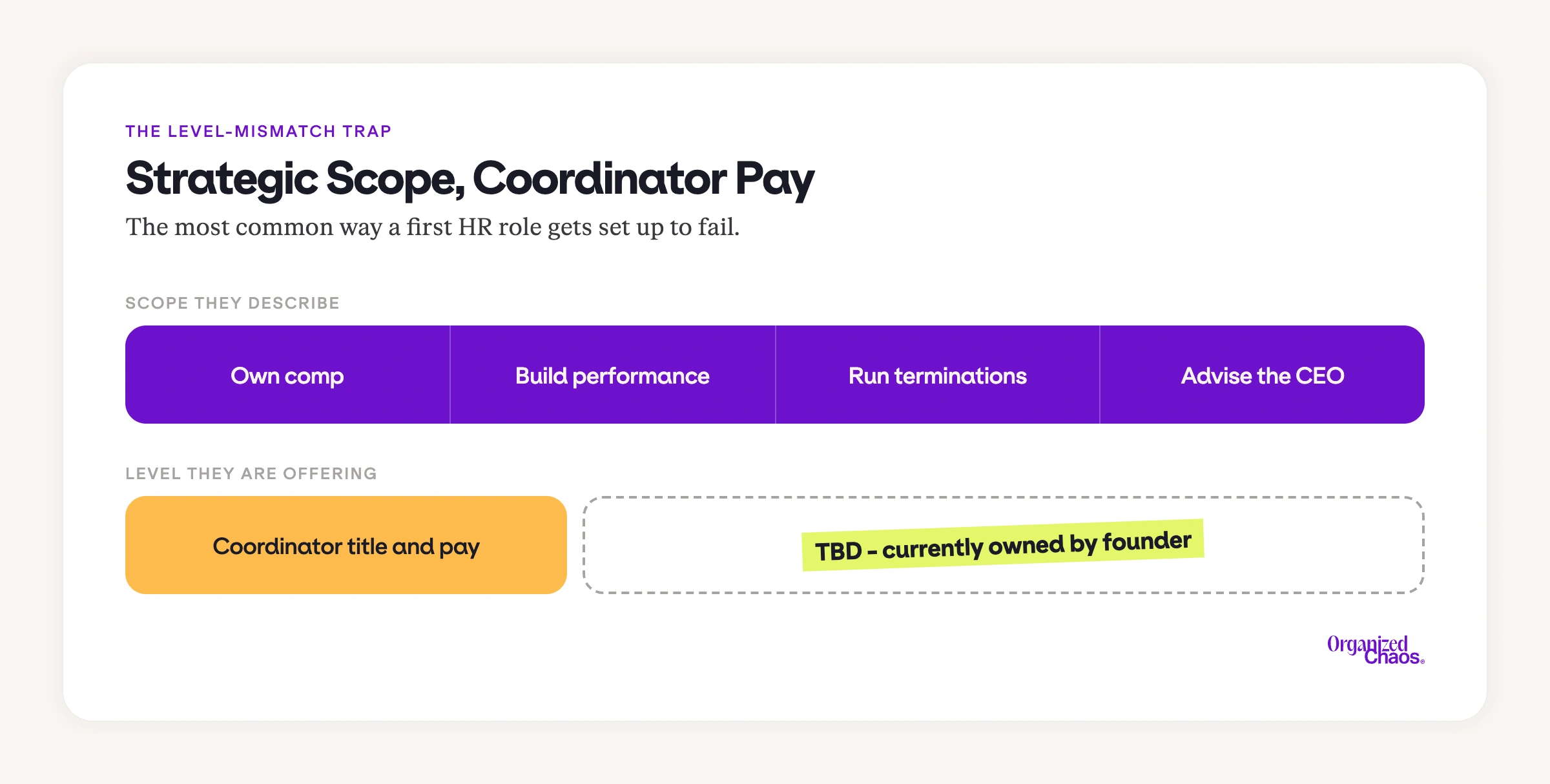
The most common trap is a level mismatch. Founders routinely scope an HR coordinator's title and salary for a job that needs a leader's judgment, and then they wonder why the HR systems and infrastructure never get built. If they're describing strategic work, owning comp, building the performance process, handling terminations, advising the CEO, while offering coordinator pay and a coordinator title, then address this during the interview.
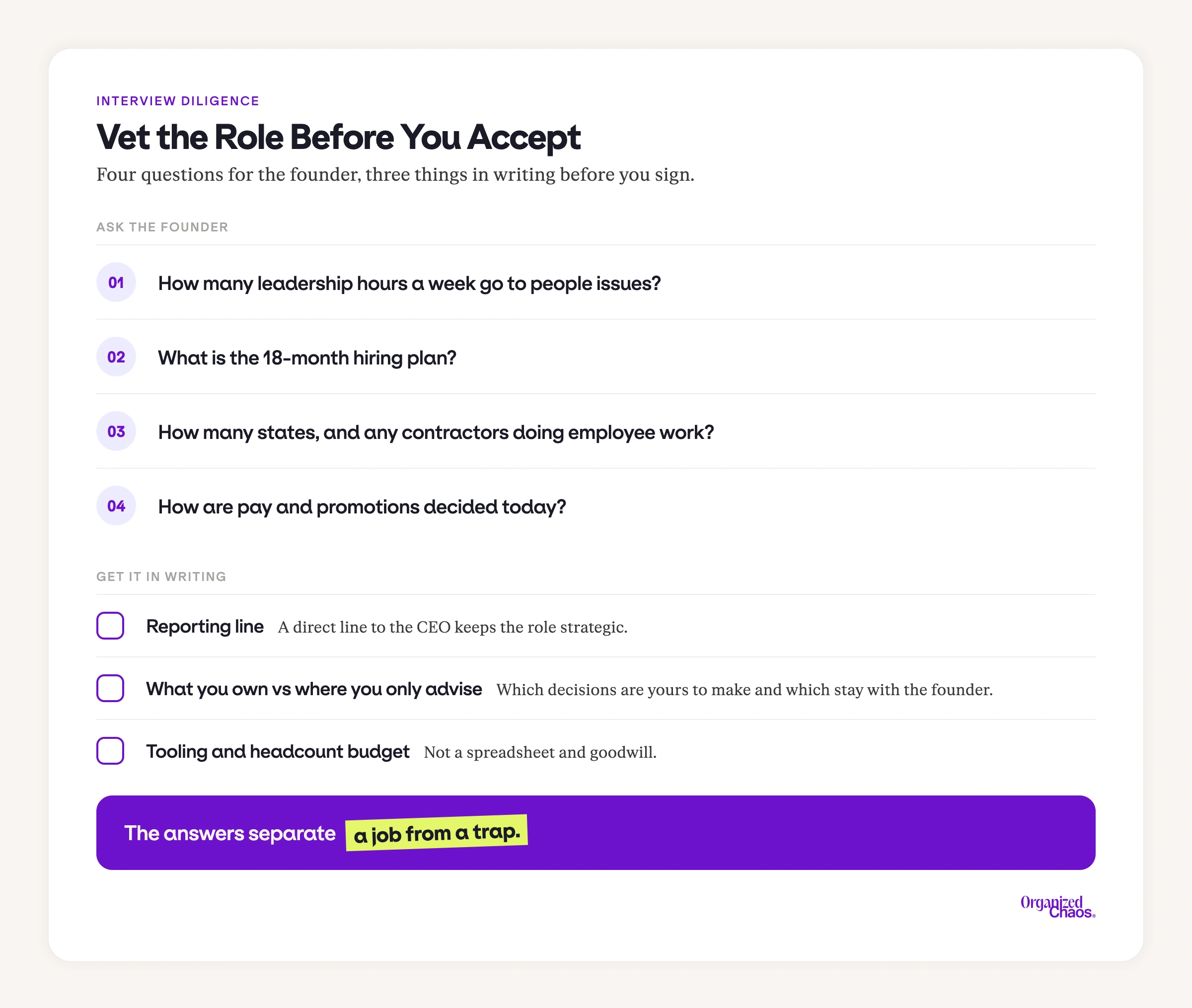
Three things are worth pinning down before you accept an offer:
- The first is who you report to, because a line into finance or operations tends to pull the role administrative, while a line to the CEO is what keeps it strategic.
- The second is what you actually own versus what you only advise on, because the answer can mean very different jobs with the same title.
- The third is whether there's a real budget for the tools and the help you'll need, or whether you're expected to clean up two years of debt with a spreadsheet and goodwill.
The Fractional Door is Open, and it's a Real Option
Sometimes the honest read is that a company has real work but not five days a week of it, and what they need is two or three days a week rather than a full-time hire. That used to be a hard sell five year ago. It isn't anymore. Some of the most impactful and best-paid people leaders I know are fractional by choice, because the model lets them do the building work at the stage they love without the politics that comes with a single full-time seat. I went deep on why the fractional model is rising and how to build a practice around it in a recent podcast episode.
If you're earlier in your career, this should change how you think about the next move. The company that can't quite justify a full-time Head of People can often justify you two days a week, and that engagement is where you prove the value that turns into a full-time offer later, at the level you actually want rather than the one they first floated.
Critical Learning Points
A CEO blaming HR in public is usually evidence of a role that was scoped to fail, and your protection against becoming that story is diligence before you accept. Run the four founder triggers as your own interview checklist, and listen for a real operational reason behind the hire rather than a headcount milestone.
Watch hardest for the level mismatch, because strategic scope at coordinator pay and title is the single most common way a first HR role gets set up to fail. Pin down your reporting line, your mandate, and your budget before you sign, and treat fractional or interim work as a strong option rather than a consolation prize.
What to do this Week
If you're interviewing for a startup HR role, write down the four triggers and turn each one into a question for the founder. Their answers will tell you whether they have a problem you can solve or an itch they want scratched.
Before you accept any offer, get the reporting line, the scope, and the HR budget in writing, and raise any level mismatch directly while you still have room to negotiate.
And if the work is genuinely real but only part-time, propose a fractional engagement instead of walking away, because you may be leaving the best version of the role on the table.
Want a fast read on whether a company is ready for HR? Run the Startup HR Readiness Assessment on the company you're evaluating. It scores the four triggers in about three minutes, and it reads just as clearly from the candidate's chair as the founder's.