
Snap's Fourth Layoff in Four Years: The Hire-Fire Cycle That AI Won't Fix
- 21 Apr 2026
- 15 mins

The last two editions of this “layoff analysis” series covered Block's 40% cut and Atlassian's 1,600-person restructuring. Both generated incredible feedback and conversations, so I'm keeping this going. This time, Snap is in the hot seat. If Block was a story about overhiring and Atlassian was a story about a broken cost structure, Snap is something worse: a company that keeps making the same workforce planning mistakes over and over again, repackaging each round with a fresh narrative while the underlying problems remain unfixed.
On April 15, 2026, Snap CEO Evan Spiegel sent a memo to employees announcing the company would cut approximately 1,000 people, representing 16% of its full-time workforce, and close over 300 open positions on top of that. The projected annualized savings: more than $500 million. The stated reason: AI is enabling smaller teams to work faster and reduce repetitive work. The stock jumped 11% on the news.
Snap is not alone in this moment. The tech industry laid off 78,557 workers in Q1 2026, with nearly half of those cuts explicitly attributed to AI. The "AI made us do it" playbook is running industry-wide, and Snap's announcement is the most visible recent example. That's exactly why it's worth a close look. When a playbook spreads this fast, the question every founder should ask is whether it actually works.
But this is not the first time Snap has done this. This is the fourth major round of layoffs in four years. In 2022, they cut 20%. In 2023, they cut 3%. In 2024, they cut 10%. Now in 2026, they're cutting 16%. Each time, the reason changes. Each time, leadership promises this will be the correction that sets the company right, and each time, the underlying problems remain.
If you're an HR leader or founder at a scaling startup, this is the pattern you need to study closely. Because Snap is a textbook case of what happens when workforce planning fails at the leadership level, when hiring becomes reactive instead of strategic, and when the people function either doesn't have a seat at the table or doesn't use it effectively.
The Numbers That Tell the Real Story
Before we unpack what went wrong from an HR and org design perspective, let's establish what the financial data actually shows, because the narrative of "AI made us do it" falls apart pretty quickly when you look at the full picture.
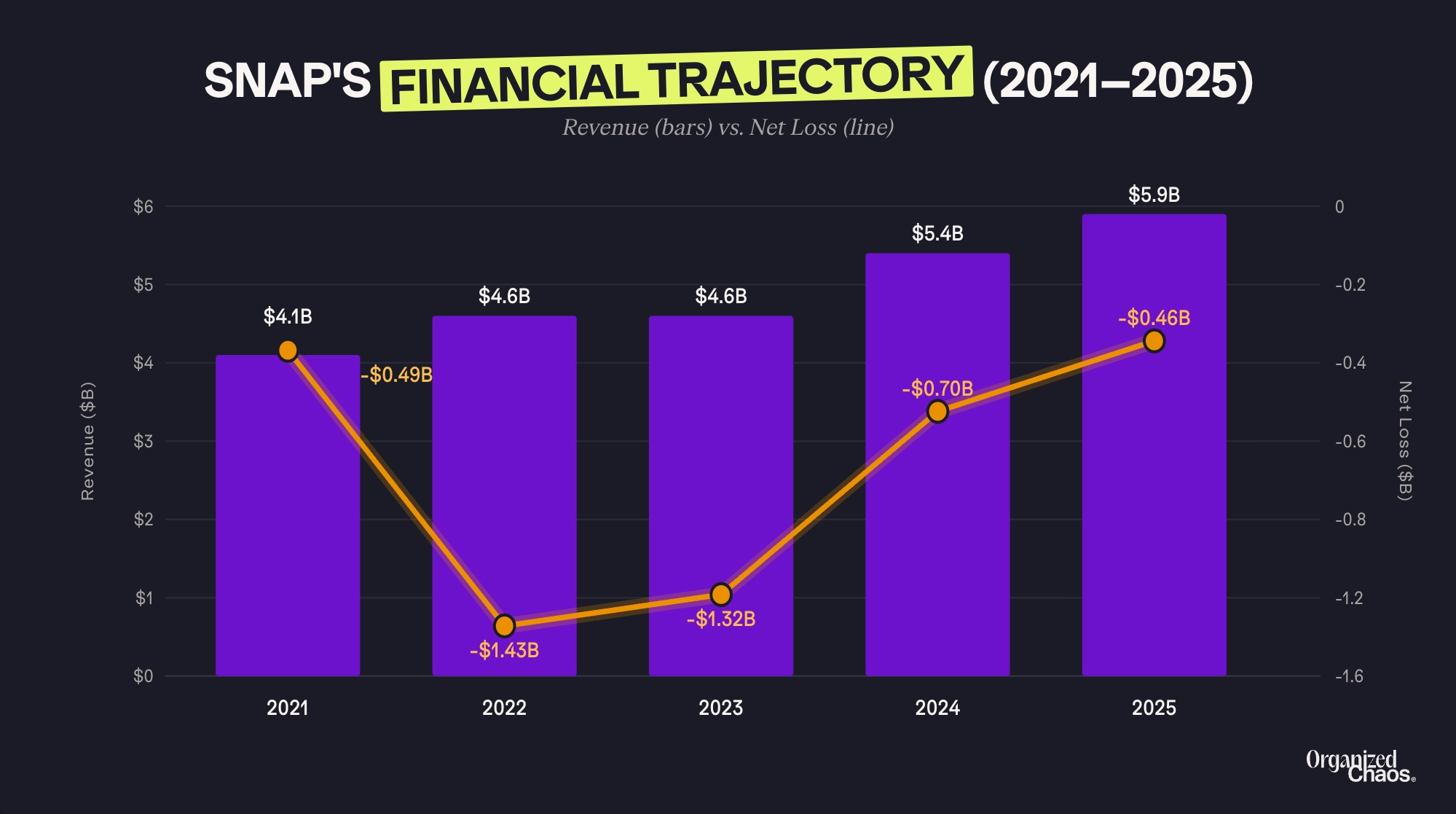
Snap's revenue trajectory has actually been improving. The company reported $5.9 billion in revenue for 2025, up 11% from $5.4 billion in 2024. Net losses have been narrowing too: from $1.43 billion in 2022, to $1.32 billion in 2023, to $698 million in 2024, to $460 million in 2025. By the time this latest cut was announced, Q1 2026 revenue guidance came in at $1.53 billion, up 12% year-over-year, with adjusted EBITDA of $233 million.
So this is not a company in a death spiral. Their revenue is growing and losses are shrinking. The trajectory, if you only look at the income statement, is actually heading in the right direction.
But here's what the income statement doesn't tell you. Snap has never posted an annual GAAP net profit. In its entire existence as a public company, going back to 2017, Snap has not had a single year where total revenue covered total expenses. Nearly a decade of operations and approximately $6 billion in annual revenue, and still no path to sustained profitability.
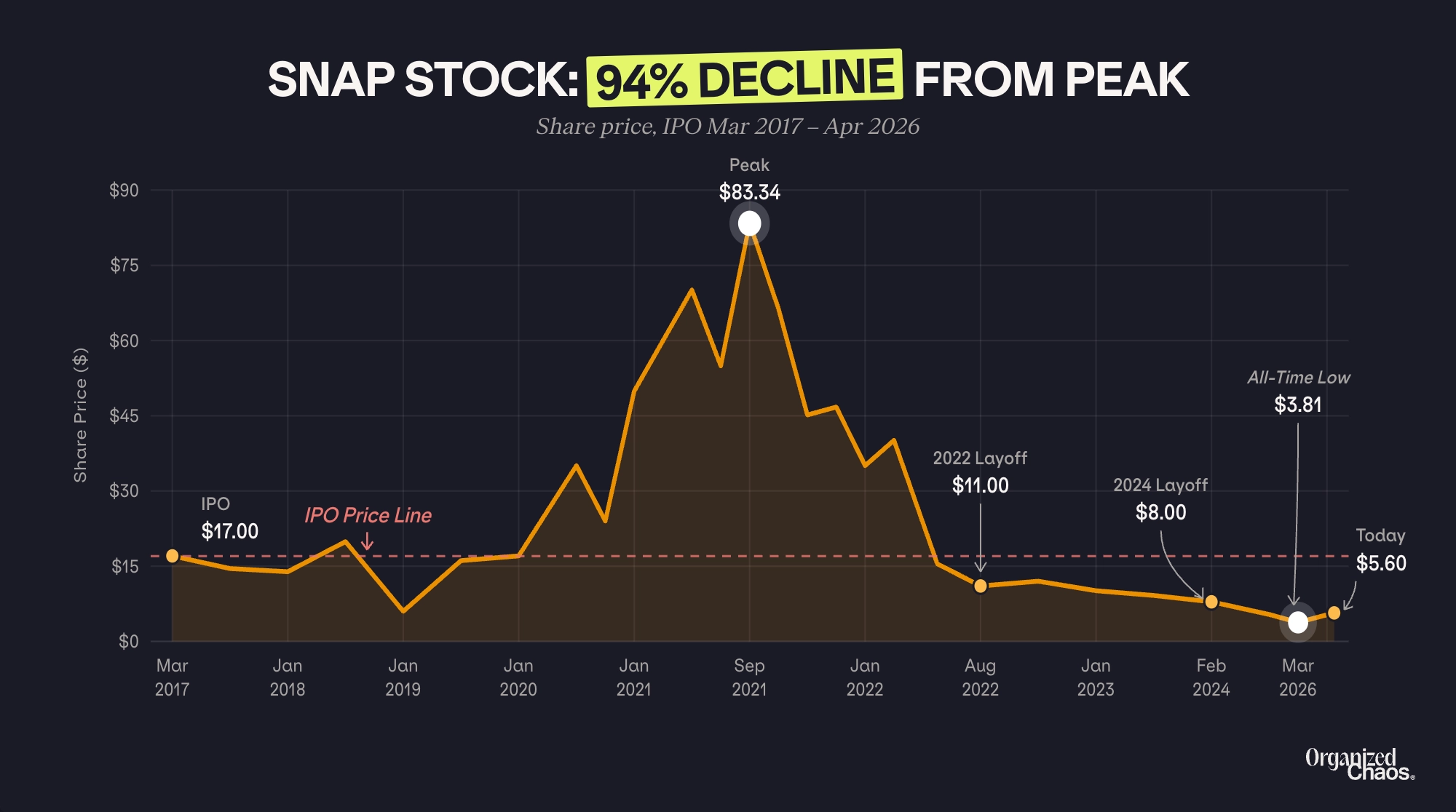
Meanwhile, the stock has collapsed. Snap shares hit an all-time high of $83.34 in September 2021. By March 27, 2026, the stock hit an all-time low of $3.81. That's a 94% decline. As of the layoff announcement, the stock was down more than 30% year-to-date in 2026 alone. Even investors who bought at the $17 IPO price in 2017 have lost roughly 65-70% of their capital.
When your market cap has evaporated by that magnitude, it changes the math on everything. Every dollar of operating expense gets more scrutiny. Every hire needs a stronger justification. And the pressure to demonstrate cost discipline becomes existential.
The Hire-Fire Cycle: A Workforce Planning Failure
This is where the CPO lens becomes critical, because the pattern at Snap is a workforce planning story that has nothing to do with AI.
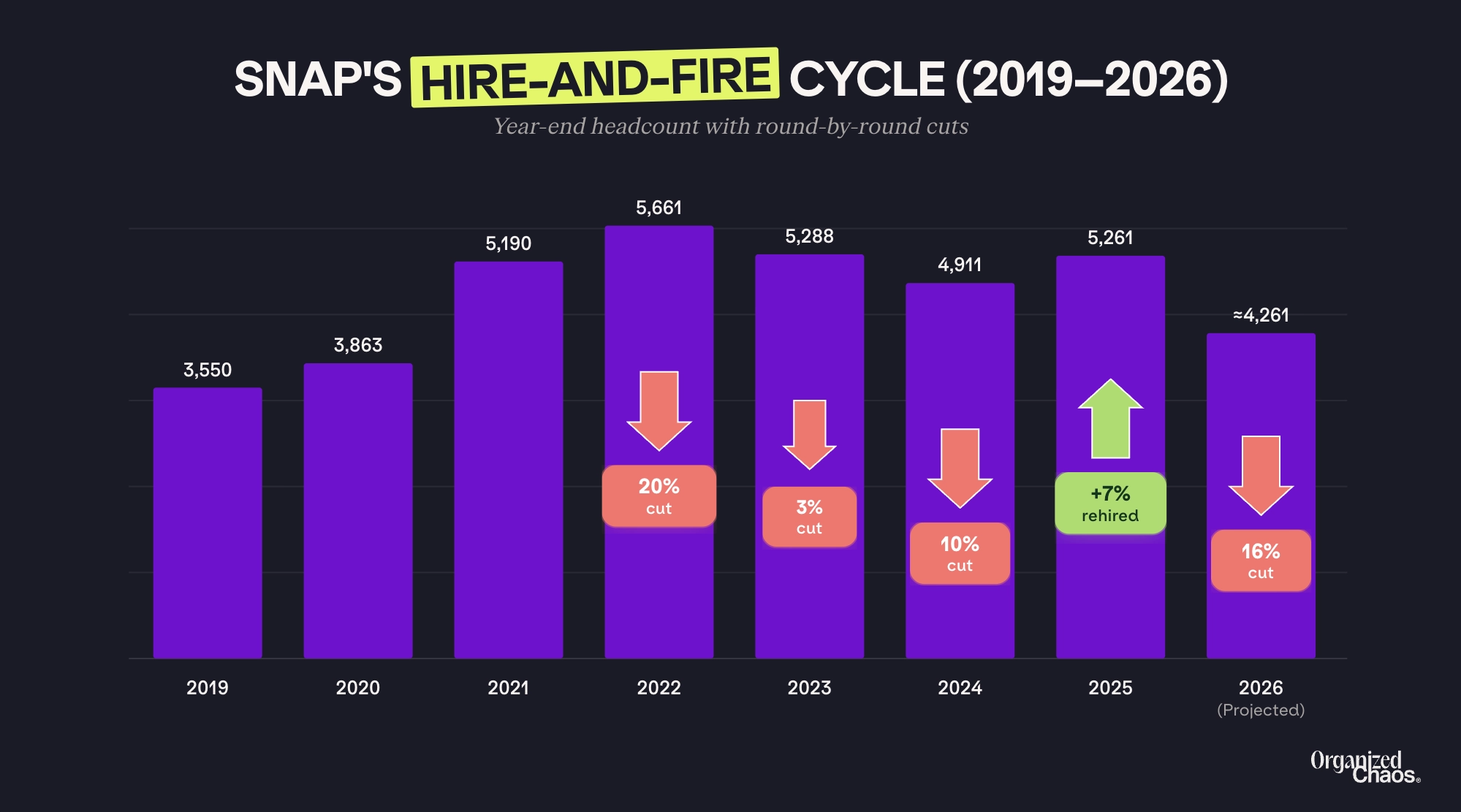
Let's look at the headcount timeline (sourced from Snap's annual 10-K filings):
- End of 2019: ~3,550 full-time employees
- End of 2020: ~3,863 (up 9%)
- End of 2021: ~5,190 (up 34%)
- End of 2022: ~5,661 (up 9%, despite cutting 20% mid-year, meaning they hired aggressively before the cut)
- End of 2023: ~5,288 (down 7%)
- End of 2024: ~4,911 (down 7%)
- End of 2025: ~5,261 (up 7%, they hired back up again)
- Post-April 2026 cut: ~4,261 (projected)
Read that sequence carefully. They cut 20% in August 2022. Then they slowly rebuilt headcount through 2025, adding roughly 350 people. And now they're cutting 16% again, plus closing 300 open roles.
This is the definition of a hire-fire cycle, and it's one of the most damaging patterns a company can fall into. Here's why:
Every time you cut and then rehire, you're destroying institutional knowledge, burning recruiting budget, paying severance, paying ramp-up costs, and creating cultural damage that compounds with each round. The remaining employees stop trusting leadership. They start job searching preemptively because they've learned the pattern: good times mean hiring, bad times mean cuts, and leadership's promises that "this is the last time" are never true.
When Spiegel announced the 2022 cuts, his memo included this line: the extent of this reduction should "substantially reduce the risk of ever having to do this again." Four years later, here we are with the fourth round.
That kind of credibility gap is brutal for culture. I've written before about the workforce planning framework I use with my clients, and the core idea is simple: before you approve any hire, you need to answer three questions:
- What role are you trying to fill?
- How does this role support a strategic goal?
- What's the business justification, including proof that you've optimized the operation first?
Snap's pattern tells me those questions were never asked with rigor, or if they were, the answers were overridden by leaders who wanted headcount regardless.
The 300 Open Positions: The Red Flag Nobody Is Talking About
The 1,000-person layoff is getting the headlines, but the 300 closed open positions might be the more damning number.
Those 300 roles were approved through some planning process. Someone wrote a job description and got the budget approval. Recruiters were likely already sourcing candidates. Interview pipelines may have been active. And now, in the same announcement that eliminates 16% of the existing workforce, leadership is saying those roles aren't needed after all.
You do not go from "we need 300 more people" to "we also need 1,000 fewer people" unless there is a fundamental disconnect between what executives are planning and where the business is actually heading. This is a leadership alignment problem disguised as an AI-enabled restructuring.
At an e-commerce company where I led HR, I dealt with this exact dynamic. Revenue grew from $45 million to $88 million, and the leadership team wanted to increase headcount by 50%, which translated to 45 hiring requests coming in. After running each one through a proper workforce planning analysis, I only recommended approving 3! The uproar was intense. But when the market turned and revenue dropped 25%, we didn't lay off a single person. The discipline of saying no during good times is what protects you during bad times.
Snap's leadership has never demonstrated that discipline. And the 300 closed positions are the proof.
Where the Cuts Actually Landed
Let me walk you through what we know about which teams were impacted across all four rounds, because the pattern here reveals something important.
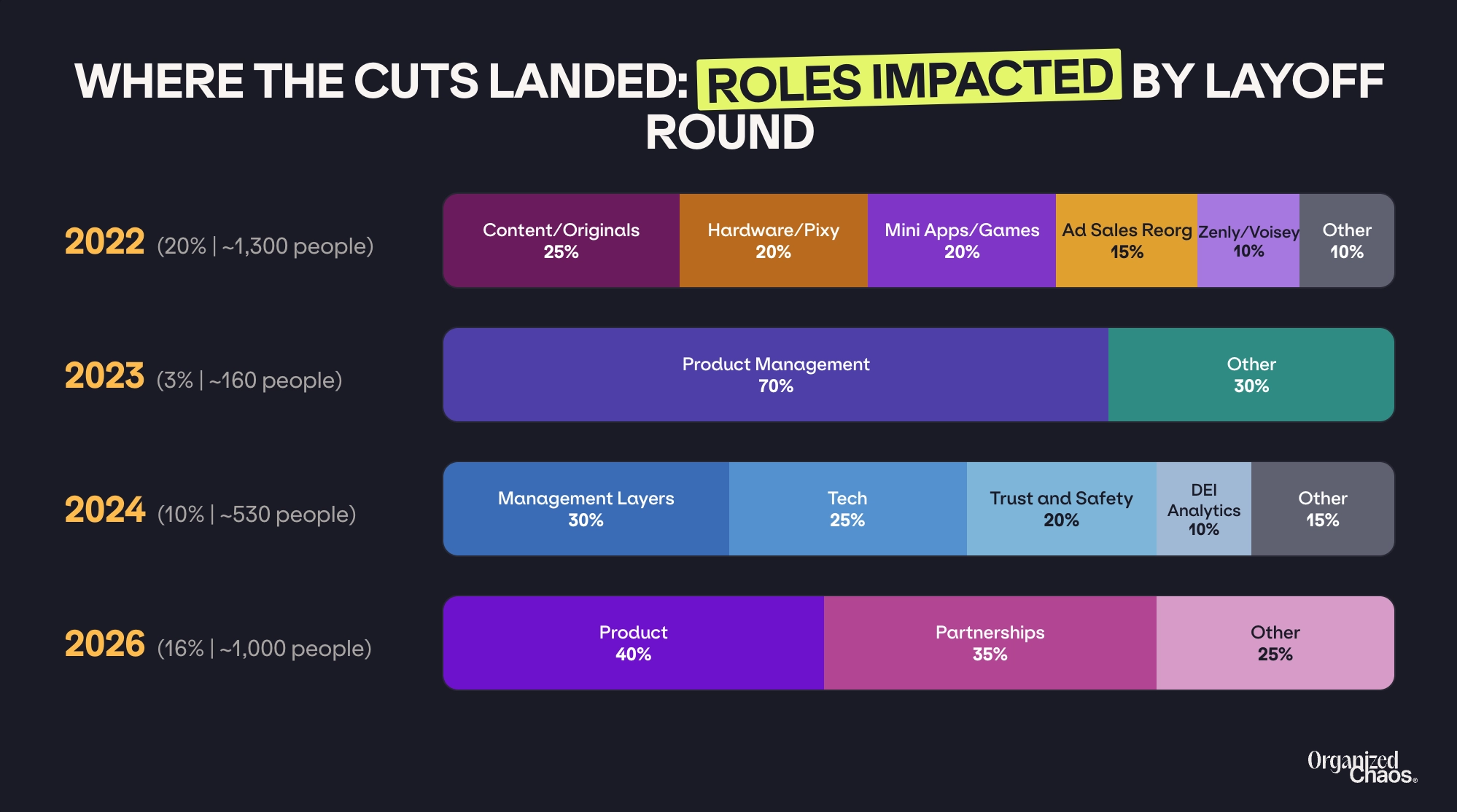
2022 (20% cut, ~1,300 people): The biggest hits were to content (Snap Originals was shut down entirely), hardware (the Pixy drone was killed), mini-apps and games (put in maintenance mode), the ad sales organization (restructured after key execs left for Netflix), and acquired apps (Zenly and Voisey were wound down).
2023 (3% cut, ~160 people): This was targeted almost entirely at product management. The stated goal was to flatten hierarchies and speed up decision-making.
2024 (10% cut, ~530 people): Management layers were reduced. Cuts hit tech, trust and safety, and DEI-related analytics roles. The company also pushed for consolidation into major hub locations.
2026 (16% cut, ~1,000 people): The latest round primarily hit product and partnerships teams. Several C-suite executives have also departed, including the COO and CBO, with Spiegel now directly overseeing business operations.
Two things stand out. First, product teams have been cut in two of four rounds (2023, and now again in 2026). If you're restructuring the same teams repeatedly, either the first round didn't go deep enough, or leadership keeps changing strategic direction and the teams built for the old strategy become expendable. Neither explanation reflects well on the planning process.
Second, the 2024 cuts to trust and safety are worth flagging because of what happened next. By March 2026, the EU had opened a formal Digital Services Act investigation into Snapchat's child safety practices. The UK and Australia were pushing for stricter controls. New Mexico had filed a lawsuit. Cutting trust and safety headcount and then facing regulatory action on safety 18 months later is a painful and expensive consequence. This is exactly the kind of downstream risk that HR should be raising during workforce planning conversations.
Where Is the CPO in All of This?
This brings me to a question I've been sitting with since the announcement, and one that I think is worth raising with some care: where does Snap's Chief People Officer, Scott Withycombe, fit into this story?
Withycombe has been at Snap since November 2017, starting as an HR Director and working his way up through Senior Director, VP of Talent & Rewards, and ultimately CPO in October 2022. That promotion came just two months after the first major layoff, the 20% cut in August 2022. So his entire tenure as the top people leader at Snap has coincided with three of four layoff rounds. He's not a newcomer who inherited a mess. He's a nine-year veteran of the company who grew up inside it.
Before I go further, I want to be clear about something. I don't know what happens inside Snap's leadership meetings. I don't know what Withycombe has advocated for behind closed doors, what proposals he's put forward that were rejected, or what constraints he's operating under. Founder-led companies with dual-class share structures, where the CEO controls the vote and the narrative, can be extremely difficult environments for any CPO to operate in. Spiegel has consolidated even more control recently, with both the COO and CBO departing and Spiegel now directly overseeing business operations. That's a lot of power concentrated in one person, and it can limit how much influence the people function actually has on strategic decisions.
What I can observe is the public record, and a few things stand out.
Every layoff memo, every SEC filing, every public statement about workforce reductions at Snap comes exclusively from Spiegel. Withycombe is completely absent from the public narrative around any of the four rounds. At companies where the CPO is a genuine strategic partner, you typically see them involved in the communication process, even if the CEO leads. Their presence signals that these decisions were made with people strategy in mind, not just financial modeling. At Snap, that signal is missing.
People leaders at public companies are in an extraordinarily difficult position during layoffs. They're often brought in late to execute decisions they didn't shape, asked to protect a culture they didn't get to design for stability, and expected to stay positive in public while managing turmoil internally. I have empathy for that position because I've been in it and close to it myself.
But I do think the pattern raises questions that are worth asking. Withycombe lists workforce planning and organizational design among his core competencies. He has an MSc from the London School of Economics in employment relations and HR management. He has the credentials and the tenure. If the people function at Snap had a genuine seat at the strategic table, would the company have fallen into a four-year hire-fire cycle? Would 300 open positions be approved and then closed in the same breath as 1,000 layoffs? Would the same product teams be restructured three times in four years? Would trust and safety headcount be cut months before a regulatory investigation?
I don't think this is a story about one person failing. I think it's a story about what happens when the people function is positioned as an executor of workforce decisions rather than a co-designer of them. And that's a structural problem that extends well beyond Snap.
For HR leaders at startups reading this: if you're the top people leader and you're not in the room when headcount decisions are being made, if you're brought in after the numbers have already been set to figure out the "how" but not the "whether," then you're just in a support role with a strategic title. And the company will eventually pay for that gap, in exactly the way Snap has been paying for it: with repeated, painful, credibility-destroying layoff cycles that never seem to end.
AI Is the Narrative But The Real Cause Is Structural
Let me be direct about the AI angle. AI is doing real work at Snap. According to Reuters, AI is now generating more than 65% of new code at the company. Spiegel's memo talks about "small squads leveraging AI tools" to drive progress. That's believable, and the broader trend of AI enabling smaller, more productive teams is real. I genuinely believe companies are going to get smaller as AI matures.
But AI alone does not explain why you need to cut 16% of your workforce two weeks after an activist investor publicly demanded you do exactly that.
Here's the timeline. On March 31, 2026, activist investor Irenic Capital Management published a letter to Spiegel. Irenic had built a 2.5% economic interest in Snap and launched a website called "savesnapnow.com." Their letter laid out a "6 Steps to 7X" plan targeting a share price of $26, up from around $4 at the time. Their key recommendations included laying off approximately 1,000 employees (Irenic suggested 21% of the workforce), shutting down or spinning off the Specs AR glasses division (which they estimated had consumed $3.5 billion in investment and was burning $500 million annually), and restructuring around AI-enabled smaller teams.
Fifteen days later, Snap announced layoffs of approximately 1,000 people, matching Irenic's recommendation almost exactly.
The company can frame this as AI-driven all it wants. But the timing, the scale, and the matching numbers are pretty damning. This is a company that was already under enormous pressure from a collapsing stock price, persistent unprofitability, and now direct activist intervention. AI provided a credible, forward-looking narrative that made the cuts look strategic rather than reactive. Wall Street rewarded it with a stock bump, which gives management breathing room. This is the same playbook we saw at Block and Atlassian.
The 55% Regret Rate That Should Scare Every Founder
Here's the part of the AI layoff story that isn't getting enough airtime. Companies doing exactly what Snap is doing right now are already regretting it.
Orgvue surveyed 1,000 C-suite executives across large US and UK employers and found that 39% had made employees redundant because of AI. Of those, 55% said they regretted the decision. More than half. The top regrets were lost institutional knowledge, damaged morale, and product quality suffering.
It gets worse. Trade outlet HCAmag reported that two in three employers who reduced headcount through AI are now actively rehiring for those roles. 32.7% have already rehired between 25% and 50% of the people they let go. They cut for AI, then they paid severance, then they paid recruiting fees again to bring the work back in-house. That's the definition of burning cash on a bad plan.
And the underlying math on AI productivity doesn't even support aggressive cuts. Morgan Stanley's most recent research shows that companies adopting AI report an 11.5% productivity increase and only a 4% net decline in headcount over the past 12 months. Productivity is running nearly 3x faster than headcount reduction. EY's December 2025 survey found only 17% of organizations are reinvesting AI productivity gains into headcount reduction. 47% are reinvesting into expanding existing AI capabilities, 42% into developing new ones. Cutting to the bone is the minority response among companies actually running the math.
So when Spiegel says AI enables smaller, faster teams, he's not wrong in the abstract. But the data suggests the correct answer to "AI is making us more productive" is almost never "lay off 16% of the company and close 300 open roles on the same day." The correct answer is usually "redeploy capacity into higher-value work before you cut." Snap chose the path that a majority of its peers are already regretting.
If you're a founder watching this play out and thinking about your own workforce plan, the question isn't whether AI will make your teams smaller. It probably will, over time. The question is whether you're going to make that transition through redeployment and natural attrition, or through a layoff cycle you'll regret within 18 months. The data says most companies choosing option B end up wishing they'd chosen option A.
The $3.5 Billion Bet Nobody Wants to Talk About
The wildcard in all of this is Specs, Snap's AR glasses. Despite the layoffs, Snap is protecting its investment in the hardware division. The glasses are expected to debut later this year.
This creates a strange dynamic. Irenic estimates that Specs has consumed more than $3.5 billion in total investment and is currently burning roughly $500 million in annual cash. That $500 million annual burn is supported by engineering, hardware, product design, optics, and developer relations headcount. With total operating expenses around $3.8 billion in 2025, the Specs division accounts for roughly 13% of Snap's entire cost structure.
So the 1,000 cuts announced today are coming almost entirely from the core Snapchat business, the part of the company that actually generates revenue. The money-losing moonshot stays protected. Think about how backwards that is.
If Specs launches and gains traction, the $3.5 billion becomes a first-mover advantage. If it flops, the company will have gutted its core business to subsidize a hardware product that never found a market. And given Snap's track record with hardware (Spectacles 1.0 was a flop, Pixy was killed within months of launch), the odds are not in their favor.
For HR leaders watching this, the lesson is clear: when leadership protects a pet project at the expense of the teams that generate actual revenue, that's a signal the people function needs to be raising hard questions in the room, during the planning process.
What the RPE Trend Actually Shows
Here's the counterintuitive part. Despite all the chaos, Snap's revenue per employee has actually been improving.
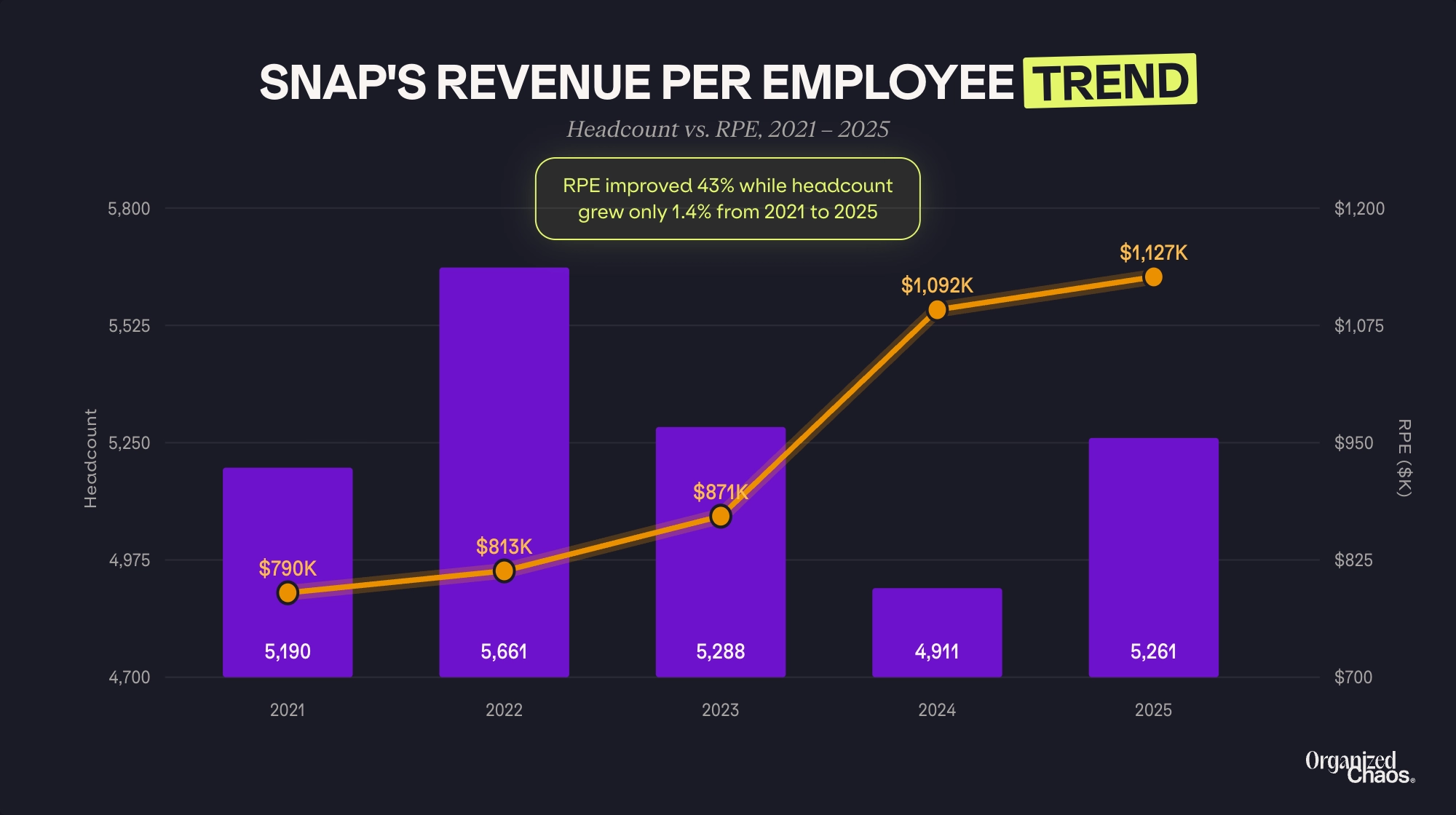
RPE went from roughly $790,000 in 2021 to $1,127,000 in 2025. That's a 43% improvement while headcount only grew 1.4% over the same period. This means the existing team was already getting more productive before these latest cuts. Revenue grew faster than headcount.
This actually undercuts the urgency of the AI efficiency argument. If your existing team is already generating 43% more revenue per person, the case for dramatic headcount reduction gets weaker. What the RPE trend really shows is that the prior rounds of cuts (2022, 2023, 2024) combined with organic revenue growth were already working. The question is whether this fourth round is genuinely necessary or whether it's a reaction to activist pressure and stock performance rather than an honest assessment of operational needs.
Closing Thoughts
Snap's fourth round of layoffs in four years is a story about structural unprofitability, reactive workforce planning, activist investor pressure, and a leadership team that keeps using different narratives to justify the same cycle. In 2022, the story was "strategic reprioritization." In 2024, it was "restructuring." In 2026, it's "AI efficiency." The narrative rotates, but the pattern stays the same: hire during good times without strategic discipline, cut during pressure without addressing root causes, and repeat.
For startup founders and HR leaders, here's what to take from this:
- Track your revenue per employee as a trend, not a snapshot. If RPE is climbing, your team is getting more productive. If RPE is flat or declining while you're adding headcount, you're building bloat that will surface during the next downturn.
- Before approving any hire, ask whether the capacity problem could be solved with process optimization or technology first. Most capacity crunches are process problems in disguise.
- Audit your open positions quarterly against strategic goals. If you can't clearly articulate why a role exists and what business outcome it's tied to, freeze it before it becomes one of those 300 positions you close alongside a layoff announcement.
- If you ever need to do layoffs, do them once, do them deep enough, and treat people well on the way out. The worst thing you can do is what Snap has done: four rounds in four years, each one promising to be the last. That approach destroys trust, kills morale, and makes your best people leave before you even get to the next round.
- Make sure your people function has a voice in cost structure and workforce planning conversations before they become layoff conversations. The trust and safety cuts in 2024 followed by regulatory investigations in 2026 are a perfect example of what goes wrong when headcount decisions are made purely on financial grounds without considering downstream risk.
- Be skeptical of the AI narrative. AI is real. Teams will get smaller. But every CEO who uses AI as the explanation for layoffs in 2026 deserves the same scrutiny you'd give any other business decision. A majority of executives who already tried this approach regret it. Ask what else is happening: investor pressure, stock performance, structural cost problems, competitive threats. AI is almost never the full story.
The real lesson from Snap is that undisciplined workforce planning creates a cycle of hiring and firing that destroys value, erodes culture, and never actually fixes the underlying problem. Build lean from the start, hire with purpose, and you'll never need to make the kind of cut that Snap keeps making.