
Who Should HR Report To? A Startup Decision Guide
- 14 Sep 2026
- 9 mins

I used to think HR always had to report directly to the CEO. I believed there were no exceptions, and I argued for this in every job or client engagement I had. I do not feel that way anymore. What changed my mind over the years is that I’ve been able to identify what the HR department needs to succeed, regardless of who it reports to.
Most companies still put the top HR leader under the CEO, and that is still what I suggest most of the time. A 2021 survey of 417 US employers by Brightmine found that 61% of HR leaders report to the CEO, president, or owner. Meanwhile, 13% report to the CFO, 10% report to the COO, and 1% report to the General Counsel.
In this guide, I’ll explain the different reporting structures for an HR department, what the research says about the impact of reporting lines on the HR department’s performance, the three questions I ask before recommending HR’s position in the org structure, and what to do if your current reporting line is not working.
Does the Reporting Line Change Anything?
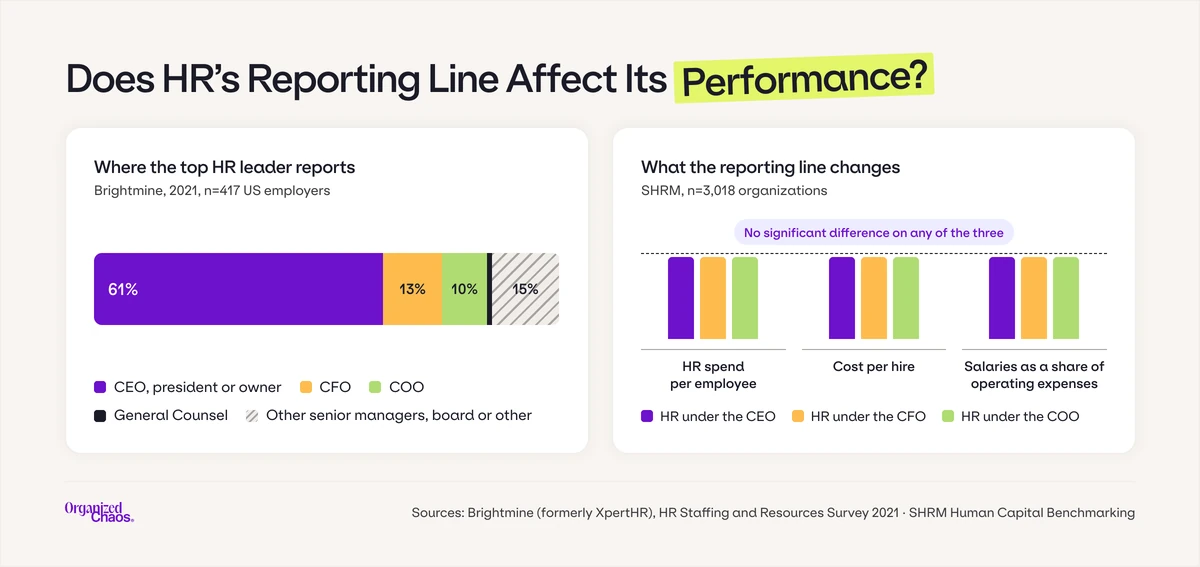
Most debates ignore this key question, but SHRM studied 3,018 organizations and discovered no significant difference in HR spending per employee, hiring costs, or the percentage of operating costs spent on salaries, regardless of who HR reports to. The metrics usually brought up in these discussions simply do not depend on the reporting line.
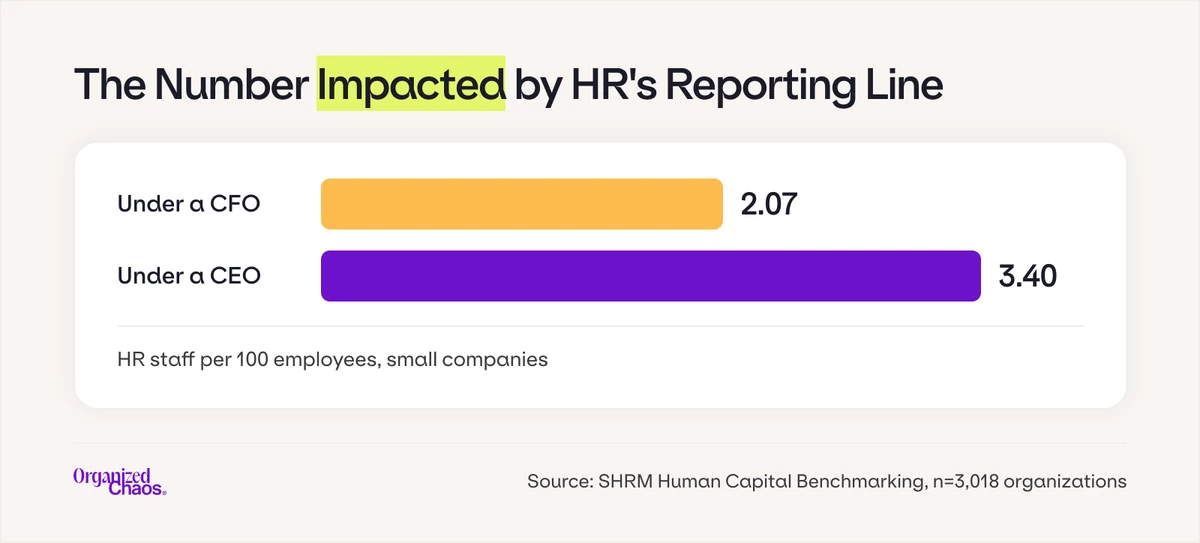
However, there is one key exception that matters for small, growing companies. In smaller organizations, HR teams reporting to a CFO tend to be leaner, with only 2.07 HR employees per 100 workers, compared to 3.40 under a CEO. This points to a difference in staffing levels rather than performance quality, but it is an important factor to consider before placing HR under the executive who controls the budget. If you choose to put HR under the CFO at around 80 employees, make sure you are aligned on the team’s headcount ratio.
The Three Questions I Ask
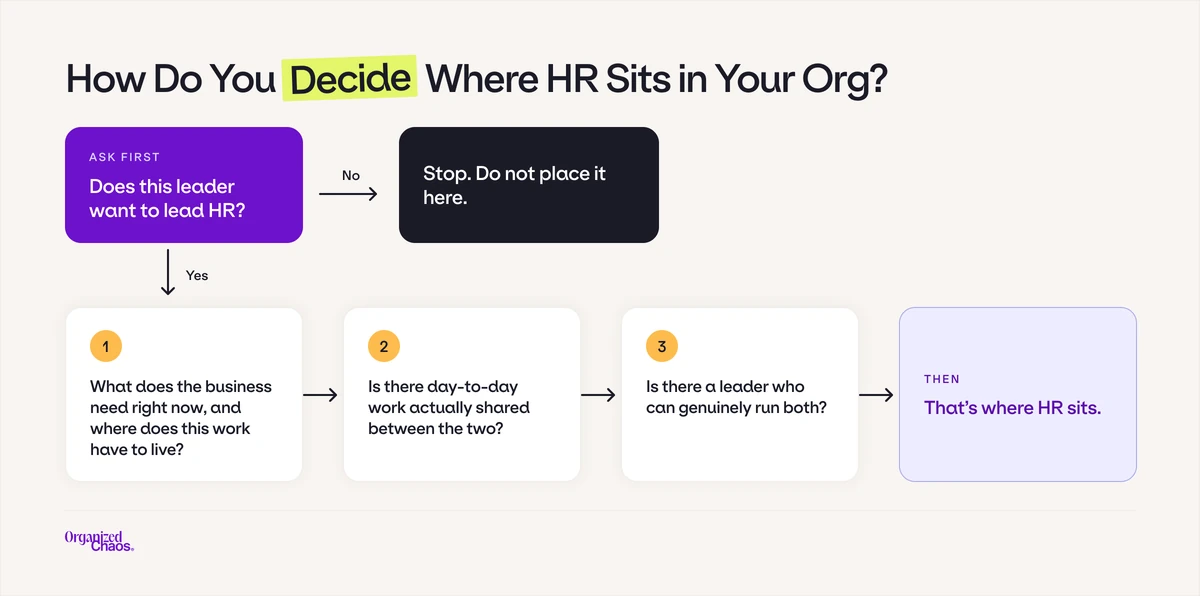
Before I recommend where any part of the HR or people team should report, I ask three questions in the following order:
- What does the business need right now, and where does this work need to live to deliver it? A company struggling to hire people and a company struggling to keep people are two different situations that will likely have different recommendations.
- Is there actual day-to-day work shared between HR and the department it would join? Think shared systems, shared data, and shared decisions. A reporting line with no shared work behind it usually does not hold up.
- Is there a leader at the company who can truly manage both departments? Not just someone who has extra time, but someone who actually knows how to do it. This is the question that determines the final outcome, yet it is the one companies skip the most.
The Main Dealbreaker: Does the Manager Actually Want to Lead HR?
A reporting setup creates real trouble when HR is placed under a manager who does not care about the role or understand how it adds value. This usually happens when leadership forces them to take it, when no one else is willing to manage it, or when the company does not value HR enough to have it report directly to the CEO.
That is the real test, and it goes beyond the usual debates over org charts. Having HR report to a CFO works well if that CFO cares about people. Combining HR expertise with financial management makes it much easier to approve people programs, turning Finance into a partner rather than a blocker. Reporting to a COO works for the same reason, because COOs oversee daily operations and can quickly improve the employee experience across the entire company. On the other hand, putting HR under a disengaged CEO is far worse than reporting to a committed CFO or COO.
If your team is being reassigned and your new manager does not want to lead HR, focus your efforts next quarter on keeping day-to-day workflows running smoothly despite an unengaged manager, rather than arguing over reporting lines.
The Benefits and Risks of Each Reporting Option
The Reporting Line Isn't the Main Risk.
In 2022, I advised a web architecture software company where the Finance team handled pay decisions while the HR team provided performance ratings. Finance set salary benchmarks for every role strictly at the 50th percentile and stopped talking to the people who knew which roles were actually critical. Within twelve months, the average time to hire jumped from 45 days to nearly 70 days, and six key employees left the company due to pay. That communication breakdown cost the company millions, compared to the $360,000 it would have taken to pay those 12 critical roles properly.
The organizational structure itself made sense on paper, but the broken connection and lack of alignment between the two teams is what caused the financial damage. I wrote about this full story, including all the specific numbers and what I would do differently, in the newsletter on Airbnb's People restructure.
This follows the exact same pattern as why renaming a department does not automatically change how it works. Simply moving a box on the org chart does not impact how daily work gets done.
Companies That Placed HR in Unconventional Roles and Succeeded
Here are four real-world examples. In each case, the key to success was the leader's specific skills rather than “how other companies are doing it.”
In late 2024, Moderna merged HR and digital technology under Tracey Franklin, who continues to oversee both areas without a separate Chief Information Officer. In January 2025, ServiceNow assigned AI leadership to Jacqui Canney, an experienced HR leader. In August 2024, Workleap, a company with 450 employees, placed seven IT staff members under its Chief People Officer, which noticeably improved their employee onboarding process. Workleap is especially relevant for growing companies, as it is the only one among the four operating at a startup scale.
Zapier provides the clearest example. In late 2025, it combined HR and AI Transformation under Brandon Sammut. When Sammut left in August 2026 to become Head of People at Mind Robotics, the AI Transformation role moved to Chief Marketing Officer Dan Slagen. The role remained intact and simply shifted to the next leader equipped to run it. No one redesigned the company structure around his departure, because the main focus was always on who could handle the work rather than which department owned it.
How to Make the Decision
Here are five steps you can finish this week:
- Write down what your business needs from HR over the next year. Include hiring targets, turnover risks, compliance needs, or whatever is actively in flight.
- Make a list of potential leaders and grade their skills. For every candidate, point to a specific team or function they have already managed that looks like this.
- Ask each candidate if they actually want to lead HR. A leader who agrees only out of obligation will end up being the unengaged manager discussed earlier.
- Assign a qualified person to handle legal compliance and employee relations separately. Small companies under 200 employees often miss this step because they rarely have someone dedicated to it. If nobody on your leadership team is qualified to make these legal and policy decisions, delegate the work to employment lawyers or a fractional HR professional.
- Record your final decision in writing, including your reasons and a date to review it. Check back in six months to evaluate whether the manager remains engaged and whether daily work is running smoothly.
If you are transferring an existing HR team to a new manager rather than building one from scratch, managing the transition is the hardest part. You can find the five steps for protecting daily operations during a move in the Airbnb newsletter.
Frequently Asked Questions
Who should HR report to?
Most companies have their top HR leader report to the CEO, president, or owner. A 2021 survey of 417 US employers showed that 61% follow this model, while 13% report to the CFO, 10% to the COO, and 1% to the General Counsel. Reporting to the CEO is the standard default, but the most important factor is whether the leader taking on HR actually wants to manage the department.
Is it bad if HR reports to finance?
The research shows it is not bad. SHRM studied 3,018 organizations and found no major differences in HR spending per worker, hiring costs, or the share of company expenses spent on salaries based on who HR reports to. The main exception is in small companies: HR teams under a CFO tend to be smaller, averaging 2.07 HR staff per 100 employees compared to 3.40 under a CEO.
Can HR report to a communications leader?
Yes. Airbnb started doing this in September 2026, and Viatris has used this setup since January 2026. The key requirement is ensuring that tasks with legal risks—such as legal compliance, workplace investigations, and employee relations—remain managed by qualified specialists.
At what company size should HR start reporting to the CEO?
There is no specific company size that triggers this change. The real test is whether your people decisions are important enough to require direct input where key company decisions and budgets are made. If hiring or keeping employees is your biggest challenge this year, HR belongs under the leader who controls those choices, regardless of company size.
Who should handle employee relations and legal compliance in a small company?
Anyone with the proper skills and experience, even if they are not a senior executive. This part of HR relies on following specific rules and procedures, so having qualified experts matters more than title or org chart position. Because companies with under 200 employees rarely have a full-time staff member for this, the two best options are hiring employment lawyers on retainer or working with a fractional HR consultant.
Before You Make Any Changes
Choosing where HR reports is an important decision, but it is less complicated than people make it seem. Answer the three evaluation questions, check if the receiving leader wants the responsibility, assign a qualified owner for legal and compliance tasks, and write down your plan with a future review date. After that, focus your effort on fixing and supporting daily team workflows, because that is where real operational problems usually happen.