
How to Implement a Hiring Freeze at a Startup
- 29 Sep 2026
- 8 mins

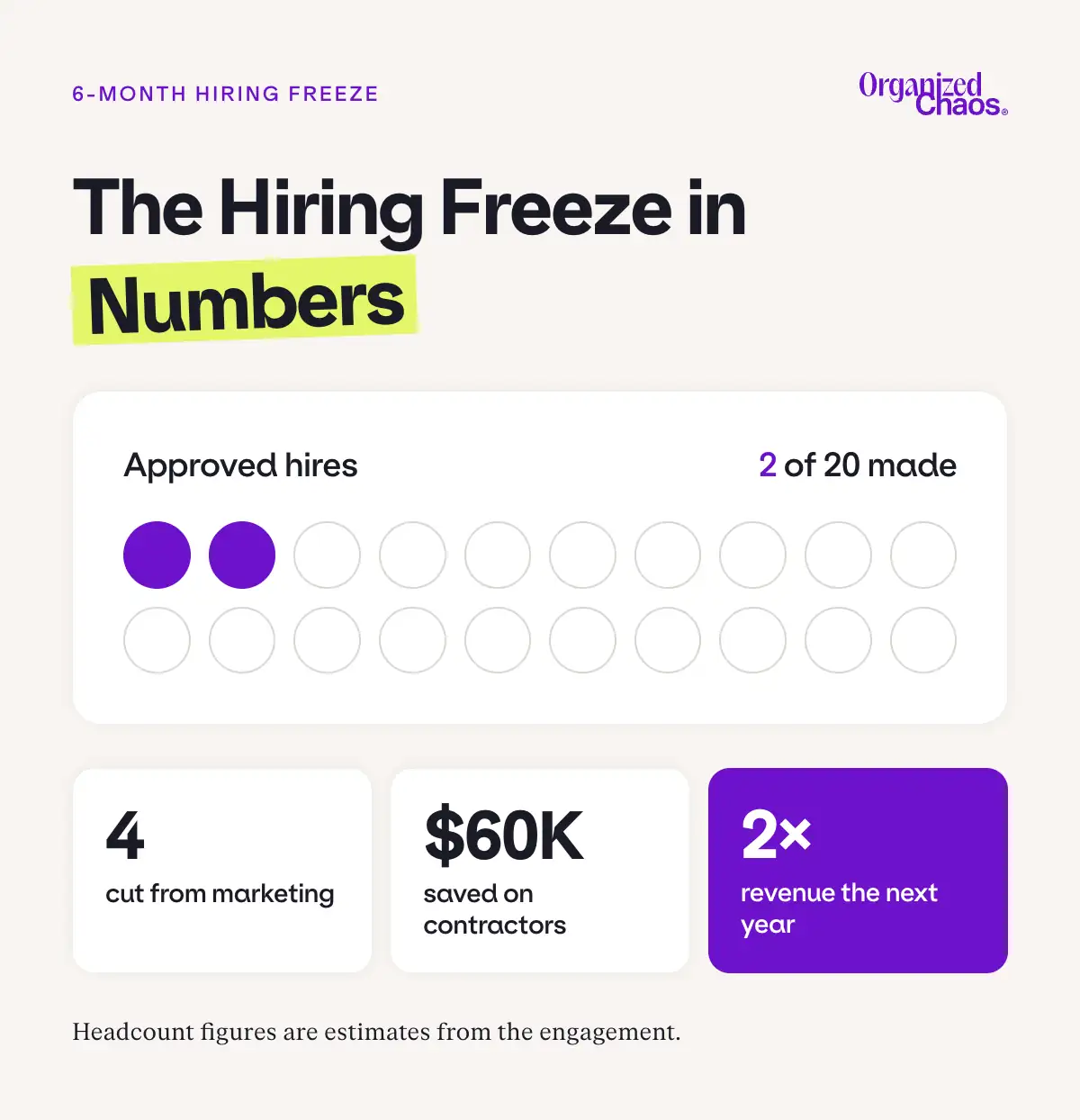
In late 2022, I recommended a hiring freeze at a company that was doing well. It was a 6-year-old Series B consumer electronics wearables company with around 80 employees, and its revenue was growing at triple digits year over year. It had 20 new sales and marketing roles approved and funded. We ended up making 2 of those hires, and the company's revenue still doubled the following year.
Why I Froze Hiring at a Growing Company
When I started working with the company, sales and marketing were already its largest teams, with around 35 of the 80 people between them. Nobody paid much attention to how fast payroll was climbing in those 2 departments, because the company was growing quickly.
The problem showed up in the results. Both teams kept adding people, but marketing performance stayed about the same. Sales also wasn't growing at the rate the company had come to expect from earlier hires. Execution got worse, while the cost of running the departments went up with every hire. Every time I asked the managers what was going on, I got the same answer: there's too much work, and we need more people.
So I decided to speak to the people doing the work. Those 2 departments in particular, had almost no structure in how they operated. Teams didn't coordinate or talk to each other, and the same process ran differently every time someone did it. Decisions were made on a whim and there was little tolerance for any strategic planning.
I went to the CEO and recommended freezing hiring in sales and marketing. My argument was that hiring more people into a growing company with weak processes would make the problem worse. Fixing it later would also be much harder than fixing it now. He agreed and supported the hiring freeze.
What the 6-Month Freeze Uncovered
The hiring freeze lasted around 6 months. It took that long because we had to validate what some employees told us about how work is being done. The freeze ended once the process fixes and the org redesign were finished.
Both teams turned out to be overstaffed, with marketing the worst of the two. People in different roles were doing the same work. The head of marketing was also doing a poor job of managing the team. We redesigned the team's workflows and processes, and we replaced some of the leaders, including the head of marketing.
Marketing had around 20 people. As best I recall, 4 employees were terminated and 3 moved into a new paid ads team that the company didn't have before. Later, we hired someone with paid ads experience to lead the new team, because no one in the company had managed a $1M paid ads monthly spend. Paid ads can get very expensive if you don't know how to manage them, so this was a business-critical role.
Out of the 20 approved hires, we made 2, both in sales and both in new regions the company wanted to sell into. The rest of the original hiring plan was completely scrapped. The fixes and the redesign showed us the company's real strengths and weaknesses, and those uncovered the need for different types of hires.
Know Which Kind of Freeze You're Running
In my experience, most hiring freezes are finance-related, and only a minority happen while the company is thriving. When the trigger is cash, the job is simpler because you need to stop the bleeding. A cash freeze usually covers the whole company. A role only gets approved when there's a very critical operational need, or when it's almost guaranteed to bring in money.
I treat a cash-based hiring freeze as a last resort. A freeze makes more sense when there's a clear inefficiency in how the teams work. It gives you time to audit how work is getting done and see where you're overstaffed or understaffed before you hire anyone else. This kind of operational freeze only covers the teams that have the problem, so it’s targeted, and doesn’t bring the entire company to a hiring standstill.
Find out which kind of freeze you're running before you talk to anyone about it. Hiring managers will come to you with questions, and you need to be able to explain the freeze to them.
How to Handle Exception Requests
Almost every manager in sales and marketing asked for an exception, most of them in the first month of the freeze. The requests stopped once the managers understood they couldn't go around the decision to the CEO.
Managers could still request a hire, but only with a solid business case that answered 3 questions:
- What will this role help us achieve that we cannot do today?
- How will you objectively measure what this role delivers if we hire for it?
- What happens to the business if we don't fill this role right away?
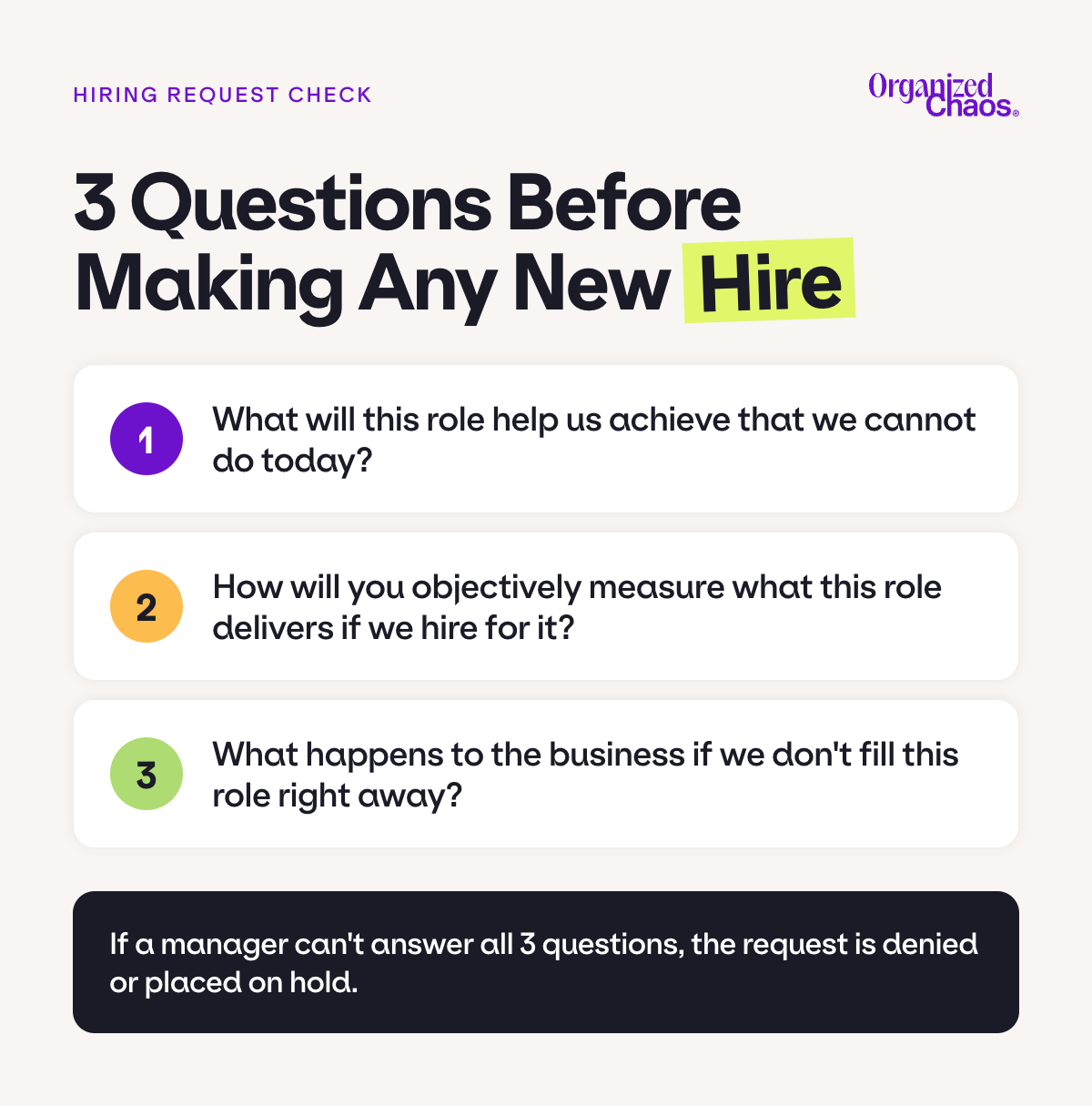
These questions tell you quickly whether a hire has a clear goal. If a manager can't answer all three questions, the request is denied or put on hold.
Count the Contractors and the Backfills
Contractors were part of the problem, especially in marketing. The team worked with a lot of freelancers and agencies that were classified as third-party vendors and not tracked as part of the company’s workforce. We found them all by reviewing vendor payments over the past 12 months.
When we counted them, we found somewhere around 15 to 20 freelancers, consultants and agencies. Some were on very high hourly rates, some were on long-term contracts they didn't need, and some were on retainers for work that wasn't needed at the time. We cut a lot of them and it saved the company approximately $60,000.
Deloitte puts non-employee workers at about 48% of the average US corporation's workforce. At companies that size, a freeze that only counts employees misses nearly half the people doing the work. If you find contractors doing permanent work, the contractor versus full-time employee test will help you decide whether to convert them to FTEs or let them go.
Backfills had to answer the same three questions as new roles. Given the state of the teams, a manager had to justify why a departure needed replacing at all. More often than not, the managers couldn't justify the role, so we agreed to wait until the fixes were in place before deciding whether to fill it.
Does a Hiring Freeze Slow Growth?
It didn't hurt this company, which still doubled its revenue the following year.
In an overstaffed team that runs inefficiently, every new hire adds cost (and complexity) faster than it adds output. Over time, the return on that spending turns negative. That's how a growing company hits a slowdown and then ends up in layoffs because its cash runway is in danger.
The Personal Impact of a Hiring Freeze on the HR Lead
At first, the freeze hurt my standing with the sales and marketing teams. Managers complained and went around me to the CEO almost every time.
The freeze succeeded because the CEO had bought into the reasoning behind it. I had shown him evidence from the teams of what was going wrong, and I had tied it to the financial impact on the company. Every time a manager came to him, he sent them back to me and said he supported whatever I recommended.
In the meantime, I talked openly with every manager who made a hiring request. I explained why it was denied and walked them through what they'd need to show to get an approval. Over those 6 months, the managers learned to think about hiring in a more calculated way. After the freeze, they were scrutinizing hiring requests from their own teams, including their own requests, before anything reached HR.
If you don't have that kind of backing, show leadership where the current trajectory takes the company. Then compare it with what a freeze and a redesign of the team could do before you hire again. The question I put to founders, in rough numbers, is this: would you rather get a 1.5x return on your hiring today, or a 5x return after 6 months of fixing the team? I walk through how to build that argument in my guide to a business case your CEO will fund. If you can't make that argument, you need to rethink whether the freeze is the right move.
How to Implement a Hiring Freeze
To implement a hiring freeze, be very clear on why you’re doing it and what will need to happen to make it go away. Agree on the messaging with leadership, and share it before managers find out through a rejected request. Then, put every hiring request, backfill, and contractor through the same three questions, and set a date to review the hiring freeze.
Here's what to do if you're tasked with implementing a hiring freeze:
- Find out why: Ask leadership why the freeze is happening, and whether it's indefinite or tied to a specific trigger or milestone. If you're the one proposing the freeze, build the business case first.
- Route every exception to you: Agree with the CEO (or your direct manager) that every exception request comes to you, and that anyone who goes around you gets sent back.
- Agree on the message: Work out the message with leadership, and share it before managers find out through a rejected request or the news spreads on its own. Getting ahead of it lets you control the story and avoid unnecessary panic about layoffs.
- Pause open roles: Stop hiring for open roles right away, unless one of them is a critical hire. Tell every candidate in the pipeline that the role is on hold.
- Specify the end point: Tell the company what would lift the freeze, such as a revenue milestone, a number of customers, or a funding round. Say when you'll review it, whether that's next quarter or next year.
- Talk to the people doing the work: Meet with every team that’s impacted by the freeze, and find out where work is duplicated, where teams don't coordinate, and where the same process runs differently each time.
- Share the 3 questions: Send every hiring manager the three questions a hiring request has to answer. Apply the same questions to backfills.
- Find every contractor: Go through your vendor payments, and identify every freelancer, consultant and agency, what each one costs, and whether you still need them.
- Explain every no: Tell each manager why a request was denied and what an approval would need.
When you lift the hiring freeze, track revenue per employee every quarter and slow your hiring pace if it drops, so you catch the next problem early before you need to implement another hiring freeze.
If you're managing a hiring freeze or planning headcount for next year, the Workforce Management module in The Startup HR Operating System walks you through every step. It covers detailed job design strategies, headcount planning that matches your business goals, and a practical process for handling off-plan hiring requests. You'll also learn how to run capacity versus capability analysis, manage hiring freezes, and adapt your workforce strategy as your startup grows.